
Startseite
-
Blog & Neuigkeiten
-
Designing Industrial LCD HMIs for 10-Year Operation Without Image Retention Problems
Designing Industrial LCD HMIs for 10-Year Operation Without Image Retention Problems
2026-07-12
13:01
Designing Industrial LCD HMIs for 10-Year Operation
Without Image Retention Problems
A procurement and engineering management guide to specifying, sourcing, and maintaining industrial LCD displays that hold image quality and supply continuity across a full decade of service life
Vom technischen Team von Kadi Display | www.kadidisplay.com
The Procurement Question That Determines a Decade of Maintenance Costs
Most display sourcing decisions get evaluated on day-one criteria: does it look good in the demo, does the brightness meet spec, does the price fit the BOM target. For industrial HMI programs with a 7-to-10-year service life — process control panels, factory automation terminals, medical device displays, transportation systems — the decision that actually matters is different: will this display still look correct, respond correctly, and remain sourceable in year seven?
Two failure patterns dominate the complaints that reach procurement and engineering management teams long after the original purchase order closed. The first is image retention — a faint ghost of a static UI element (a button outline, an alarm icon, a logo) that remains visible after the screen content changes, eventually becoming a permanent, unfixable defect. The second is supply discontinuity — the exact panel specified at program launch becomes unavailable mid-production, forcing an unplanned engineering and qualification cycle that costs far more than the panel itself.
This guide is written for the people who own these decisions but aren’t necessarily display engineers: procurement managers evaluating supplier quotes, engineering managers signing off on BOM changes, and program managers responsible for a product’s total cost of ownership across its full service life. It covers what image retention actually is, why it happens, the specific design and sourcing choices that prevent it, and the supplier qualification practices that protect a 10-year program from forced redesign.
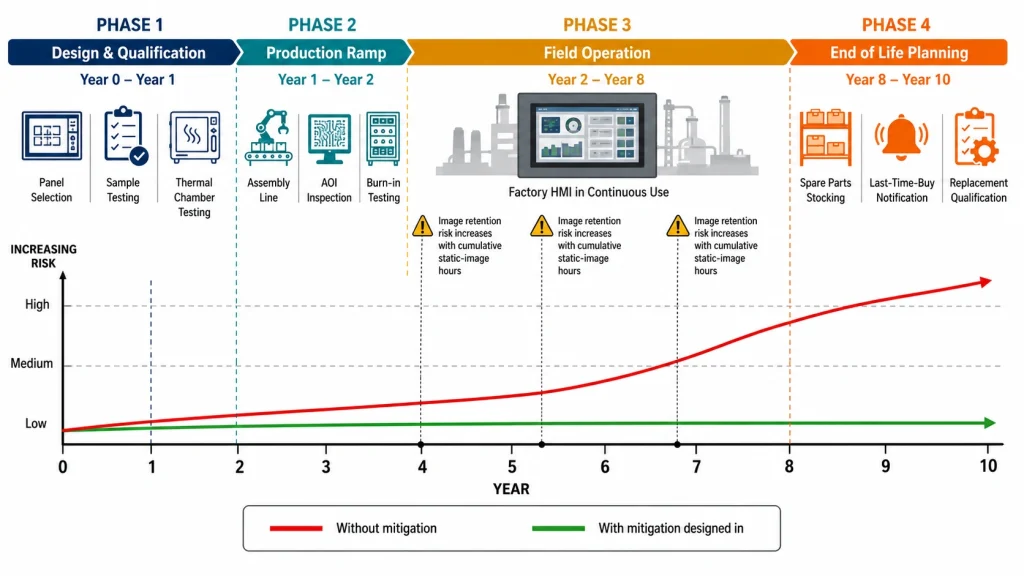
Image Retention: What It Is and Why Industrial HMIs Are Especially Exposed
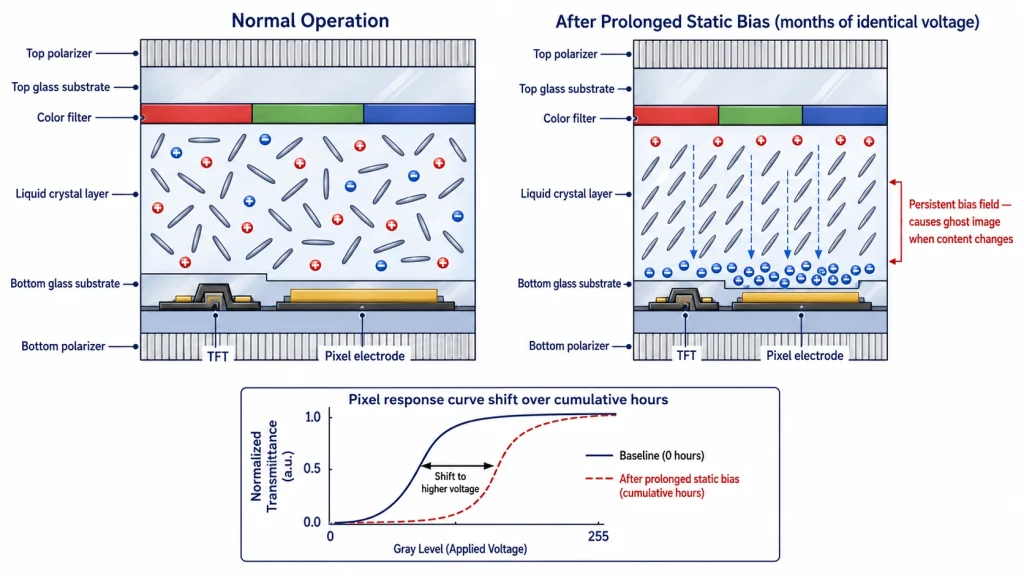
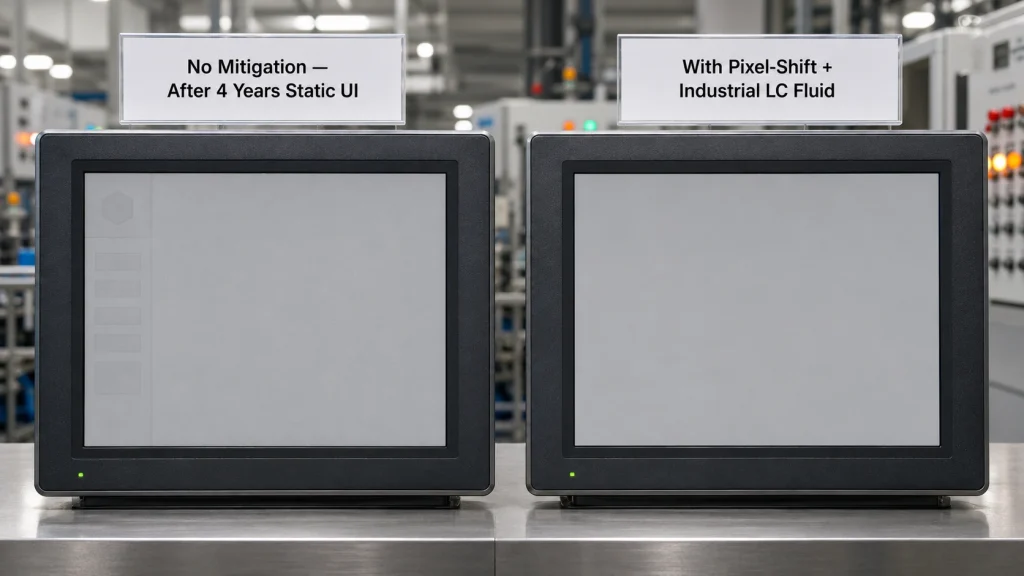
Image retention — sometimes called image sticking, ghosting, or burn-in in casual usage — occurs when liquid crystal molecules fail to fully relax back to their neutral orientation after being held in a specific voltage state for an extended period. The molecules develop a slight, persistent bias toward their most recent orientation. When the display content changes, that bias is visible as a faint shadow of the previous static image, most noticeable against a uniform background.
Industrial HMI applications are disproportionately exposed to this failure mode compared with consumer electronics for one structural reason: HMI screens display the same static elements — navigation bars, alarm status icons, machine state indicators, company branding, fixed gauge outlines — for the entire operating life of the equipment, frequently running 24 hours a day, 7 days a week, for years without a power cycle. A consumer smartphone display rarely shows the identical pixel pattern for more than a few minutes at a time. A factory SCADA terminal can show the same navigation sidebar in the same position for 50,000+ cumulative hours.
The mechanism has two contributing factors that compound over a long service life. First, ion migration within the liquid crystal cell: trace ionic impurities in the LC fluid drift toward one electrode under sustained DC bias, accumulating near the surface and creating a residual field that persists after the driving voltage changes. Second, capacitive memory effect in the pixel’s storage capacitor and thin-film transistor: prolonged identical charging cycles can shift the TFT’s threshold voltage slightly, biasing the pixel’s response curve. Both effects are technically reversible at first but become progressively less so with cumulative exposure time — which is precisely why the failure shows up in year three or four of a ten-year program rather than during a 100-hour qualification test.
Five Design Strategies That Prevent Image Retention Over a 10-Year Service Life
Image retention risk is not eliminated by hoping for the best from a generic commercial panel — it is engineered out through specific panel technology choices, driving circuit design, and software-level mitigation that should be evaluated during the initial display specification phase, not discovered as a field complaint in year four.
Specify Industrial-Grade LC Fluid and Driving Scheme
Why it matters for 10-year operation: Consumer-grade LCD panels are optimized for cost and power efficiency under typical consumer usage patterns — short viewing sessions, frequently changing content, regular power cycling. Industrial-grade panels use LC fluid formulations and TFT driving schemes specifically selected for resistance to ion migration under sustained static bias.
Engineering data: Industrial panels commonly implement frame inversion or column inversion driving schemes that periodically reverse the polarity of the voltage applied to each pixel — typically every frame or every few frames — which prevents the sustained DC bias that drives ion migration. Consumer panels may use less aggressive inversion schemes optimized for power consumption rather than retention resistance. Confirm the panel’s driving scheme classification directly with the supplier rather than assuming it from the resolution and size specification alone.
Procurement action: Request explicit confirmation of the LC driving scheme (frame inversion, column inversion, or dot inversion) and ask whether the panel has been qualified for sustained static image display — not just general industrial temperature and vibration specifications. A panel sold as ‘industrial grade’ for thermal and mechanical reasons does not automatically carry image-retention-resistant driving electronics.
Build Periodic Pixel-Shift or Inversion Logic Into the HMI Software
Why it matters for 10-year operation: Software-level mitigation reduces the cumulative static exposure time for any single pixel pattern, directly addressing the root cause rather than relying entirely on panel hardware resistance. This is a low-cost mitigation that engineering teams frequently omit because it doesn’t appear in any panel datasheet checklist.
Engineering data: A pixel-shift routine that moves static UI elements (status bars, fixed labels, logos) by 1–2 pixels on a scheduled interval — for example, every 30–60 minutes — meaningfully reduces the cumulative time any single set of pixels holds an identical voltage state, without being visually perceptible to the operator. Some industrial HMI frameworks include this as a configurable display health feature; LVGL-based and Qt-based systems can implement it as a simple periodic widget-position offset in application code.
Procurement action: Specify pixel-shift or periodic screen-content variation as a software requirement in the HMI application specification, not as an optional nice-to-have. Confirm with the firmware or application team during program kickoff that this logic is included in the initial software architecture rather than retrofitted after image retention complaints begin.
Avoid Maximum Contrast Static Elements in the UI Design
Why it matters for 10-year operation: The visual severity of image retention is directly related to the contrast and color saturation of the static element relative to its surrounding background. A bright white icon on a pure black background creates a far more visible retention artifact than a muted grey icon on a mid-tone background, even if the underlying physical retention magnitude is similar.
Engineering data: Maximum contrast static elements (pure white on pure black, or fully saturated primary colors held in fixed positions) represent worst-case driving conditions for ion migration and produce the most visually obvious retention artifacts when they do occur. UI design guidelines for long-service-life HMI products commonly recommend muted background tones and reduced-contrast static elements specifically for this reason, independent of general aesthetic preference.
Procurement action: Include a UI design review specifically for static element contrast and saturation as part of the HMI software qualification process. This is a zero-BOM-cost mitigation — it requires no different hardware, only a design guideline applied during UI development.
Specify and Verify Backlight Lifetime Independent of Panel Lifetime
Why it matters for 10-year operation: Backlight degradation and image retention are different failure modes but are frequently confused during procurement discussions because both manifest as ‘the display doesn’t look right anymore.’ A 10-year HMI program needs both panel longevity and backlight longevity confirmed independently, since a panel with excellent retention resistance paired with an undersized backlight still fails the 10-year requirement.
Engineering data: Industrial-grade LED backlights commonly carry rated lifetimes of 50,000 to 70,000 hours to L50 (50% brightness, a common industry degradation threshold) at rated operating temperature. At full 24/7 operation, 50,000 hours equates to approximately 5.7 years — meaning a single-sourced 50,000-hour backlight may not comfortably reach a 10-year service target without either a brighter initial specification (to tolerate degradation) or a field-replaceable backlight design.
Procurement action: Calculate required backlight lifetime explicitly: (target service years × 8,760 hours/year × duty cycle) and compare against the supplier’s rated L50 hours at your application’s actual operating temperature, not the datasheet’s room-temperature figure. For 24/7 10-year programs, this calculation often justifies either a backlight lifetime upgrade or a field-serviceable backlight module design.
Specify Wide Operating Temperature LC Fluid for the Actual Deployment Environment
Why it matters for 10-year operation: Temperature extremes accelerate both image retention mechanisms (ion migration mobility increases with temperature) and general LC fluid degradation. A panel specified with margin against the application’s real thermal environment experiences less cumulative stress over a 10-year life than one operating at the edge of its rated range continuously.
Engineering data: Standard commercial LCD panels are typically rated 0°C to +50°C. Industrial-grade wide-temperature panels commonly extend to −20°C to +70°C or −30°C to +85°C, using LC fluid formulations and polarizer materials selected for stability across that wider range. Operating a standard-grade panel near the edge of its rated range for years accelerates both backlight degradation and the chemical processes underlying image retention.
Procurement action: Measure the actual sustained operating temperature inside the enclosure at the display mounting location — not the ambient factory temperature — across a full annual cycle if possible. Specify a panel rated with at least 10–15°C margin above the measured sustained maximum, not just the absolute peak excursion.
The Total Cost of Ownership Argument for Procurement Decision-Makers
Display sourcing decisions are frequently evaluated on unit price alone during the RFQ stage, which systematically undervalues the long-term cost difference between commercial-grade and industrial-grade panels. The following framework reframes the decision in terms that align with how procurement and engineering management teams actually measure program success.
The framing that resonates with engineering management: a commercial-grade panel saving $15–25 per unit on a 500-unit program saves $7,500–$12,500 in upfront BOM cost. A single forced mid-program redesign — triggered by panel EOL, premature image retention complaints requiring a field retrofit campaign, or backlight failures inside the warranty period — routinely costs more than that in engineering time alone, before counting field service labor, customer goodwill, or schedule delay costs. This is the argument that converts a unit-price objection into a program-risk discussion.
Supplier Qualification: What to Verify Before Locking In a 10-Year Program
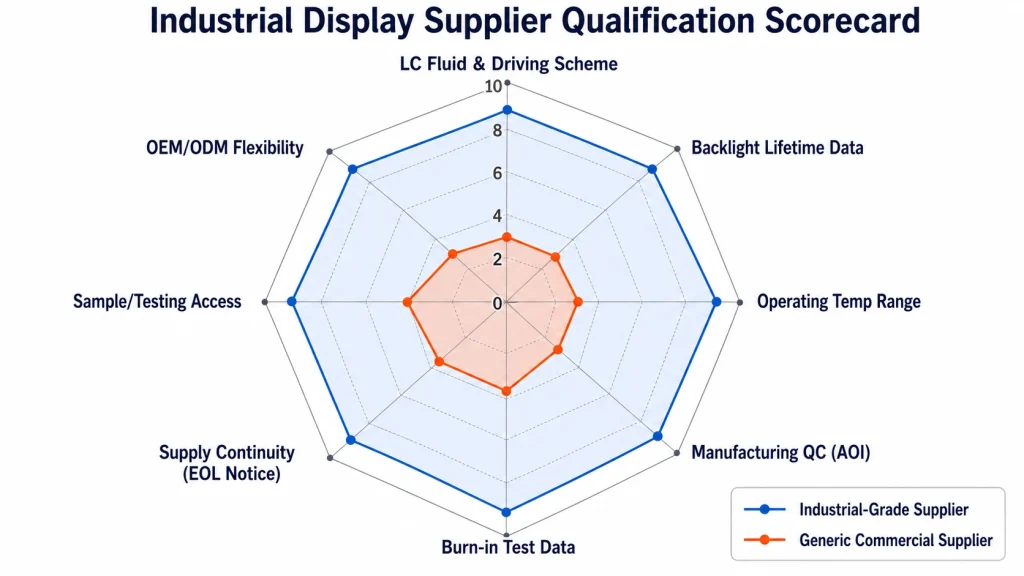
Long-life HMI programs depend on supplier qualification practices that go beyond a standard datasheet review. The following items distinguish a supplier capable of supporting a genuine 10-year program from one whose ‘industrial grade’ marketing language isn’t backed by the underlying manufacturing and quality control practices.
Kadi Display’s documentation on wide-temperature TFT displays for industrial applications outlines a representative example of this qualification depth — wide-temperature LC formulations rated −30°C to +85°C, heat-resistant UV-stable polarizers, and industrial-grade components rated for life beyond 50,000 hours. Their broader guide on choosing the best industrial TFT LCD for embedded devices frames long-term availability — explicitly described as a 5-to-10+ year consideration — as a core selection criterion alongside brightness and interface, which aligns directly with the procurement framework in this guide.
Field Maintenance Strategy for the Second Half of a 10-Year Program
Even with correct upfront specification, a 10-year HMI program benefits from a defined field maintenance strategy rather than a reactive run-to-failure approach, particularly once the deployment passes the 5-year mark where backlight degradation and cumulative retention risk both increase.
- Schedule a mid-life brightness audit around year 5. Measure actual field brightness against the original specification using a calibrated luminance meter on a representative sample of deployed units. This provides early warning of backlight degradation trending toward the L50 threshold before operators begin reporting readability complaints.
- Stock spare display modules proportional to fleet size and expected failure curve. A common industrial practice is stocking 3–5% of deployed unit count as spares for fleets in years 5–10, increasing if the supplier’s EOL notice period is shorter than the remaining program life.
- Track field image retention reports as a leading indicator, not just a complaint to resolve case-by-case. A cluster of retention complaints appearing around the same operating-hours milestone across multiple units indicates a systemic specification issue (insufficient driving scheme, missing software mitigation) rather than isolated unit defects, and should trigger a design review rather than only individual unit replacement.
- Confirm the supplier’s EOL notification process is actively monitored, not just contractually present. Assign explicit ownership — typically within procurement or supply chain management — for tracking EOL notices across all critical components including the display, and initiating requalification planning immediately upon notice rather than waiting for the final order window.
The Single Most Useful Procurement Question
“What is your minimum EOL notification period, and can you provide it in writing as part of the supply agreement?” This one question, asked and documented before the purchase order is issued, does more to protect a 10-year program from forced mid-life redesign than any other single procurement action. A supplier confident in long-term supply will answer this readily and specifically; vague or evasive answers are themselves useful diagnostic information about supply continuity risk.
Summary — The Specification Decisions That Compound Over a Decade
Image retention prevention and 10-year supply continuity are not separate concerns from a procurement perspective — they are both consequences of the same underlying decision: whether the display was specified and sourced as a genuinely industrial-grade component, or as a commercial-grade panel wearing an industrial label. The technical differences — LC driving scheme, backlight lifetime rating, operating temperature margin, manufacturing quality control depth, and supply chain commitment — are knowable and verifiable at the RFQ stage, before any purchase order is issued.
For procurement and engineering management teams evaluating display suppliers for long-life industrial HMI programs, the practical takeaway is to move the evaluation criteria beyond brightness and price into the five design strategies and supplier qualification items covered in this guide — and to document supply continuity commitments in writing as a standard part of the sourcing agreement, not an afterthought discovered when the first EOL notice arrives unexpectedly in year six.
For industrial-grade TFT LCD display modules engineered for long-term continuous operation — including wide-temperature LC formulations, confirmed backlight lifetime ratings, and documented supply continuity commitments — explore Kadi Display’s industrial TFT LCD product range or review their guidance on IPS panel selection for embedded and industrial display interfaces for panel technology considerations relevant to long-service-life HMI design.
Product Reference & Procurement Support
For industrial TFT-LCD display modules engineered for 10-year continuous operation — wide-temperature LC fluid, confirmed backlight lifetime, AOI-inspected manufacturing, and documented supply continuity — contact Kadi Display at Sales@sz-kadi.com. OEM and ODM services available with flexible MOQ for qualification programs. Browse industrial display product range →
Haftungsausschluss: Lifetime figures, temperature ratings, and cost comparisons in this guide are representative industry ranges for procurement planning reference and must be verified against specific supplier datasheets and your application’s actual operating conditions. Backlight lifetime (L50) and image retention resistance vary by manufacturer, LC fluid formulation, and driving circuit design. All brand and product names are the property of their respective owners. This article does not constitute financial or contractual advice; supply agreement terms should be reviewed by appropriate procurement and legal personnel.
Vorherige
LCD Pressure Damage: Why Industrial Touchscreens Develop Spots After Installation
Nächster
How to Choose FFC/FPC Connectors for Industrial Touchscreen Products
Hinterlasse einen Kommentar

Neueste Blog & Nachrichten
- Industrial LCD EOL: What Happens from Pre-Announcement to Replacement Mass Production?
- Electronic Component Obsolescence Management for Industrial Displays: An OEM Guide
- How to Develop a Production Ready Custom Display Assembly TFT Module Touch Cover Glass FPC Bonding and Mounting
- 15 Pin vs 22 Pin Raspberry Pi DSI Connectors Cable Pinout and Compatibility
- Native MIPI DSI vs LVDS or HDMI Bridge: An OEM Display Architecture Decision Guide