
Startseite
-
Blog & Neuigkeiten
-
How to Control TFT LCD Revisions After Replacement Approval: Golden Samples, PCNs, Lot Traceability, and Incoming Inspection
How to Control TFT LCD Revisions After Replacement Approval: Golden Samples, PCNs, Lot Traceability, and Incoming Inspection
2026-10-29
12:00
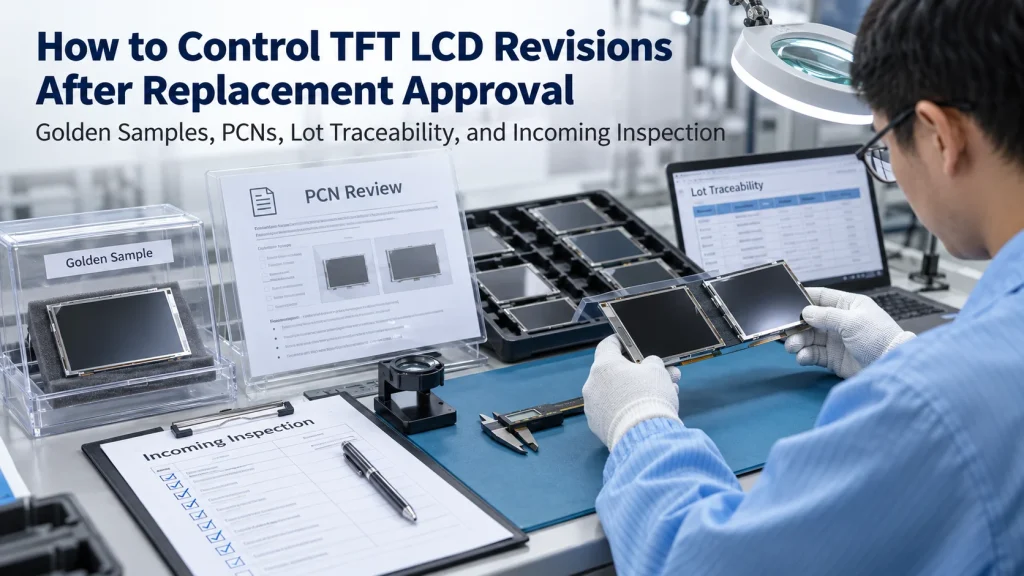
TFT LCD revision control begins after replacement approval establishes that a module can work in the target equipment. Approval does not guarantee that every later shipment will match. OEMs need a controlled baseline that connects the sample to drawings, firmware, supplier notices, production lots, and incoming inspection. Treat the approved replacement as a complete configuration, not only as a part number.
TFT LCD Revision Control Starts After Approval
A qualification report shows whether a candidate meets defined requirements under tested conditions. Production change control ensures that later shipments retain the approved configuration.
Begin with the evidence created during the industrial LCD drop-in replacement checklist. The released record should identify every approved difference from the legacy display and any dependent change to the host, cable, bracket, touch controller, firmware, or work instruction.
Assign an internal part number or revision that makes the compatibility boundary clear. A conditional alternate may require a specific firmware build, hardware revision, or equipment serial range. The naming system should prevent operators from mixing those conditions.
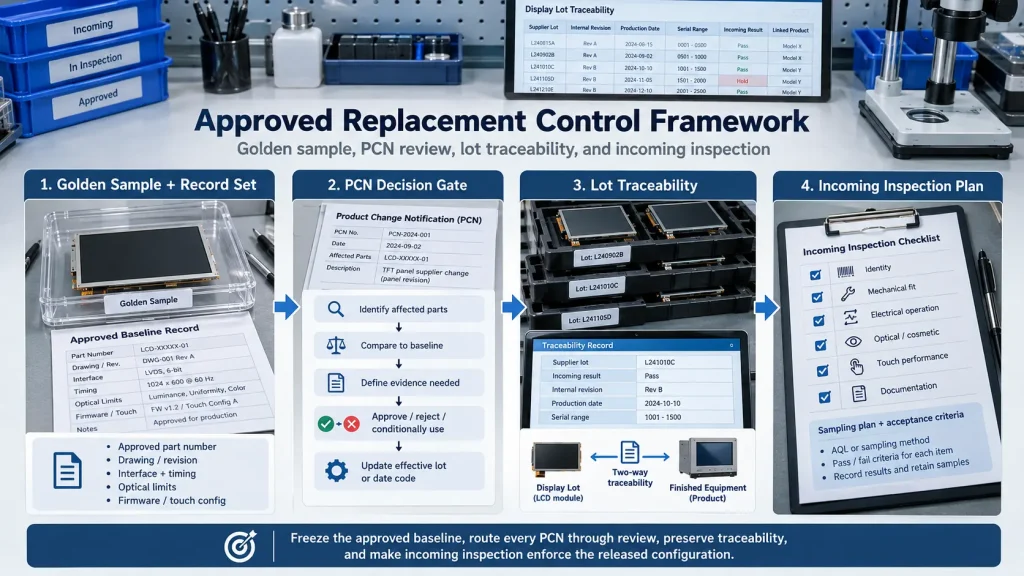
Establish a Golden Sample and Its Record Set
A golden sample in manufacturing provides a physical comparison reference, but the sample alone cannot define acceptance. Displays age, storage conditions affect appearance, and subjective visual judgments vary. Pair the unit with approved records and written limits.
The baseline package should identify:
- Supplier and OEM part numbers, revision codes, and approval date
- Module drawing, active-area position, FPC geometry, connector and pinout
- Touch panel, cover glass, bonding, surface treatment, and related drawings when applicable
- Electrical interface, timing, power sequence, backlight control, and firmware configuration
- Optical and cosmetic criteria, test method, viewing conditions, and approved limit samples
- Qualification report, deviations, approvals, and the products or serial ranges covered
Protect the reference from routine production use and record any damage or aging. When a visual defect cannot be expressed adequately with a measurement, controlled boundary samples can show acceptable and unacceptable conditions more clearly than one ideal unit.
Route Every PCN Through a Defined Decision Gate
A supplier product change notification, or PCN, should trigger a documented review before changed material reaches unrestricted production. A label wording change may need only document control. A driver IC, polarizer, touch firmware, bonding material, factory, or process change may require technical evaluation.
Use a consistent PCN decision sequence:
- Identify affected supplier parts, internal parts, open orders, inventory, and products.
- Compare the proposed change with the approved baseline and list every known delta.
- Define the evidence required, from document review to bench tests, assembled-system checks, or partial requalification.
- Record approval, rejection, temporary deviation, or conditional use before the cut-in date.
- Update controlled documents and communicate the effective lot, date code, or serial range.
The supplier’s notification does not replace the OEM’s change control. The OEM still decides where the changed display can be used and which verification fits the risk.
Connect Lot Traceability to Finished Equipment
Lot traceability in manufacturing should allow a team to move in both directions. Starting with an LCD lot, it should identify the finished equipment that received it. Starting with a field unit, it should identify the display revision and relevant production lot.
Capture the supplier lot or date code at receiving and preserve it through assembly and shipment. Where unit-level capture is impractical, define the smallest batch that supports containment. Link it to the internal revision, incoming result, production date, equipment serial range, and any approved deviation.
Mixed inventory deserves special control during a running change. Separate old and new revisions physically, label their status, and define the exact cut-in rule. If firmware or hardware compatibility differs, the traveler or manufacturing system should force the correct pairing. This prevents a technically approved alternate from entering an incompatible build.
Turn the Approved Baseline Into an Incoming Inspection Plan
An incoming inspection checklist should verify characteristics that protect interchangeability and reveal uncontrolled change. The approved comparison unit helps inspectors recognize the released construction and appearance, while drawings, test methods, and numerical limits decide acceptance.
Select checks according to risk and detectability. Useful receiving controls may include:
- Identity: part number, revision, label, date code, and lot code
- Mechanical fit: outline, active area, FPC exit, and connector orientation
- Electrical operation: interface, startup, reset, image stability, and backlight control
- Optical and cosmetic quality: specified measurements, pixel criteria, contamination, scratches, and mura
- Touch performance: controller and firmware identity, mapping, noise behavior, and operation with the released cover stack
- Documentation: required records, PCN status, deviation number, and drawing revision
Define the sampling plan, measurement method, equipment, environmental conditions, acceptance criteria, and reaction plan. An incoming quality inspection cannot prove long-term reliability, but it can stop mislabeled, damaged, or visibly changed material before it reaches the line. Trend defects by supplier lot and revision so recurring changes become visible.
Control Nonconforming Material and Temporary Deviations
When incoming material differs from the baseline, quarantine it before line use. Record the delta and affected shipment. Engineering should decide whether it represents a documentation error, supplier escape, unannounced change, or an approved revision missing from internal records.
A temporary deviation needs a defined quantity or time window, named products, required screening, approval authority, and closure condition. If the change becomes permanent, update the baseline, inspection plan, bill of materials, firmware records, work instructions, and golden sample as applicable.
Verify the Change in Pilot Production
Before unrestricted release, confirm repeatability in a pilot or first production lot. Monitor yield, image and touch failures, assembly fit, startup behavior, and symptoms linked to one module lot or system configuration. The display integration isolation workflow can help when a prototype passed but pilot units fail.
Open-bench operation cannot replace checks in the final enclosure when pressure, grounding, cable routing, heat, or electromagnetic conditions may affect performance. If the solution includes modified FPCs, touch integration, bonding, or mechanical coordination, a customized display solution may provide a clearer release boundary than independently managed parts.
Ask the Supplier for Evidence That Supports Control
Before ordering production quantities, confirm how the supplier identifies revisions, communicates PCNs, separates lots, preserves test records, and handles material produced before approval.
KADI Display presents an industrial display portfolio with TFT LCD modules and project-specific integration support. Depending on the project, support may include touch integration, optical bonding, FPC or cable customization, interface adaptation, sample verification, and supply planning. Confirm the scope against the host platform, mechanical requirements, operating environment, and volume plan.
For lifecycle planning, KADI aims to support industrial display products for five to eight years. Its stated EOL process generally includes a pre-announcement about three months before the official notice, a last-buy window extending six months after the notice, and final shipments roughly three to five months after the last-buy deadline before running change and new-model mass production. These are planning guidelines rather than an unconditional guarantee, so project-specific dates and stock commitments require confirmation.
Schlussfolgerung
Replacement TFT LCD control depends on a traceable link from approval evidence to each production lot. Freeze the complete configuration, maintain a protected golden sample with written limits, route PCNs through an engineering decision, and make incoming inspection enforce the released baseline. Lot records and controlled cut-in rules then make containment practical when a revision changes or a field issue appears.
For a revision-control or supply-transition review, contact KADI’s technical team with the legacy and replacement model numbers, approved drawings, host and firmware revisions, expected quantity, operating conditions, and required cut-in date.
Häufig gestellte Fragen
Is a Golden Sample Enough to Approve Future TFT LCD Lots?
No. A golden sample is a useful physical reference, but written specifications, drawings, test methods, acceptance limits, and revision records must define compliance.
Which TFT LCD Changes Usually Need Requalification?
The required scope depends on risk. Changes to the panel source, driver IC, touch controller or firmware, FPC, connector, polarizer, bonding construction, optical stack, factory, or key process may require focused or broader verification.
How Should an OEM Handle Old and New LCD Revisions at the Same Time?
Segregate and label inventory, define an effective lot or serial range, enforce firmware and hardware compatibility rules, and retain traceability from the display lot to finished equipment.
What Should an Incoming Inspection Plan Do After Replacement Approval?
It should verify identity and the characteristics most likely to expose an uncontrolled change, then define sampling, measurement conditions, acceptance criteria, and a clear reaction plan.
Vorherige
Nicht mehr
Nächster
Industrial LCD EOL: What Happens from Pre-Announcement to Replacement Mass Production?
Hinterlasse einen Kommentar

Neueste Blog & Nachrichten
- How to Control TFT LCD Revisions After Replacement Approval: Golden Samples, PCNs, Lot Traceability, and Incoming Inspection
- Industrial LCD EOL: What Happens from Pre-Announcement to Replacement Mass Production?
- Electronic Component Obsolescence Management for Industrial Displays: An OEM Guide
- How to Develop a Production Ready Custom Display Assembly TFT Module Touch Cover Glass FPC Bonding and Mounting
- 15 Pin vs 22 Pin Raspberry Pi DSI Connectors Cable Pinout and Compatibility