Inicio
-
Blog & Noticias
-
Unión por aire frente a unión óptica: cómo elegir para pantallas táctiles industriales
Unión por aire frente a unión óptica: cómo elegir para pantallas táctiles industriales
2026-06-25
00:00
Unión óptica para pantallas táctiles industriales Se ha convertido en una decisión de diseño clave cuando las pantallas se utilizan en entornos luminosos, polvorientos, húmedos o con fuertes vibraciones. El método de unión entre el panel LCD, el sensor táctil y el cristal protector afecta directamente a la legibilidad, la reflexión, el contraste, la resistencia a los impactos, la estabilidad táctil y la fiabilidad a largo plazo.
En una sala de control interior, una pantalla táctil estándar puede funcionar correctamente con una simple unión por aire. Sin embargo, cuando la misma pantalla se utiliza en una interfaz hombre-máquina (HMI) exterior, una estación de trabajo médica, maquinaria agrícola, terminal de carga o panel de control de vehículos, pequeñas pérdidas ópticas pueden convertirse en problemas reales en el campo. Los operadores pueden ver reflejos en lugar de datos. La pantalla puede verse descolorida bajo luz ambiental intensa. El polvo o la humedad pueden quedar atrapados alrededor del espacio de aire. Estos problemas no siempre son causados por el panel LCD en sí. Muy a menudo, provienen de la estructura de unión.
Kadi Display suministra módulos LCD TFT industriales, pantallas táctiles TFT, pantallas de alto brillo, monitores industriales, pantallas AMOLED, pantallas para Raspberry Pi, soluciones de visualización integradas, accesorios y soluciones de visualización personalizadas para proyectos de equipos B2B. La empresa se especializa en control industrial, equipos médicos, sistemas integrados, aplicaciones para exteriores e integración de pantallas OEM/ODM.
¿Qué es la unión por aire?
Una estructura económica para entornos controlados.
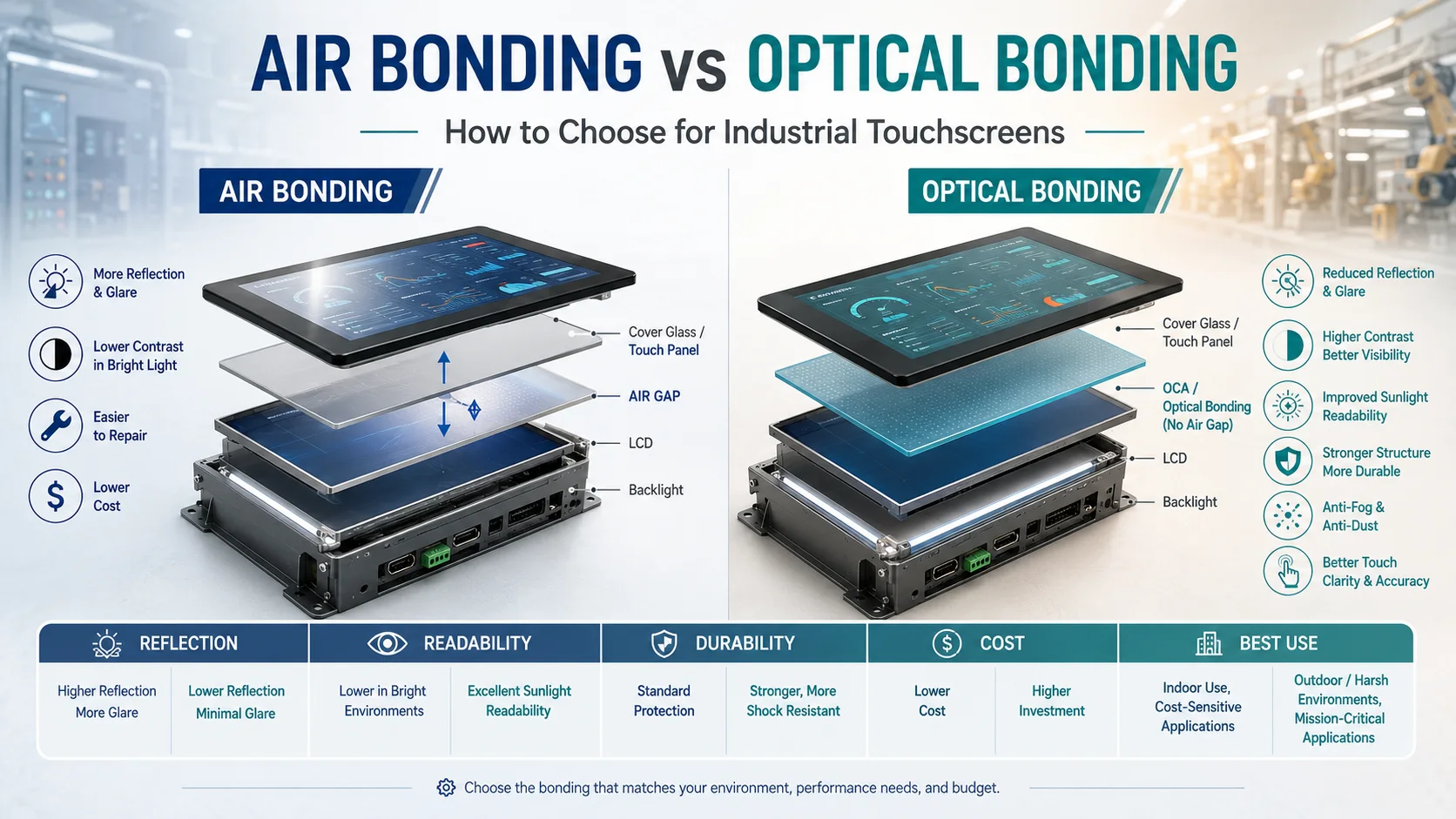
La unión por aire implica que el panel LCD y el panel táctil o el cristal protector se ensamblan con una capa de aire entre ellos. Las piezas suelen fijarse por los bordes con cinta adhesiva o mediante unión por marco. Esta estructura es muy utilizada porque es relativamente sencilla, rentable y más fácil de reparar o reemplazar en comparación con la unión óptica completa.
Para pantallas táctiles industriales de interior, la unión por aire sigue siendo una opción práctica. Un panel de control instalado en un taller limpio, un terminal de posición fija dentro de un armario o un dispositivo utilizado bajo iluminación estable pueden no requerir el alto rendimiento óptico de una pantalla totalmente laminada. Si la pantalla no está expuesta a la luz solar directa, vibraciones, condensación o limpieza frecuente, la unión por aire puede cumplir con los requisitos del proyecto sin generar costos innecesarios.
El punto débil: el espacio de aire
La capa de aire también constituye la principal limitación. La luz se refleja en cada superficie donde el aire entra en contacto con el vidrio o el plástico. En un panel táctil LCD laminado, un menor número de puntos de reflexión internos suele traducirse en un mejor contraste. En una pantalla laminada con aire, el espacio entre las capas puede aumentar la reflexión y reducir la nitidez de la imagen, especialmente bajo una iluminación ambiental intensa.
El espacio de aire también puede generar problemas mecánicos y ambientales. Bajo vibración, la estructura de la pantalla puede perder rigidez. En aplicaciones con cambios de temperatura, la humedad o el empañamiento pueden ser un problema si el diseño mecánico no está bien controlado. En el caso de pantallas HMI para exteriores, paneles de control de vehículos y pantallas táctiles médicas, estos problemas suelen hacerse más evidentes una vez que el producto pasa de la fase de prototipo a su uso en campo.
¿Qué es la unión óptica?
Cerrando la brecha entre las pantallas LCD y los paneles táctiles.
La unión óptica utiliza una capa adhesiva transparente, como OCA u OCR, para rellenar el espacio entre el panel LCD y el sensor táctil o el cristal protector. En lugar de dejar un espacio de aire, las capas de la pantalla se unen formando una estructura óptica más compacta. Esto reduce los reflejos internos, mejora el contraste y facilita la lectura de la pantalla en entornos luminosos.
Para aplicaciones industriales, la unión óptica OCA resulta especialmente útil cuando la pantalla debe funcionar cerca de ventanas, en exteriores, dentro de cabinas de vehículos o en equipos expuestos a cambios de luz. La mejora no es solo estética. Una mayor legibilidad puede reducir los errores del operador, acortar el tiempo de respuesta y aumentar la fiabilidad del dispositivo durante su uso diario.
Mejor estructura para aplicaciones exigentes
La unión óptica también puede mejorar la resistencia mecánica, ya que la estructura frontal se integra mejor. Esto es importante para las pantallas táctiles utilizadas en maquinaria agrícola, equipos médicos, paneles HMI industriales y terminales robustos. Cuando el cristal protector, el sensor táctil y la pantalla LCD están unidos, es menos probable que el módulo presente separación visible de capas o reflejos internos causados por el espacio de aire.
En dispositivos médicos, la unión óptica permite un diseño de superficie frontal más limpio y una mayor resistencia al polvo y la humedad. En pantallas táctiles industriales para exteriores, se puede combinar con retroiluminación de alto brillo, cristal protector antirreflejos (AG) o antirreflejos (AR) y paneles LCD TFT IPS de amplio ángulo de visión para mejorar la legibilidad bajo la luz solar.
Unión por aire frente a unión óptica: principales diferencias
Legibilidad, reflexión y contraste
La diferencia más evidente entre la unión por aire y la unión óptica radica en el rendimiento visual. La unión por aire suele ser aceptable en interiores con iluminación controlada. La unión óptica es más resistente cuando la pantalla debe permanecer legible bajo la luz solar, lámparas industriales o vidrio reflectante.
Una pantalla legible a la luz del sol no depende únicamente del brillo. Un panel de 650 cd/m² o 1000 cd/m² puede verse débil si la reflexión interna es alta. La unión óptica ayuda a que la pantalla aproveche mejor su brillo al reducir la pérdida de luz dentro de la estructura. Para una pantalla táctil industrial, esto puede ser más valioso que simplemente aumentar la potencia de la retroiluminación, lo que podría generar calor y reducir su vida útil.
Durabilidad, empañamiento y estabilidad táctil.
La unión por aire facilita la reparación y reduce el coste inicial, pero es menos adecuada para aplicaciones con vibraciones frecuentes, riesgo de condensación o cambios ambientales bruscos. La unión óptica proporciona una estructura más sólida y puede reducir la probabilidad de empañamiento interno causado por el espacio de aire entre las capas.
La experiencia táctil también puede resultar más directa gracias a la unión óptica. Al estar las capas más próximas entre sí, se reduce la distancia visual entre el cristal protector y la imagen LCD. Esto puede mejorar la precisión táctil percibida en pantallas táctiles capacitivas, especialmente cuando los operadores interactúan con iconos pequeños, controles deslizantes o elementos de interfaz médica.
Cuando la unión por aire es suficiente
Equipos para interiores y equipos de bajo costo.
La unión por aire suele ser suficiente para equipos de interior donde la pantalla no está expuesta a luz intensa, humedad, polvo, vibraciones o impactos frecuentes. Algunos ejemplos son terminales de fábrica sencillas, pantallas de control de oficinas, instrumentos de interior y dispositivos de uso fijo donde la facilidad de reparación y el menor coste son más importantes que el rendimiento óptico.
Para los equipos de compras, la unión por aire puede ser una decisión razonable cuando la pantalla se utiliza en un entorno estable y el producto no requiere visibilidad a plena luz del sol. La clave es probar la pantalla en el ángulo de instalación y las condiciones de iluminación reales antes de aprobar su estructura.
Cuándo merece la pena el coste de la unión óptica
Pantallas HMI, médicas y para vehículos para exteriores
La unión óptica suele justificar el coste adicional cuando la pantalla táctil debe permanecer nítida en condiciones exigentes. Los paneles HMI para exteriores, las pantallas de maquinaria agrícola, los salpicaderos de los carros de golf, las tabletas industriales, las pantallas táctiles médicas y los terminales integrados robustos son ejemplos comunes.
También muestra Pantalla LCD IPS TFT de 8,0 pulgadas y resolución 1200×1920 La pantalla táctil capacitiva OCA con interfaz MIPI es un ejemplo práctico de producto. Esta pantalla utiliza laminación óptica OCA y ofrece un brillo típico de 650 cd/m², interfaz MIPI DSI, controlador HX8279-D01, 16,7 millones de colores y un rango de temperatura de funcionamiento de -20 °C a 70 °C. Su ángulo de visión de 85°/85°/85°/85° permite una lectura multiángulo para HMI industriales, sistemas de control inteligentes, dispositivos integrados y aplicaciones semiabiertas.
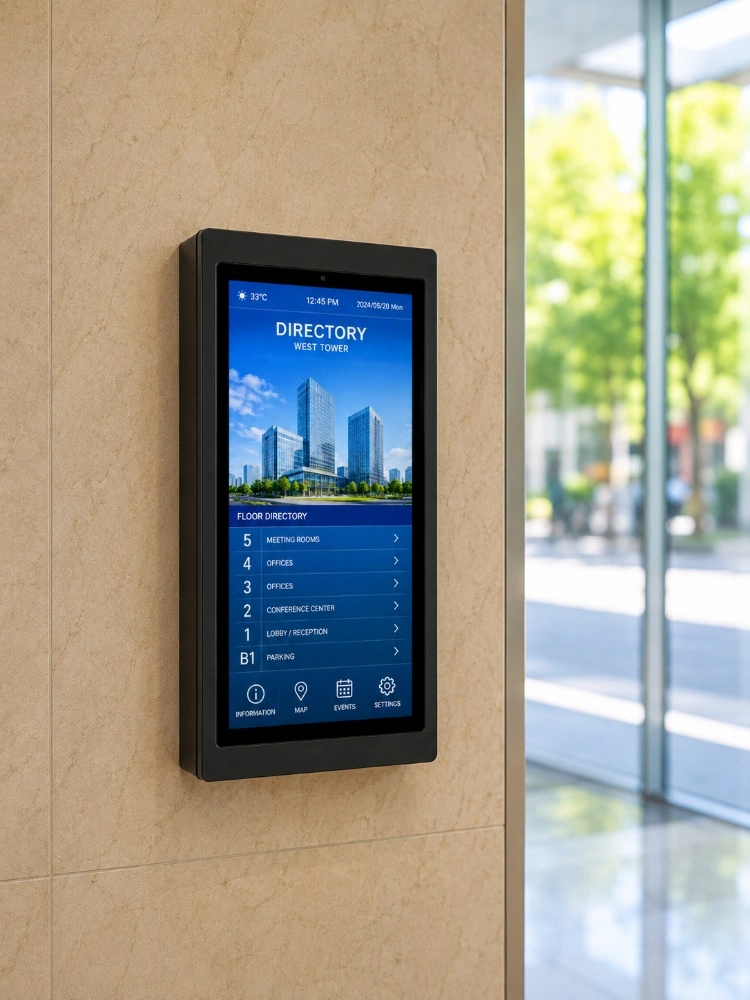
El producto refleja una tendencia común en el diseño industrial: la unión óptica se combina con el rendimiento de las pantallas LCD IPS TFT, la tecnología táctil capacitiva, el alto brillo y la compatibilidad con diversas interfaces. Kadi Display también ofrece ajuste de brillo, unión óptica, recubrimientos AG/AR/AF, personalización del panel táctil, diseño de la cubierta de vidrio, modificación de FPC y desarrollo de interfaces HDMI, MIPI y LVDS para proyectos específicos de cada cliente.
Cómo elegir el método de adhesión adecuado
Comience con el entorno de uso.
El método de unión más adecuado depende del entorno de uso del dispositivo. Para dispositivos de interior con iluminación estable, se puede utilizar la unión por aire. En el caso de pantallas médicas que requieren una legibilidad nítida, pantallas táctiles para vehículos expuestas al sol y vibraciones, o interfaces hombre-máquina (HMI) para exteriores con problemas de reflejos, se recomienda considerar la unión óptica.
Los ingenieros y compradores deben tener en cuenta el brillo, el tamaño de la pantalla, el grosor del cristal protector, el tipo de pantalla táctil, la temperatura de funcionamiento, el diseño de la carcasa, el grado de protección IP, el método de limpieza, la vida útil prevista y el volumen anual de producción. Estos detalles ayudan a determinar si el proyecto requiere una pantalla táctil TFT estándar o una pantalla con unión óptica personalizada.
La capacidad del proveedor es importante.
El proceso de unión es una parte crucial de la fabricación de pantallas táctiles. Para obtener resultados estables, se requiere una cuidadosa selección de materiales, control de la unión, inspección y planificación de la cadena de suministro a largo plazo. Kadi Display Es un fabricante de pantallas con sede en Shenzhen, con más de 20 años de experiencia, un taller de producción de más de 10 000 metros cuadrados y sistemas de calidad que abarcan las normas ISO 9001, ISO 14001, ISO 13485 e IATF 16949. La empresa realiza inspecciones AOI durante el proceso de fabricación de FOG para garantizar la fiabilidad de la unión y la uniformidad de la pantalla.
Para los proyectos B2B, este conocimiento previo de producción es importante porque la pantalla es difícil de modificar una vez que se han iniciado los trabajos de carcasa, firmware, enrutamiento de cables y certificación.
Conclusión
Tanto la unión por aire como la unión óptica tienen cabida en el diseño de pantallas táctiles industriales. La unión por aire es adecuada para aplicaciones en interiores, donde el costo es un factor crítico y se requiere facilidad de reparación. La unión óptica es una opción más robusta cuando la legibilidad, el control de la reflexión, la resistencia a los impactos, el rendimiento antivaho y la fiabilidad a largo plazo son más importantes.
En el caso de interfaces hombre-máquina industriales, dispositivos médicos, terminales para exteriores, sistemas embebidos, maquinaria agrícola y paneles de control de vehículos, la unión óptica puede mejorar la experiencia de visualización de maneras que el brillo por sí solo no puede solucionar. Kadi Display Ofrece pantallas táctiles TFT y soluciones de visualización personalizadas que combinan la unión óptica OCA, paneles LCD TFT IPS de alto brillo, pantallas táctiles capacitivas, tratamiento de superficies, personalización de interfaces y soporte de ingeniería para equipos listos para la producción.
Preguntas frecuentes
P1: ¿Cuál es la diferencia entre la unión por aire y la unión óptica?
A: La unión por aire deja un espacio de aire entre la pantalla LCD y el panel táctil o el cristal protector, mientras que la unión óptica rellena ese espacio con una capa adhesiva transparente como OCA u OCR. La unión por aire es más económica y fácil de reparar. La unión óptica reduce los reflejos, mejora el contraste y permite una mejor legibilidad en entornos luminosos o con condiciones de luz adversas.
P2: ¿Merece la pena la unión óptica para las pantallas táctiles industriales?
A: La unión óptica es recomendable para pantallas táctiles industriales utilizadas en interfaces hombre-máquina (HMI) para exteriores, equipos médicos, pantallas de vehículos, maquinaria agrícola o terminales robustas. Mejora la visibilidad bajo la luz solar, reduce los reflejos internos, refuerza la estructura de la pantalla y puede ayudar a disminuir los problemas de empañamiento o relacionados con el polvo.
P3: ¿Mejora la legibilidad a la luz del sol el uso de la unión óptica?
A: La unión óptica mejora la visibilidad bajo la luz solar al reducir la reflexión interna entre la pantalla LCD, el panel táctil y el cristal protector. Una pantalla de alto brillo resulta más eficaz cuando se reduce la pérdida de luz dentro de su estructura. En pantallas táctiles para exteriores, la unión óptica se suele utilizar con cristal protector antirreflejos (AG) o antirreflejos (AR).
P4: ¿Cuándo debo elegir la unión por aire para una pantalla táctil?
A: La unión por aire es una opción recomendable para pantallas táctiles de uso interior, protegidas de la luz solar directa, la humedad, las vibraciones y la limpieza frecuente. Resulta adecuada cuando el control de costes, la facilidad de reparación y el rendimiento básico de la pantalla son más importantes que la legibilidad a la luz del sol o una estructura robusta.
P5: ¿Puede Kadi Display personalizar una pantalla táctil con unión óptica?
A: Kadi Display ofrece personalización de pantallas táctiles mediante unión óptica para proyectos de visualización industriales e integrados. Las opciones personalizadas incluyen unión OCA, ajuste de brillo, recubrimiento AG/AR/AF, diseño de pantallas táctiles capacitivas, personalización del vidrio protector, modificación de FPC y desarrollo de interfaces HDMI, MIPI o LVDS.
PREVIOR
Cómo afecta la vida útil de la retroiluminación LED a la fiabilidad de las pantallas LCD TFT industriales
Siguiente
¿Qué es una pantalla LCD de amplio rango de temperatura y cuándo la necesitan los dispositivos industriales?
Deja un comentario

Últimos blogs y noticias
- MIPI DSI Display Driver Development for Embedded Linux What Hardware Buyers Need to Confirm
- Why PCAP Touchscreens Need Retuning After Cover Glass Coating or Optical Bonding Changes
- Why Outdoor LCDs Fog Inside: Condensation, Sealing, Vents, and Heaters
- IP65 vs IP67 Industrial Displays: What the Rating Actually Covers
- How to Specify a Touchscreen for Food-Processing Equipment