
Accueil
-
Blog & Actualités
-
Optical Bonding vs Air Bonding for Industrial Touchscreens: Cost, Durability & Performance
Optical Bonding vs Air Bonding for Industrial Touchscreens: Cost, Durability & Performance
2026-08-16
22:33
Optical Bonding vs Air Bonding for Industrial Touchscreens: Cost, Durability & Performance
A practical engineering guide to light transmission, impact behavior, condensation risk, OCA vs LOCA, production yield, and lifecycle cost
A bright LCD can still look gray outdoors when its front stack traps reflections. This selection guide explains what changes when the air gap is filled, where optical bonding genuinely improves an industrial touchscreen, and when a lower-cost air-bonded assembly remains the sound engineering choice.
The 30-Second Decision: Optical Bonding vs Air Bonding
Short answer: Choose optical bonding when glare, fogging, vibration, glass safety, or parallax can create a field failure. Choose air bonding for controlled indoor light, stable enclosures, easy service, and strongly cost-limited projects.
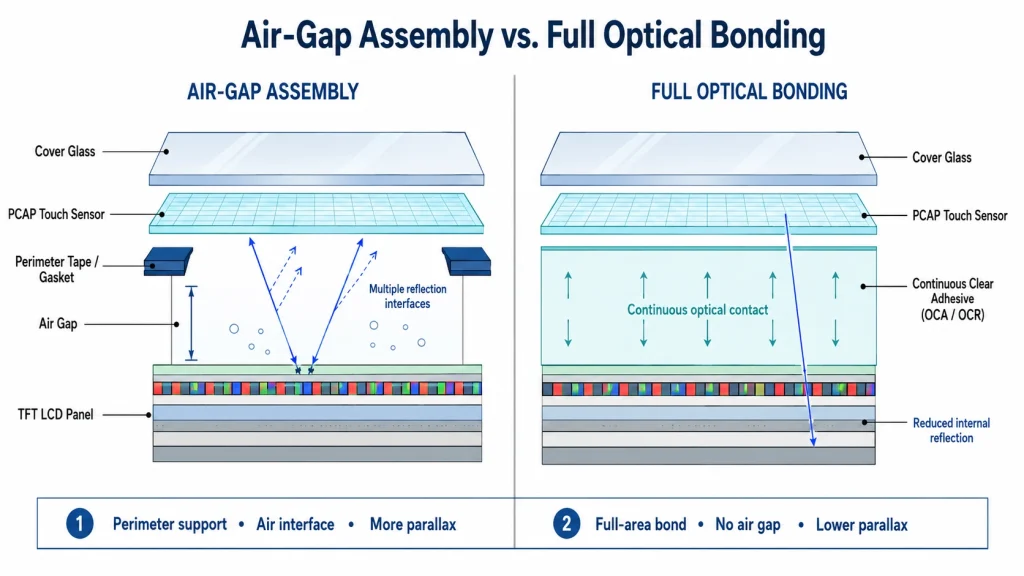
Air bonding attaches the touch panel or lens around its edge, leaving an air gap above the LCD. The touch screen bonding process is fast and the layers are easier to separate. Its weakness is the same gap that makes it inexpensive.
Optical bonding fills the gap with index-matched material. OCA is a clear adhesive film; LOCA is a dispensed liquid, also called OCR. Both reduce internal reflections and couple the stack mechanically.
Best rule – Bonding is a front-stack decision, not an LCD brightness accessory. Freeze the cover glass, touch sensor, adhesive, LCD polarizer, bezel pressure, and environmental profile as one qualified assembly.
Optical Performance: Transmission Is Only Half the Story
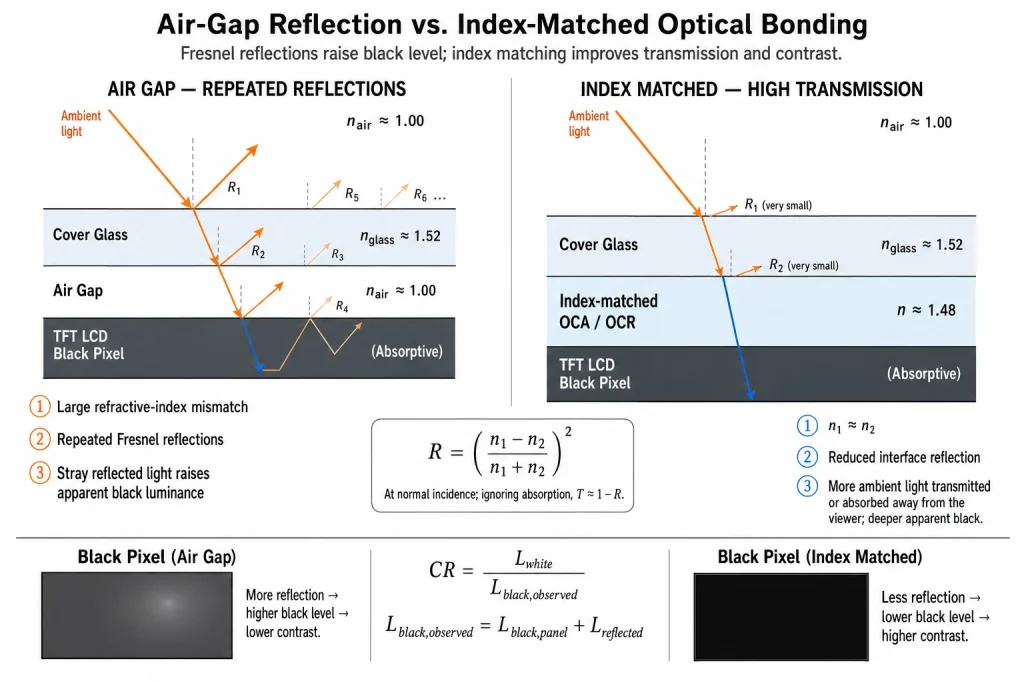
At normal incidence, Fresnel reflectance is R = ((n1 – n2) / (n1 + n2))². An air/glass boundary near n = 1.0/1.5 reflects about 4% at one surface. Multiple boundaries can wash out black pixels before LCD luminance becomes limiting.
A current 3M OCA sheet reports n = 1.4809 at 633 nm and 0.1-0.2% haze. Pairing n = 1.50 glass with n = 1.48 adhesive gives about 0.005% theoretical reflection at that interface. Real modules still reflect at the outer cover, polarizers, electrodes, and coatings.
Bonding can therefore improve readability without more backlight power. An Arkema LOCA reference reports 97% transmission at 380 nm and 99% above 400 nm. These are material results; the finished stack also includes ITO, ink, polarizers, coatings, and process contamination.
Problem: A specification asks for “more than 90% transmittance,” yet the prototype remains hard to read under a factory skylight.
Réponse : Measure luminous transmittance, haze, and reflectance on the complete display stack. Then test contrast under the actual illumination angle. A high-transmission stack can still have poor ambient contrast if reflected light reaches the operator.
For surface-treatment trade-offs around the outermost glass, use Kadi Display’s anti-glare vs anti-reflection guide for industrial displays. AG scatters reflections but adds haze; AR reduces specular reflection but needs its own durability review.
Impact Resistance and “Explosion-Proof” Claims
Optical bonding can improve damage tolerance, but it does not make ordinary cover glass explosion-proof. The adhesive supports a larger area of the lens, reduces unsupported flex, and may retain fragments after breakage. A bonded stack can therefore behave more predictably under a local strike or sustained vibration than a cover lens spanning an air gap.
Results depend on glass chemistry, thickness, edge finish, cutouts, ink, adhesive modulus, bond line, bezel pressure, enclosure stiffness, and impact location. A rigid adhesive transfers stress; a soft one may pump under vibration. “Optically bonded” is not an impact rating.
For public kiosks, mining controls, marine terminals, vehicle displays, and food-processing HMIs, specify the required enclosure impact class and test the complete product. IEC 62262 defines the IK code for external mechanical impacts. IEC 60068-2-27 addresses shock, while IEC 60068-2-6 covers sinusoidal vibration. The test severity, mounting fixture, cable routing, operating state, and post-test acceptance limits must match the application.
Safety wording – Use “improved impact resistance” or “fragment retention” only when supported by assembly-level tests. Do not market a touchscreen as explosion-proof, vandal-proof, or IK-rated because it uses optical bonding.
Validate center/edge impact, powered vibration, and shock in the production enclosure. Inspect cracks, delamination, bubbles, light leakage, touch drift, mura, fragment release, and electrical safety.
Condensation, Dust, and Temperature Cycling
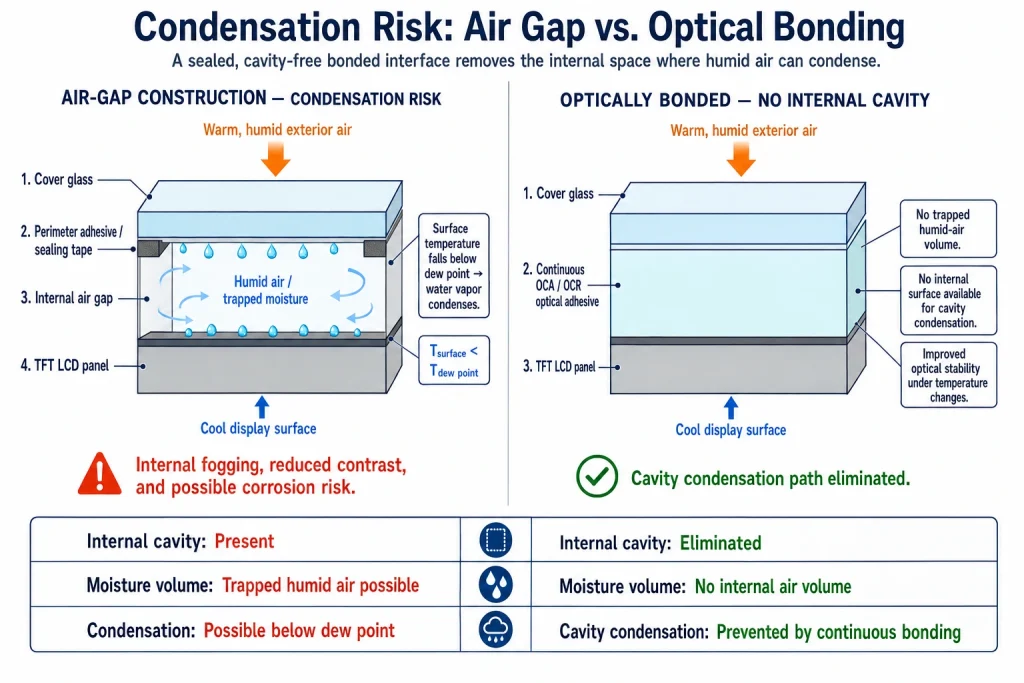
Condensation needs moisture, a surface below the local dew point, and a path for moist air to reach it. An air-bonded cavity supplies the volume where water can appear. A cold-start outdoor HMI may look normal in the factory and then fog when warm humid air enters the bezel and meets a cold cover or LCD surface.
Optical bonding removes the cavity at the bonded interface, but it is not an IP rating. Moisture may still enter through the enclosure, connector, edge seal, vent, or damaged edge, and dew can still form outside the cover.
The cited 3M OCA sheet reports no appreciable visible deterioration in a glass/OCA/glass sample after 1,000 hours at 85°C/85% RH and 200 thermal-shock cycles from -40°C to 95°C. That demonstrates the sample, not a finished PCAP touchscreen.
A practical plan combines temperature-change testing, high-humidity exposure, powered cold starts, and inspection during recovery. IEC 60068-2-14 provides change-of-temperature methods. IEC 60068-2-78:2025 covers steady-state damp heat without condensation, so add a product-specific dew/fog test if condensation is the failure being investigated.
Common mistake – A 85°C/85% RH result does not automatically prove anti-condensation performance because the standard damp-heat method is designed around high humidity without condensation. Define an explicit dew-point crossing when fogging matters.
OCA vs LOCA: Materials and Process Windows
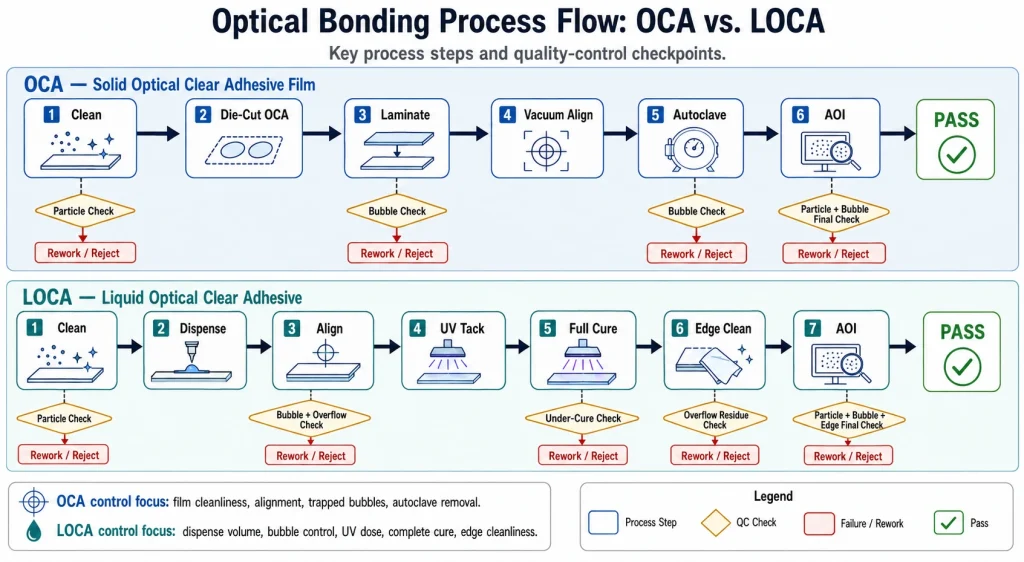
OCA vs LOCA depends on display size, flatness, printed steps, cure access, rework policy, and supplier experience. Neither wins every project.
OCA: dry-film optical bonding
OCA is a controlled-thickness film. It is die-cut, laminated to the first substrate, vacuum-aligned to the second, then pressure-treated or autoclaved. Common acrylic films need no UV cure. Particles, liner marks, bubbles, and printed steps are key risks.
LOCA: liquid optical bonding
LOCA is dispensed, flowed, aligned, and cured. It fills gaps and stepped geometry well, but volume, edge dams, squeeze-out, cure dose, shadow areas, and cleanup need control. One 3M reference recommends four minutes at 9 mW/cm² while warning that cure depends on spectrum, distance, and substrate transmission.
A detailed factory sequence is available in Kadi Display’s optical bonding process overview. For sourcing discussions, ask the supplier to name the adhesive family, nominal bond line, lamination/cure window, cleanroom class, outgoing inspection, and rework limit.
Cost, Yield, and Rework: Build a Lifecycle Model
Air bonding usually has the lowest unit conversion cost. Frame adhesive is inexpensive, cycle time is short, and a damaged touch sensor may be replaced without sacrificing the LCD. Optical bonding adds adhesive, cleaning, alignment, vacuum equipment, cure or autoclave time, inspection, and yield risk. Kadi Display’s published surface-treatment guide gives a planning range of roughly US$15-$50 added per 4-10 inch custom assembly, depending on size and volume.
That premium is not the whole cost. A low-cost air-bonded display can create service calls for glare complaints, internal contamination, fogging, lens movement, or impact damage. Conversely, a fully bonded service part may require replacing the entire LCD-touch-lens assembly after a cracked cover, even when the LCD still works.
Illustrative model: The table below is a transparent sensitivity example for 1,000 seven-inch units, not an industry benchmark. Replace every assumption with supplier quotes and your field data.
Under these assumptions, optical bonding does not win on cost alone. The OCA option adds $26,750 in conversion and factory-loss burden versus air bonding, while the modeled return-rate difference avoids 22 field events. Break-even is therefore about $1,216 per avoided return. A truck roll, machine downtime, safety incident, or lost outdoor readability can exceed that threshold; a desktop device returned by parcel may not.
Cost decision – Use optical bonding when it closes a stated requirement or when the avoided field consequence exceeds the premium. Do not justify it with a generic claim that “bonding always lowers total cost.”
Rework Rate and Supplier Yield: What to Ask Before Nomination
Separate factory rework from field returns. Track first-pass yield, bubbles, particles, alignment, cosmetic rejects, separation damage, and scrap. In the field, distinguish delamination, yellowing, edge lift, touch drift, cracked glass, fogging, and enclosure stress.
Request data for the same size, stack, and adhesive. Five-inch flat-glass yield says little about a 15.6-inch cover with deep printed steps. Record pilot and steady-state yield, repair success, and the point after which separation is prohibited.
- Process capability: alignment tolerance, particle standard, bubble size/count limit, bond-line tolerance, cure or autoclave record.
- Inspection: lighting conditions, magnification, automated optical inspection coverage, mura check, touch test, and cosmetic zones.
- Rework: permitted time window, separation temperature/chemistry, LCD polarizer damage limit, cleaning residue check, and maximum attempts.
- Traceability: adhesive lot, shelf life, lamination recipe, cure dose, operator/equipment ID, and outgoing result linked to the module serial or lot.
The contract should state who absorbs an LCD lost during separation. Otherwise, the lamination quote can hide its costliest failure mode.
Selection Matrix and Validation Plan
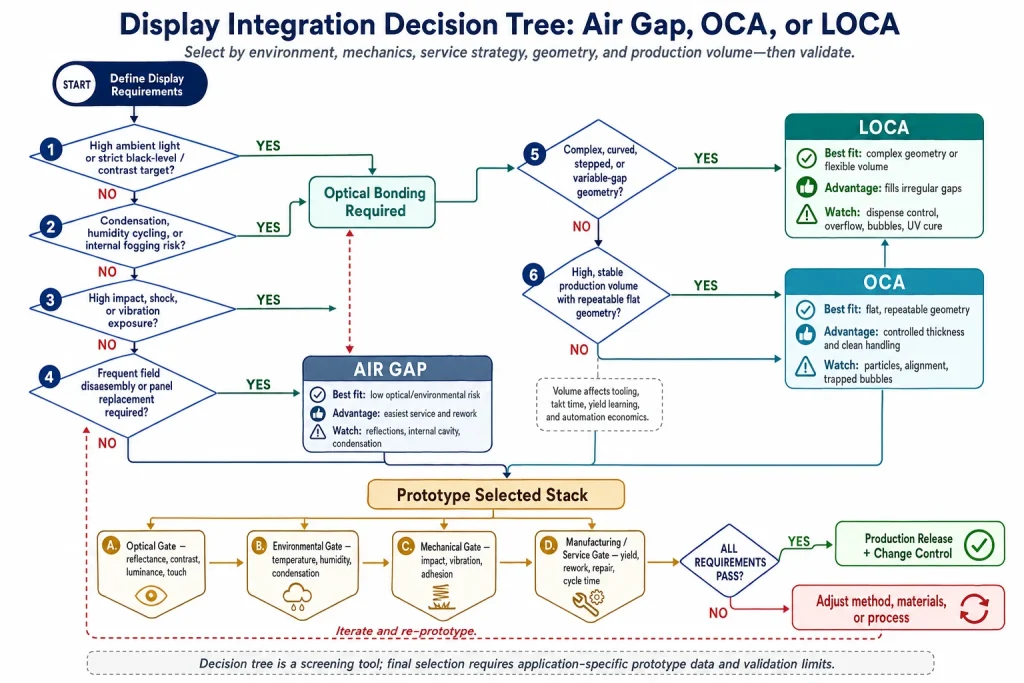
Convert the environment into pass/fail requirements. This avoids over-specifying a clean indoor HMI or under-specifying an outdoor touchscreen.
- Map ambient light, viewing angle, temperature ramp, humidity, washdown, dust, vibration, impact, cleaning chemistry, service access, and planned lifetime.
- Build two production-intent samples with the same LCD, brightness, touch controller, cover glass, coating, and enclosure: air bonded and optically bonded.
- Measure full-stack transmittance, haze, reflectance, black-state ambient contrast, touch accuracy, and optical uniformity before environmental testing.
- Run thermal change, humidity/dew, shock, vibration, impact, UV, cleaning, and powered-operation tests at application-specific severities.
- Inspect bubbles, delamination, yellowing, mura, touch drift, cracks, fog, seal failure, and enclosure-induced stress; then update the lifecycle cost model with observed yield.
As a production example, Kadi Display’s 8.0-inch 1200 x 1920 MIPI touch display with OCA optical bonding specifies 650 cd/m² typical brightness, -20°C to 70°C operation, and wide-view IPS performance. It illustrates a useful system point: bonding, luminance, touch, viewing angle, and interface must be selected together.
FAQ: Optical Bonding vs Air Bonding
Does optical bonding increase display light transmission?
It removes a reflective air interface, improving usable contrast. Measure the finished stack because glass, ITO, polarizers, coatings, and contamination also contribute.
Is OCA better than LOCA for industrial touchscreens?
OCA suits flat, repeatable stacks; LOCA fills gaps, steps, and irregular geometry. Supplier process maturity matters more than the label.
Can optical bonding stop condensation?
It removes the bonded-interface cavity. It does not stop exterior dew or moisture elsewhere; verify sealing and cross the dew point during testing.
Is an optically bonded touchscreen explosion-proof?
No. Bonding may support the lens and retain fragments, but impact, IK, hazardous-location, and explosion-protection claims require the applicable complete-product design, certification, and tests.
Why is air bonding easier to repair?
Perimeter adhesive is easier to separate without peeling the LCD polarizer. A fully bonded stack may require module-level replacement.
What should a touch screen bonding process specification contain?
Define drawings, adhesive and bond line, cleanliness, alignment, process window, cure/autoclave record, inspection, optical/touch tests, rework limits, reliability, and traceability.
Engineering source notes
Optics and materials: IEEE Fresnel reflection overview; 3M OCA 8146-X data sheet; Arkema Sartomer LOCA resource.
Test frameworks: IEC 60068-2-78:2025 damp heat; IEC 60068-2-14:2023 temperature change; IEC 60068-2-27 shock; IEC 60068-2-6 vibration; IEC 62262 IK code.
Product Reference & Engineering Support – Kadi Display supports touch modules, cover-glass customization, OCA/LOCA evaluation, surface treatments, brightness tuning, pilot builds, and production qualification. Visit kadidisplay.com/product or contact Sales@sz-kadi.com with the display size, environment, volume, cover drawing, and target tests.
Explore industrial TFT LCD touch display modules or the Kadi Display product catalog.
Disclaimer: Optical, cost, yield, return-rate, and reliability values in this guide are representative ranges, cited material data, or explicitly labeled planning assumptions. They are not specifications, guarantees, legal advice, safety certification, or compliance approval. Verify the complete display stack against current datasheets, application tests, samples, and standards. Third-party trademarks belong to their respective owners.
Précédent
Industrial Display Stack-Up Design: Integrating LCD, Touch, PCB, FPC, and Enclosure
Suivant
ESP32-S3 RGB LCD + LVGL: PSRAM, Buffers, and Tearing Control
Laisser un commentaire

Derniers blogs et nouvelles
- MIPI DSI Display Driver Development for Embedded Linux What Hardware Buyers Need to Confirm
- Why Outdoor LCDs Fog Inside: Condensation, Sealing, Vents, and Heaters
- IP65 vs IP67 Industrial Displays: What the Rating Actually Covers
- How to Specify a Touchscreen for Food-Processing Equipment
- Thermal Management for High Brightness LCDs in Sealed Outdoor Enclosures