
Casa
-
Blog & Notizie
-
Industrial LCD EOL: What Happens from Pre-Announcement to Replacement Mass Production?
Industrial LCD EOL: What Happens from Pre-Announcement to Replacement Mass Production?
2026-10-23
12:04
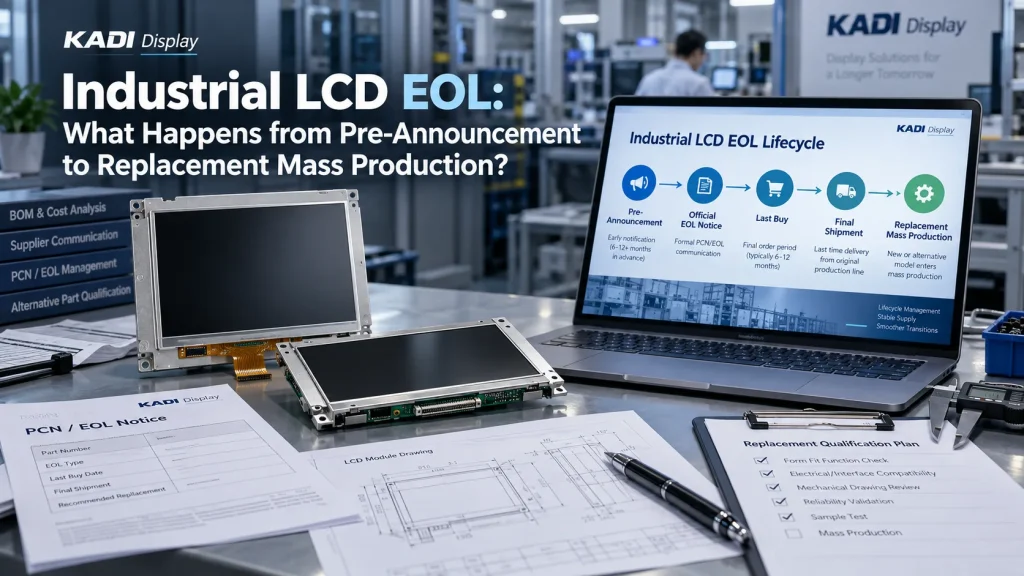
An industrial LCD EOL normally unfolds as a managed transition rather than a single stop date. The sequence may include an early warning, an official end-of-life notice, a last-buy period, final shipments, replacement qualification, a controlled running change, and mass production of the approved successor.
For an OEM, each phase creates a different decision. Purchasing must quantify remaining demand. Engineering must determine whether the proposed display works in the released product. Manufacturing must prevent old and new configurations from becoming mixed or untraceable. Dates vary by model and project, so the written notice and project agreement remain the governing documents.
Why an industrial LCD reaches EOL
An LCD module depends on more than the visible panel. Its supply may rely on glass, driver ICs, timing devices, backlight components, connectors, touch electronics, custom FPCs, and assembly materials. A critical item can become unavailable even when customers still want the finished module. Demand may also fall below the level required to keep a production line active.
EOL therefore describes a supply status, not a field failure. Installed displays may continue to operate, while the original orderable configuration becomes difficult or impossible to manufacture. The OEM’s task is to protect production and service demand while moving toward a controlled successor.
Phase 1: EOL pre-announcement
A pre-announcement gives the OEM time to investigate before the formal purchase clock begins. KADI Display generally uses an EOL pre-announcement about three months before the official notice for affected industrial display products. During this period, the customer and supplier can discuss replacement candidates and identify the information needed for a decision. Actual timing depends on the product and project confirmation.
The OEM should first confirm the complete affected configuration. That includes the LCD model and suffix, drawing revision, touch option, cover glass, bonding stack, cable or FPC, controller board, firmware, and any approved deviations. A notice for one component may affect several finished display assemblies, while a notice for a panel does not automatically apply to every related product.
Demand planning should begin at the same time. Record inventory, open orders, annual usage, service obligations, expected product retirement, and forecast uncertainty. Engineering should obtain the proposed replacement datasheet and drawings early enough to identify obvious mechanical, electrical, optical, touch, or software differences.
Phase 2: The official EOL notice
The official EOL notice should turn an early investigation into a dated project. Confirm the affected part, last order date, last shipment date, minimum order conditions, cancellation rules, and any restrictions on order changes. Also determine whether the notice covers the full module, an internal component, or a specific customized configuration.
Assign one owner for the transition record and name decision owners in engineering, purchasing, quality, manufacturing, and service. Connect every important date to an action and show which assumptions still need confirmation. An email without a product mapping or owner does little to protect the build schedule.
At this point, the OEM usually evaluates two paths in parallel: purchase enough of the old configuration to cover remaining demand, or qualify a replacement before the old supply ends. Many programs use a limited last-time buy as a bridge while engineering validates the successor.
Phase 3: Last-buy and replacement evaluation
For affected projects, the stated process generally provides a last-buy window of about six months after the official EOL notice. During this period, the replacement model can be evaluated and approved while the OEM decides how much of the original display to purchase. This period may vary, and the confirmed notice dates should control the plan.
A last-time-buy quantity should cover more than the next production forecast. Include service stock, expected yield loss, forecast error, storage limits, retirement plans, and the risk that demand continues longer than expected. Too little stock can interrupt production. Too much ties up cash and may leave aging inventory.
Replacement qualification should start with the released system requirements. Compare module outline, active area, mounting points, connector position, pinout, voltage rails, power sequence, display timing, backlight drive, optical limits, touch behavior, firmware support, and environmental conditions. KADI’s industrial LCD replacement checklist provides a detailed method for recording these old-to-new differences and the evidence needed before release.
Interface names alone cannot establish compatibility. Two modules labeled LVDS or MIPI DSI may use different mapping, timing, initialization, lane configuration, voltage, or backlight control. The guide to display interface conversion limits explains why a bridge, cable, or adapter cannot correct every mismatch.
Phase 4: Final shipments and the running change
After the last-buy deadline, production of the original display may continue only long enough to complete accepted orders. For affected KADI Display projects, final shipments may generally occur about three to five months after the last-buy deadline. The schedule remains subject to material availability, the specific notice, and project confirmation.
Use this interval to close qualification items and prepare the production change. Confirm which orders receive the old model, which receive the successor, and whether mixed deliveries are possible. Define labeling, incoming inspection, lot traceability, storage separation, work instructions, firmware selection, and service identification before the first new unit enters production.
Phase 5: Replacement mass production
Mass production begins only after the replacement configuration has passed the agreed approval process. A sample that displays an image on a bench does not prove production readiness. The released package should identify the exact display revision, drawings, cable or FPC, controller settings, software or initialization files, inspection criteria, test limits, and approved host configuration.
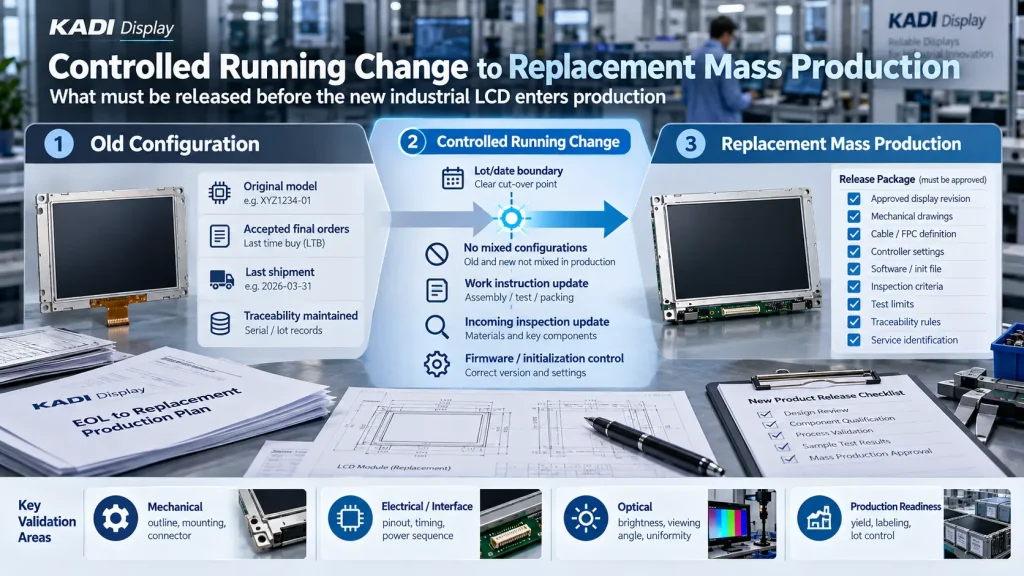
A running change may move directly from the old configuration to the new one, or the two may overlap for a controlled period. Manufacturing needs a clear date or lot boundary. Purchasing needs separate orderable identities. Quality needs evidence that inspection and end-of-line tests can detect the wrong configuration. Service teams need to know whether the replacement fits earlier equipment and which supporting parts or instructions apply.
Early production should use controlled lots and recorded results. Review assembly yield, boot behavior, image stability, touch performance, optical acceptance, and failures that appear only in the final enclosure. Any approved deviation should name its scope and authority rather than becoming an undocumented production habit.
What the OEM should ask the display supplier
A useful EOL response should provide dates, affected identities, order conditions, and a replacement path. Ask how the supplier controls revisions, communicates product changes, manages customized items, and supports samples and qualification evidence. Confirm whether the proposed successor is a true drop-in candidate or requires a cable, controller, firmware, mechanical, or touch change.
KADI Display aims to support industrial display products for five to eight years, subject to the selected configuration, volume plan, and application. Its industrial display product range can be combined with project-specific support for touch and cover glass integration, optical bonding, FPC or cable customization, controller adaptation, mechanical coordination, and sample verification. The exact lifecycle and support scope should be confirmed for each project.
Conclusione
An industrial LCD EOL transition has five practical phases: pre-announcement, official notice, last-buy and evaluation, final shipment, and replacement mass production. Early work establishes the affected configuration and demand. The official notice fixes the decision dates. The last-buy period protects near-term supply while engineering qualifies the successor. Final shipments create the boundary for a controlled change, and mass production begins with a released, traceable configuration.
Domande frequenti
Does an EOL notice mean the LCD stops shipping immediately?
Usually not. The notice should state the last order and shipment dates. Available time depends on the product, remaining materials, accepted orders, and supplier terms.
What is the difference between last buy and last shipment?
The last-buy date is the deadline for placing an eligible final order. The last-shipment date is when the supplier expects to complete delivery of accepted orders.
Can a replacement LCD enter production before the old model is exhausted?
Yes, if the OEM approves a controlled running change. The release should define the effective lot or date, configuration identity, inspection method, software needs, and service rules.
How long can an industrial display remain available?
KADI Display aims for five to eight years of long-term supply support. The applicable period and EOL schedule depend on the selected display, customization, demand, and project agreement.
For an EOL timeline review or replacement fit check, contact KADI’s technical team with the current part number, drawings, host interface, annual demand, remaining program life, service requirement, and operating environment.
PREVIDENTE
Non più
Prossimo
Electronic Component Obsolescence Management for Industrial Displays: An OEM Guide
Lascia un commento

Ultimi Blog & Notizie
- Industrial LCD EOL: What Happens from Pre-Announcement to Replacement Mass Production?
- Electronic Component Obsolescence Management for Industrial Displays: An OEM Guide
- How to Develop a Production Ready Custom Display Assembly TFT Module Touch Cover Glass FPC Bonding and Mounting
- 15 Pin vs 22 Pin Raspberry Pi DSI Connectors Cable Pinout and Compatibility
- Native MIPI DSI vs LVDS or HDMI Bridge: An OEM Display Architecture Decision Guide
Blog & Notizie correlate
-
 TN contro IPS2024-7-9
-
TN contro IPS2024-7-9