
Casa
-
Blog & Notizie
-
How to Build Supply Chain Resilience for Long-Lifecycle Industrial Display Projects
How to Build Supply Chain Resilience for Long-Lifecycle Industrial Display Projects
2026-11-05
12:10

An industrial display can remain in a machine, medical instrument, kiosk, or embedded platform for years after design release. During that time, panels, controllers, materials, and processing sites may change. Supply chain resilience is not the promise that nothing will change. It is the ability to detect change early, protect approved production, qualify a controlled response, and recover without losing configuration control.
That approach matches the broader resilience principles of visibility, flexibility, buffers, and collaboration described by the Association for Supply Chain Management. For an OEM display project, however, those principles must be translated into drawings, BOM ownership, forecasts, notice rules, samples, validation evidence, and release decisions.
Map the Display Supply Chain as an Assembly
Do not assess resilience at the panel part-number level alone. The orderable display may include a TFT LCD cell, backlight unit, driver ICs, polarizers, FPC, touch sensor, touch controller, cover glass, bonding material, controller board, cables, firmware, and mechanical parts. A disruption in any controlled element can stop shipment or alter final-system behavior.
Create an assembly map identifying each controlled item, manufacturer or site, change-communication owner, single-source dependency, lead-time context, and alternate. Link drawings, specifications, firmware IDs, approved-vendor lists, test reports, and golden-sample references. This working record shows where change could enter and who must act.
Prioritize dependencies by consequence. A replaceable standard cable does not carry the same risk as a panel whose outline, timing, optics, or power sequence affects the whole product.
Design for Controlled Flexibility Before Sourcing
Resilience begins with the product architecture. Define which characteristics are hard stops and which can be adapted. Mechanical envelope, active area, interface, native timing, voltage rails, initialization, backlight control, optical performance, touch behavior, and environmental limits normally need explicit boundaries. Connector position, cable routing, mounting datums, and firmware ownership can be just as important as the headline display size and resolution.
Where practical, use stable interfaces, separable cables or adapter boards, and software settings that allow a qualified alternate without redesigning the host. Preserve customization where it creates value and an engineered migration path elsewhere. KADI’s customized display solutions can include touch, cover glass, bonding, FPC or cable, interface adaptation, controller-board support, and mechanical coordination, with scope confirmed for the project.
Give suppliers a controlled requirements package rather than a feature list. An industrial display RFQ checklist should define the purchased assembly, mission profile, host platform, volume range, program duration, evidence required, lifecycle expectations, and approval process. This makes a second source or replacement comparable to the released baseline instead of merely similar on paper.
Establish Supplier Governance and Early-Warning Triggers
A supply chain resilience strategy needs operating rules after supplier selection. Agree which changes require a product change notification, the minimum information expected, where notices are sent, and whether written approval is required before implementation. Include manufacturing-site changes, material substitutions, IC or firmware revisions, process changes, discontinuance, and changes to approved alternates where relevant.
Pair change control with a forecast cadence. Share rolling demand assumptions and flag major changes, pilot builds, service demand, and seasonal peaks. A forecast is not automatically a purchase commitment or capacity reservation; the agreement must state what it does. Review orders, lead-time movement, constrained subcomponents, allocation, and lifecycle signals according to risk.
Use objective triggers: incomplete change evidence, lead time beyond the protected demand window, repeated delivery misses, allocation, site loss, unapproved lot identity, or EOL. Give each trigger an owner, deadline, and response such as capacity confirmation, buffer review, alternate sampling, or replacement qualification.
Use Inventory to Buy Time, Not to Replace Engineering
Safety stock, finished-goods buffers, and bridge buys can absorb short disruptions only when tied to risk and consumption. Calculate the protected demand window from usage, lead time, forecast error, service obligations, and recovery qualification time. Segment inventory by exact configuration and revision.
Long storage creates obligations for packaging, environment, inspection, shelf life, and functional retest. A last-time buy should follow a documented comparison of remaining demand, carrying risk, cash exposure, scrap allowance, and replacement qualification cost. It is a bridge decision, not a complete resilience plan.
Prequalify the Recovery Path Before a Shortage
For high-consequence dependencies, identify the recovery route while the released product remains available. It may be an approved alternate, an adapter-based configuration, a form-fit-function replacement, or a planned redesign. Record what is proven and what requires revalidation; “drop-in” never substitutes for evidence.
Create a production-intent baseline containing the approved part number and revision, drawings, BOM and approved sources, firmware or configuration identifiers, host settings, cables, optical stack, golden samples, and acceptance results. That baseline lets engineering compare a candidate against the product that actually passed, not against an incomplete datasheet.
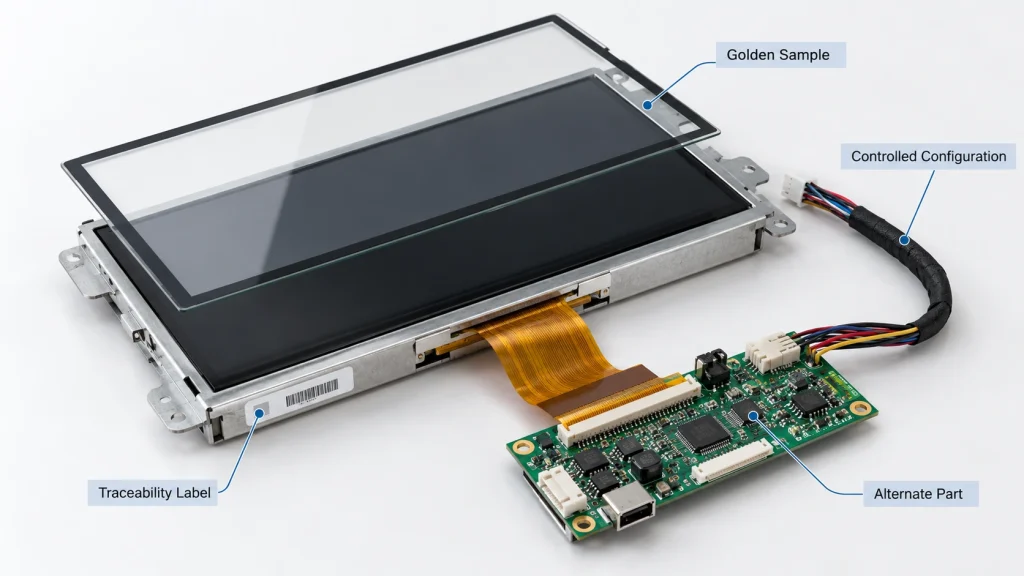
Use a risk-based form-fit-function matrix covering mechanical, electrical, optical, touch, thermal, environmental, software, cosmetic, and final-equipment checks as applicable. The industrial LCD drop-in replacement checklist provides a practical starting point. Release only the configuration represented by the evidence.
Measure Readiness, Not Just On-Time Delivery
On-time delivery is a lagging indicator. Measure how quickly the team can see, decide, and recover:
- Time to detect:interval between a supplier event and the OEM receiving actionable information.
- Time to decide:interval from a complete notice to an approved commercial and technical path.
- Time to qualify:duration from candidate identification to documented release.
- Protected demand window:confirmed supply plus usable controlled inventory expressed as time at an agreed demand scenario.
- Traceability coverage:proportion of shipments that can be tied to the approved configuration, lot, date code, and change history.
- Recovery readiness:status of alternate identification, sample availability, validation planning, tooling, firmware, and capacity confirmation.
Review these measures at assembly level. A green delivery dashboard can conceal a single-source controller or untested substitute, while a known risk with an owner, buffer, candidate, and scheduled validation may be manageable.
Build a Project-Specific Continuity Plan with KADI
KADI Display positions itself as an industrial display manufacturer and custom display solution provider. Depending on the project, support can include display selection, touch and cover integration, bonding, FPC or cable customization, interface or controller-board adaptation, mechanical coordination, sample verification, and long-term supply planning. Scope and commitments still require project-specific confirmation.
KADI’s supplied lifecycle reference describes a 5–8-year support objective for suitable industrial display projects and an illustrative EOL sequence: discussion and replacement selection may begin about three months before an official notice; a last-buy window may remain open for about six months after the notice; and final shipment plus running change or new-model mass production may follow roughly three to five months after the last-buy deadline. Treat this as a planning framework, not a universal guarantee. The actual dates and obligations must be written into the project record.
For a new or existing program, use KADI’s engineering contact page to submit the assembly definition, host and interface details, drawings, environmental conditions, demand profile, program duration, current risks, and evidence required. A useful response should separate confirmed facts, assumptions, open items, proposed controls, and customer-owned validation.
Conclusione
Supply chain resilience for long-lifecycle industrial displays is built before the shortage. Map the assembly, design controlled flexibility, make supplier warnings actionable, size inventory as a time buffer, prequalify recovery paths, and measure readiness. The goal is not to freeze the supply chain. It is to ensure each change reaches production through an evidence-based decision.
Domande frequenti
What is the biggest supply risk in an industrial display project?
It is usually an unmanaged dependency: an item, site, firmware, material, or process that can change without enough visibility or qualification time.
Is dual sourcing always the best resilience strategy?
No. A true second source must be technically and commercially viable. For some custom assemblies, a controlled replacement path, shared tooling strategy, or adapter-based architecture is more realistic than maintaining two interchangeable suppliers.
How much safety stock should an OEM hold?
There is no universal quantity. Base it on demand scenarios, lead time, forecast error, service obligations, supplier risk, storage controls, and the time required to qualify and release an alternate.
Does a long-term supply target guarantee that the same LCD will never change?
No. Long-term support is project-specific, and components, processes, or sites may change. The practical protection is an agreed notification, traceability, validation, inventory, and replacement process tied to the approved configuration.
PREVIDENTE
Non più
Prossimo
Last-Time Buy or LCD Replacement? A Decision Framework for Long-Lifecycle Display Projects
Lascia un commento

Ultimi Blog & Notizie
- How to Build Supply Chain Resilience for Long-Lifecycle Industrial Display Projects
- Last-Time Buy or LCD Replacement? A Decision Framework for Long-Lifecycle Display Projects
- How to Control TFT LCD Revisions After Replacement Approval: Golden Samples, PCNs, Lot Traceability, and Incoming Inspection
- Industrial LCD EOL: What Happens from Pre-Announcement to Replacement Mass Production?
- Electronic Component Obsolescence Management for Industrial Displays: An OEM Guide
Blog & Notizie correlate
-
 TN contro IPS2024-7-9
-
TN contro IPS2024-7-9