
Industrial Display RFQ Checklist: Build a Supplier-Ready Evidence Package
2026-09-15
10:27
Industrial Display RFQ Checklist: Build a Supplier-Ready Evidence Package
Define the Assembly You Are Buying
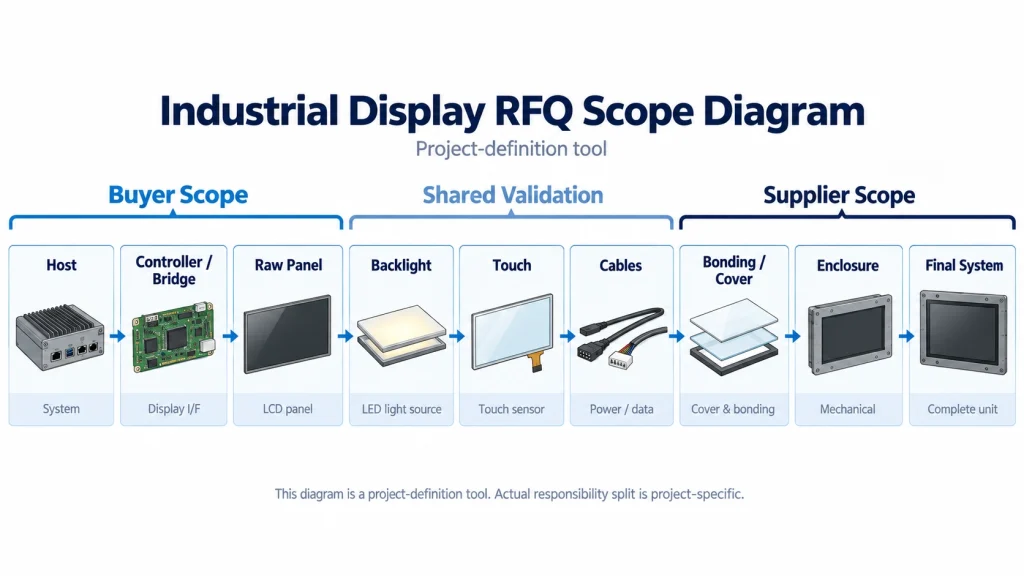
SCOPE & NON-CLAIM Begin the RFQ with one sentence that defines the purchasable assembly: raw TFT panel; panel plus touch; bonded display stack; panel with controller board and cables; or complete monitor/housing. Name who owns the host, interface conversion, backlight drive, touch integration, enclosure, software, regulatory approval and final-system validation. Without this boundary, two suppliers can quote different products against the same words.
Define the Deliverable Before Listing Display Specifications
Many quotation delays begin with an ambiguous noun. “LCD,” “touchscreen,” and “HDMI display” can describe very different supply boundaries. A bare TFT panel needs host timing, power, backlight drive, and a compatible interconnect. A display-touch assembly adds sensor, controller, cover, bonding, and touch firmware. An HDMI display generally includes a controller board between the video source and the raw panel. A monitor or open-frame assembly may also include housing, keys, speakers, power conversion, and mounting hardware.
Use the first page of the RFQ to establish that boundary. Suppliers can then price the same object and identify customer-owned items without burying assumptions in email.
If the delivery level is still open, request separate options rather than one blended price. KadiDisplay’s industrial TFT LCD selection guide can help convert the application into a realistic shortlist before the supplier is asked to optimize a quotation.
Build a One-Page RFQ Cover Sheet
The cover sheet should let a supplier decide who must review the request and which questions block a meaningful quote. Keep it short, but make the configuration identifiable.
Identify which numbers are requirements and which are planning assumptions. “1,000 nit” may be a true measured need, a customer phrase, or an early placeholder. State the lighting condition and readability objective so the supplier can propose brightness, surface treatment, bonding, thermal, and power options without treating one number as the whole optical design.
Use Requirements That Can Be Answered
Supplier comparison needs conditions, limits, evidence and ownership—not adjectives that each bidder can interpret differently.
Use a Requirement-and-Evidence Matrix, Not a Feature Wish List
For every requirement, add status, source, tolerance or condition, priority, supplier response, proposed part/configuration, evidence reference, deviation, and owner. That structure lets engineering and purchasing see where a low price depends on an unstated change.
Application and optical requirements
Describe users, viewing distance, orientation, content, ambient lighting, direct-sun exposure, night use, camera interaction, required viewing direction, and whether polarized eyewear matters. Ask for the measurement method and conditions behind luminance, uniformity, contrast, color, viewing, response, and surface-treatment claims. Do not compare values measured under different methods as though they were equivalent.
State whether cover glass, black mask, AG/AR/AF treatment, air bonding, optical bonding, or a sealed front is part of the quoted stack. If the requirement exceeds a catalog configuration, route it explicitly through the KadiDisplay customized display category and ask which drawings, materials, tooling, samples, and validation remain project-specific.
Electrical, interface, and software requirements
Name the host output and role, not merely the connector. Record interface version where known, lanes or channels, link rates, native timing, color format and depth, mapping, synchronization, voltage domains, rails, current, reset, standby, and power sequence. For controller-board requests, include accepted source modes, EDID behavior, scaling/aspect policy, latency sensitivity, firmware update/recovery, OSD, keys, backlight control, touch path, and required cables.
Mark unknown items. A supplier may need the host schematic, timing export, panel profile, or source EDID to close them. If the project is still comparing architectures, ask for a standard module and a controller-based option separately; do not assume HDMI, LVDS, eDP, MIPI DSI, and RGB are interchangeable labels.
Touch and human-interface requirements
Specify touch technology, interface, operating system, number of contacts only if required, coordinate orientation, glove or stylus use, water/contaminant conditions, cover thickness, edge treatment, cosmetic mask, bonding, palm or false-touch concerns, and service method. Request the controller and firmware identity for the quoted stack. Touch performance must be validated after cover, bonding, display noise, chassis ground, cable routing, and enclosure are finalized.
Mechanical and interconnect requirements
Attach a controlled envelope drawing or CAD export. Distinguish module outline, active area, viewing area, touch active area, cover outline, bezel opening, thickness, local protrusions, connector envelope, mounting datums, keep-outs, cable exits, and service access. Do not design from nominal values alone.
Use KadiDisplay’s industrial display stack-up guide when defining the front-to-back assembly. It helps identify requirements for gasket compression, no-pressure zones, FPC routing, bracket flatness, grounding, heat paths, and assembly sequence that a panel outline cannot express.
Environment, quality, compliance, and lifecycle
Translate the use case into a mission profile: powered and storage temperatures, humidity, condensation, thermal transitions, shock, vibration, UV, chemicals, ingress, cleaning, ESD/EMC context, duty cycle, and service life. Ask which evidence applies to the exact quoted configuration and which tests remain the equipment manufacturer’s responsibility.
For quality, request cosmetic zones and inspection conditions, pixel-defect agreement, dimensional controls, traceability fields, firmware control, golden references, change-notification process, deviation handling, packaging, incoming checks, and corrective-action contact. Do not insert an AQL or defect limit unless it belongs to the applicable contract or standard edition.
For supply, request full orderable part identity, current status, approved substitutions, forecast expectations, MOQ and lead-time context, lifecycle policy, PCN/EOL terms, last-time-buy process, second-source strategy, and record retention. Dates, quantities, pricing, tooling, and capacity belong to the quotation; they are not timeless product facts.
Force a Structured Supplier Response
A response schema makes every deviation, assumption and unavailable fact visible before price comparison begins.
Require the Supplier to Return a Structured Response
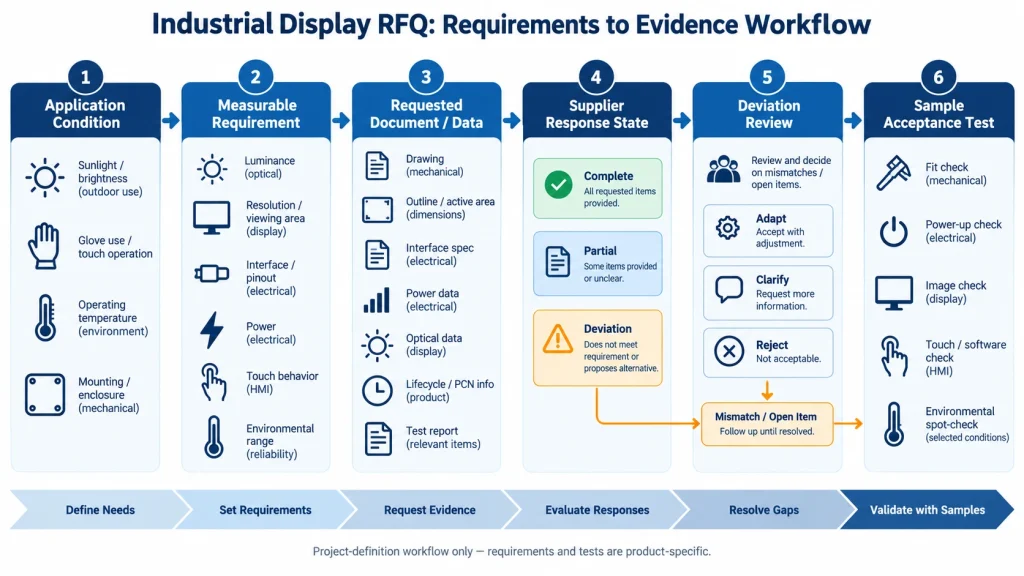
A supplier response should be easy to compare across candidates. Ask the supplier to repeat each mandatory requirement, state comply/deviation/unknown, identify the exact proposed configuration, and link the answer to a controlled document or planned test. A blank cell is not acceptance.
Ask suppliers to identify whether a number is typical, guaranteed, measured, simulated, or proposed. Also ask whether evidence belongs to the exact stack or only to a component. A touch-controller ESD rating, for example, is not a final-system ESD result.
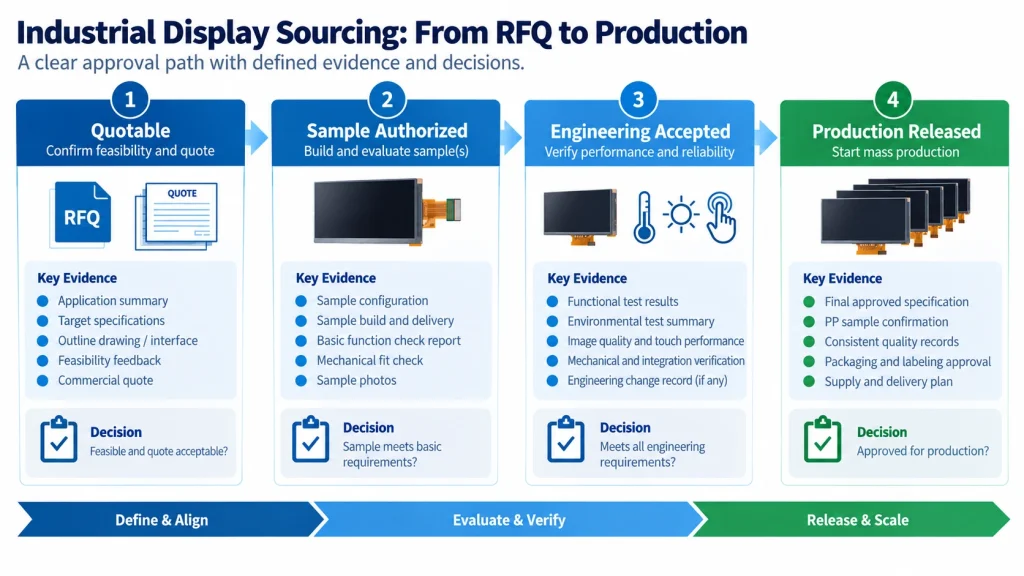
Separate Quote, Sample and Production Approval
Quotation, sample authorization, engineering acceptance and production release are different states with different evidence burdens.
Separate Quotation, Sample Approval, and Production Release
Treat the RFQ as the first controlled artifact in a chain. The quotation defines scope, price context, assumptions, exclusions, and proposed configuration. Sample approval confirms only the tests and sample identities recorded. The purchase specification and approved BOM define what production may supply.
Do not let a successful sample silently become the specification. Capture every approved drawing, firmware hash, timing file, cable, cover stack, measurement method, exception, and limit. Compare the production quotation against that package before the first purchase order.
Issue the RFQ as a Controlled Package
The issued RFQ and returned exceptions must remain one controlled commercial-technical record.
Control Deviations, Options, and Commercial Assumptions
An RFQ is most useful when it allows alternatives without allowing silent interpretation. Ask the supplier to repeat each requirement as complies, deviates, not offered, or requires clarification, and to cite the supporting document or proposed test. Blank cells should remain open actions rather than being treated as acceptance.
Require prices to identify what is included: LCD, touch sensor, cover lens, bonding, controller/bridge board, backlight driver, cable/FPC, firmware or tuning, tooling, fixtures, qualification, packing, certifications and engineering work. Separate nonrecurring engineering or tooling from unit pricing. State quantity breaks, currency/incoterm assumptions where relevant, sample and mass-production lead-time definitions, minimum order or lot conditions, quotation validity, and whether forecasts reserve capacity. These terms are project-specific; the article should not imply one universal commercial model.
When several configurations are proposed, give each a unique option code and complete BOM-level description. “Standard,” “high brightness,” or “custom touch” is not enough to compare later samples with the quotation. Tie every sample label, drawing, firmware file and test record to that option code.
The RFQ should also define change communication before purchase: the identity fields expected on product and packing, lot/date traceability, notice scope, evidence supplied with a change, sample availability, lifecycle-status communication, and whether written approval is required. These clauses do not guarantee uninterrupted supply, but they make ownership and escalation visible.
Before award, hold a requirement-closeout review. Read every deviation and assumption, identify which numbers are guaranteed versus typical, confirm whether environmental and optical values apply to the module or complete bonded assembly, and list validation still owned by the buyer. A lower price based on an unpriced cable, missing touch tuning, or unconfirmed temperature grade is not a comparable quotation.
Give the supplier the intended verification method wherever a requirement can be interpreted several ways. Brightness, contrast, color, uniformity, reflectance, touch performance, power, startup time, dimensional datum and cosmetic limits depend on conditions and methods. State the measurement geometry, ambient state, warm-up, test pattern, instrument class, sample state and acceptance rule at the level justified by risk. If the method is not yet fixed, ask the supplier to propose one and flag it for agreement before qualification.
Use priorities deliberately. Mark true hard stops separately from targets and preferences, but do not label everything “mandatory.” A transparent hierarchy lets the supplier propose a lower-risk standard option where customization adds little value, while preserving the requirements that protect fit, safety, usability and service. Record who can approve a deviation; informal acceptance during a call should not silently rewrite the RFQ.
Return every approved clarification to the controlled requirements matrix before quotation comparison.
RELEASE GATE Send the RFQ only when the cover sheet names the assembly boundary, requirement matrix, drawings and host details; the supplier response template exposes deviations; sample and production gates are separate; and every attachment has a revision. Archive the issued package and all clarifications so the final purchase specification can be traced to the quotation that was evaluated.
KadiDisplay can review the package through its engineering contact page. Include drawings, host/interface details, touch and cover requirements, environmental context, target quantities, schedule and required evidence; pricing, availability and lifecycle commitments require a current project-specific response.
Primary Sources
- Microsoft display-device design guidance
- VESA overview of DisplayPort and embedded-display context
- Texas Instruments product change notification process
ENGINEERING DISCLAIMER This article is an RFQ authoring aid. It is not a supplier quotation, a purchase specification, a universal sampling plan, or evidence that a module or final product is certified for an application. Before award, project owners must agree the purchased assembly, guaranteed versus typical values, measurement conditions, deviations, sample plan, commercial terms, change-notice rights, and production acceptance evidence. Do not treat an attractive response or a working sample as authorization to release an unresolved configuration.
PRIVENTE
Não mais
NEXTO
Industrial LCD Drop-In Replacement Checklist: From Hard Stops to Release Evidence
Deixe um comentário

Recent Blog & News
- Industrial Display RFQ Checklist: Build a Supplier-Ready Evidence Package
- Industrial LCD Drop-In Replacement Checklist: From Hard Stops to Release Evidence
- MIPI DSI in Industrial LCD Displays: What Engineers Should Know
- MIPI DSI vs LVDS vs RGB vs eDP: Which Interface Is Best for Industrial Displays?
- PCAP Touch Works on the Bench but Fails After Metal Enclosure Assembly: An Isolation Checklist