
Home
-
Blog & News
-
From MiniLED to MicroLED: The Evolution Path of High-Brightness Industrial Displays
From MiniLED to MicroLED: The Evolution Path of High-Brightness Industrial Displays
2026-06-12
11:18
From MiniLED to MicroLED: The Evolution Path of High-Brightness Industrial Displays
Choosing correctly among 400 nits, 1000 nits, and 2000 nits — and understanding what comes next for high-brightness LCD, MiniLED, and MicroLED technology in rugged outdoor HMI applications
By Kadi Display Technical Team | www.kadidisplay.com
Why High Brightness Is Entering a New Technology Cycle
For many industrial display projects, brightness has been treated as a simple specification line: 400 nits for indoor use, 1000 nits for sunlight-readable equipment, and 2000 nits for difficult outdoor environments. That shorthand is useful, but it hides a much larger transition happening behind the LCD panel. The next question is no longer only how bright the screen can become. The better question is how that brightness is produced, controlled, cooled, and maintained across a seven-to-ten-year industrial product life.
Traditional LED-backlit TFT LCD remains the practical foundation of most industrial HMI displays. It is mature, cost-stable, widely available in 4.3-inch to 21.5-inch sizes, and easy to integrate with LVDS, eDP, RGB, HDMI, or MIPI DSI interfaces. For 400 nits indoor panels and many 1000 nits outdoor-capable modules, conventional edge-lit or direct-lit LED backlights still make economic sense. The design problem becomes harder at 1500 nits and 2000 nits, where heat density, backlight uniformity, optical film stress, LED lifetime, and sealed-enclosure temperature all become limiting factors.
MiniLED and MicroLED enter the discussion because both promise a different way to think about high brightness. MiniLED keeps the LCD architecture but replaces the coarse LED backlight with many smaller LEDs and more controllable dimming zones. MicroLED goes further: every pixel emits its own light, eliminating the LCD cell and backlight entirely. In theory, MicroLED is the ultimate high-brightness display technology. In practice, it is still contending with cost, mass transfer, inspection, repair, and size-yield challenges before it becomes a normal choice for industrial display procurement.
The Present Baseline: 400 Nits, 1000 Nits, and 2000 Nits LCD
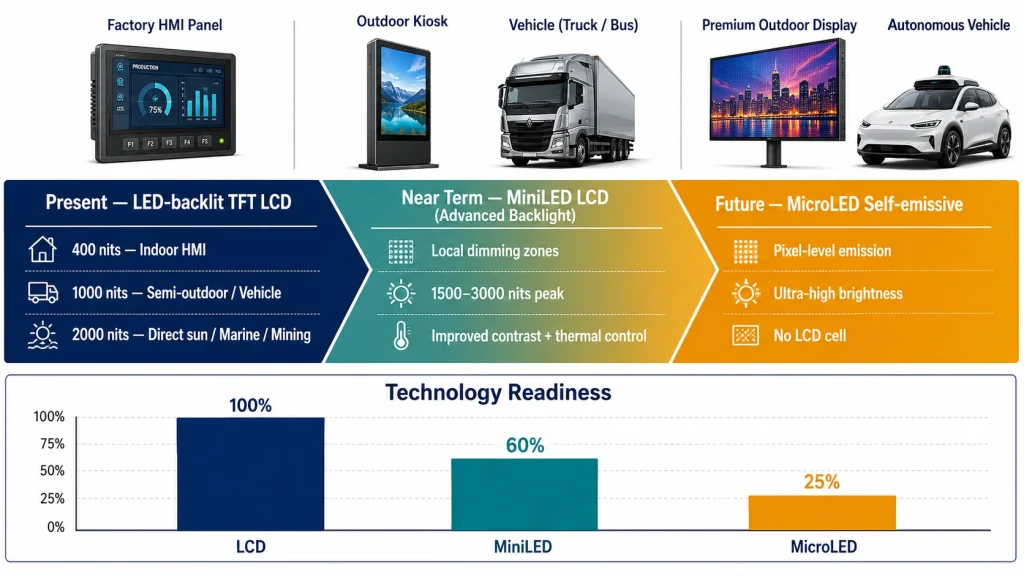
The current industrial display market is built around brightness tiers. Each tier represents not just a brightness level, but a different engineering zone with distinct design requirements, thermal challenges, and operator interaction contexts.
400 nits — Indoor Industrial Standard
Technology today: Standard LED-backlit TFT LCD
Main use environment: Indoor HMI, control rooms, embedded terminals, laboratory instruments, medical devices, rack-mount systems
Design risk: Over-brightness can cause operator eye fatigue during long shifts; calibrate brightness to ambient lux
Next technology pressure: Low — mature LCD remains best fit for this environment; MiniLED offers no advantage
1000 nits — Sunlight-Readable Threshold
Technology today: High-brightness LED LCD with AG/AR coating options
Main use environment: Agricultural vehicles, EV charging terminals, outdoor payment kiosks, marine consoles, shaded outdoor HMI
Design risk: Glare if surface reflection is not controlled — AG/AR treatment is mandatory; verify ECR under actual ambient lux
Next technology pressure: Moderate — MiniLED may improve efficiency and local dimming in UI-mixed applications
2000 nits — Extreme Outdoor / Safety-Critical
Technology today: Reinforced high-brightness LCD with optical bonding, adaptive dimming, and sealed enclosure
Main use environment: Direct sunlight, marine navigation, mining equipment, desert SCADA, outdoor surveillance, autonomous vehicle HMI
Design risk: Heat accumulation, backlight lifetime, optical film stress, enclosure temperature — requires full thermal engineering
Next technology pressure: High — MiniLED becomes attractive for thermal management; MicroLED is the long-term target
2000+ nits — Next-Generation Horizon
Technology today: MiniLED LCD / MicroLED self-emissive (early adoption)
Main use environment: Premium outdoor, mission-critical displays, autonomous vehicles, high-value rugged systems
Design risk: Cost, supply chain, repairability, production qualification, and integration complexity
Next technology pressure: Very high — technology adoption timeline depends on manufacturing cost and yield maturity
A 400 nits TFT LCD is the default answer for indoor industrial control panels, medical instruments, and embedded terminals. At this level, the design priority is not maximum luminance — it is stable color, long backlight life, moderate power, low heat, and operator comfort during long shifts. The 2000 nits category is where the display stops being just a panel and becomes a thermal-optical system. It requires optical bonding, anti-glare or anti-reflective cover glass, ambient light sensing, PWM or DC dimming, wide-temperature materials, and a housing that can remove heat. In other words, 2000 nits is not simply twice 1000 nits; it requires a fundamentally different engineering mindset.
MiniLED: An Evolutionary Upgrade, Not a Full Replacement
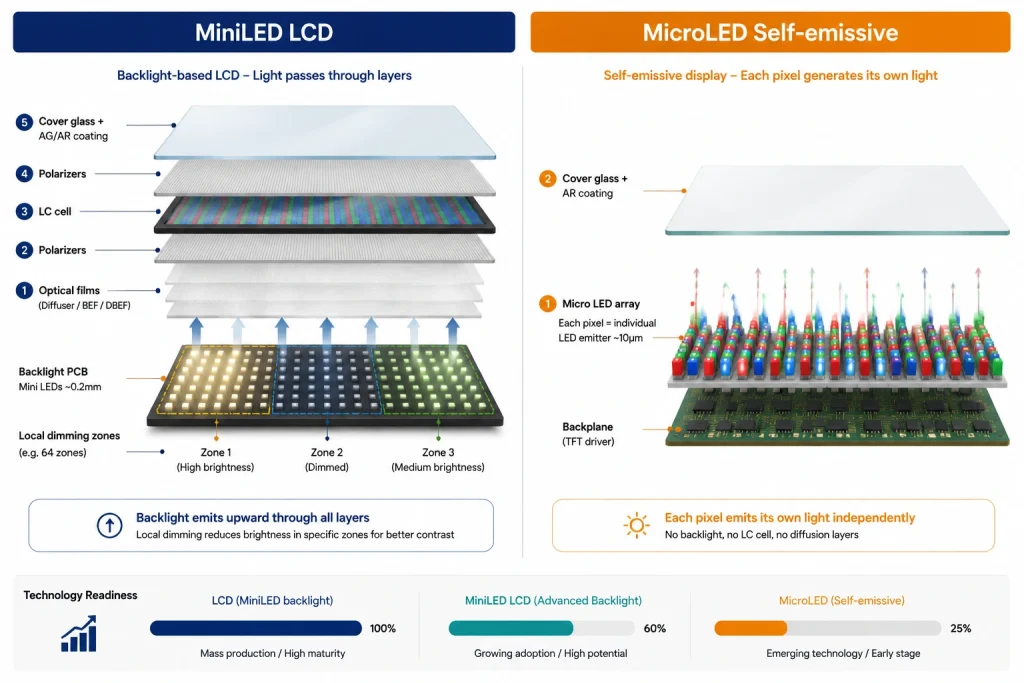
MiniLED is sometimes described as a new display type, but for industrial engineers it is better understood as an advanced LCD backlight. The image is still formed by a liquid crystal panel. The difference is that the backlight uses many smaller LEDs, grouped into independently controlled local dimming zones that can be driven at different brightness levels simultaneously.
This architecture has three practical advantages for high-brightness industrial displays. First, it can improve perceived contrast without asking the entire panel to run at maximum output — darker interface regions receive less backlight while critical alarm areas and bright map zones receive more. Second, it can reduce average power consumption in interfaces with dark backgrounds, night modes, or dashboards where only a fraction of the screen is bright at any moment. Third, it gives system designers a more flexible path to 1500 nits and 2000 nits peak brightness without forcing the whole backlight to behave as a single uniform light source.
MiniLED does not remove the usual outdoor display requirements. The LCD still needs optical bonding to reduce internal reflections. The front surface still needs AG or AR treatment. The system still needs thermal spreading and dimming control. What MiniLED changes is the granularity of brightness control — and in an industrial HMI that displays alarms, charts, camera feeds, and dark-mode interfaces simultaneously, this can reduce the average heat load even while preserving high peak brightness when required.
Why MiniLED Matters More at 2000 Nits Than at 400 Nits
At 400 nits, MiniLED is usually unnecessary for industrial projects. A standard LED backlight can provide adequate luminance with lower cost, simpler driver design, and lower thermal complexity. The display may run for years inside a machine cabinet or control panel without needing advanced local dimming. The customer is often buying supply stability and integration flexibility, not cinema-grade contrast control.
At 1000 nits, MiniLED begins to make sense for selected use cases. A vehicle dashboard, rugged tablet, marine console, or outdoor kiosk may benefit from better dimming control if the interface contains both bright warning zones and dark map areas. Still, conventional high-brightness LED LCD remains the mainstream choice because cost, availability, and proven reliability often matter more than local dimming precision in standard industrial procurement.
At 2000 nits, the argument becomes much stronger. A conventional 2000 nits LCD pushes the backlight hard across the entire screen at all times. If the UI is mostly dark — showing a map background, a night-mode dashboard, or a system status overview with black regions — the backlight still operates globally, wasting energy and generating heat that the enclosure must dissipate. A MiniLED design can reduce output in less critical regions while maintaining readable highlights and critical alarm areas at full brightness. This is why MiniLED is not only about better contrast; in rugged outdoor displays operating at sustained high brightness, it becomes a thermal-management strategy that can extend backlight lifetime and reduce enclosure cooling requirements.
MicroLED: The Real Break from LCD Backlight Thinking
MicroLED is different from MiniLED in a fundamental way. MiniLED is a backlight behind an LCD. MicroLED is self-emissive: each microscopic LED acts as a pixel or subpixel. There is no liquid crystal shutter and no separate backlight. This gives MicroLED the combination that industrial display designers want in theory: very high brightness, deep black level, fast response, high efficiency at high luminance, wide viewing angle, and long lifetime compared with many OLED implementations.
For industrial screens, the appeal is clear. An outdoor HMI that reaches 2000 nits or higher without a hot full-panel backlight. A marine navigation display with true black at night and full sunlight readability at noon. A rugged vehicle display with no LCD cell response limitation in cold weather. A sealed mining terminal that generates less heat at sustained high brightness. These are the reasons MicroLED appears so prominently in future-display roadmaps from Yole, SEMI, and display industry analysts.
But the technology still needs to move from premium demonstrations into cost-stable, mid-size, rugged, repairable modules before it can replace LCD in ordinary industrial procurement. The core manufacturing challenge is mass transfer: a full-color MicroLED display requires red, green, and blue emitters to be accurately placed at enormous scale, each emitter small enough to form a single subpixel. Any misaligned, missing, or underperforming emitter becomes a visible defect. Mass transfer, inspection, repair, color conversion, and backplane integration are not peripheral concerns — they are the central barriers to cost reduction.
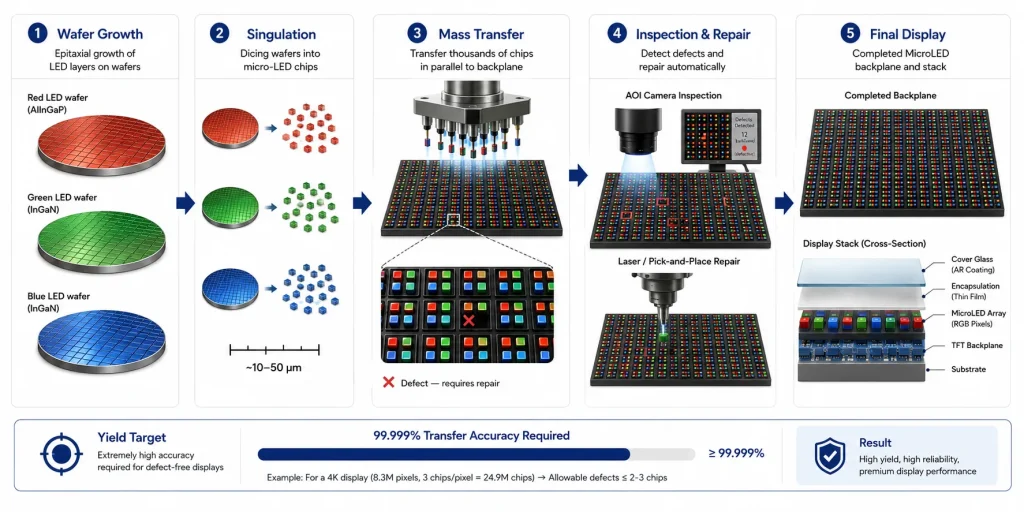
The Manufacturing Gap: Why MicroLED Is Not Yet the Default Industrial Answer
The delay in MicroLED adoption is not caused by a lack of engineering interest. It is caused by manufacturing economics at a scale that the display industry has not previously faced. Industry reporting in 2025 and 2026 describes MicroLED as moving from extended R&D into early commercialization — but not yet broadly cost-competitive for mainstream displays. Yole Group’s MicroLED analysis notes renewed momentum and early production activity, while also indicating that the manufacturing route remains a central development area rather than a commoditized process.
This matters for industrial buyers because their decision process is conservative by necessity. A factory HMI, outdoor kiosk, mining vehicle display, or medical terminal cannot be specified based on technology excitement. It must be available for years, repairable in the field, electrically stable across temperature and vibration, qualified to relevant industrial standards, and affordable at the expected production volume. MicroLED may be technically superior in optical metrics, but industrial adoption will follow supply-chain maturity, not press announcements.
The practical situation through the second half of the 2020s: conventional high-brightness LCD remains the volume production technology. MiniLED is the next premium upgrade layer for selected high-performance applications. MicroLED is the longer-term destination for high-brightness, high-contrast, low-power outdoor equipment — when manufacturing yield and repair processes reach industrial-grade economics.
A Practical Adoption Timeline: How Far Away Is the Next Generation?
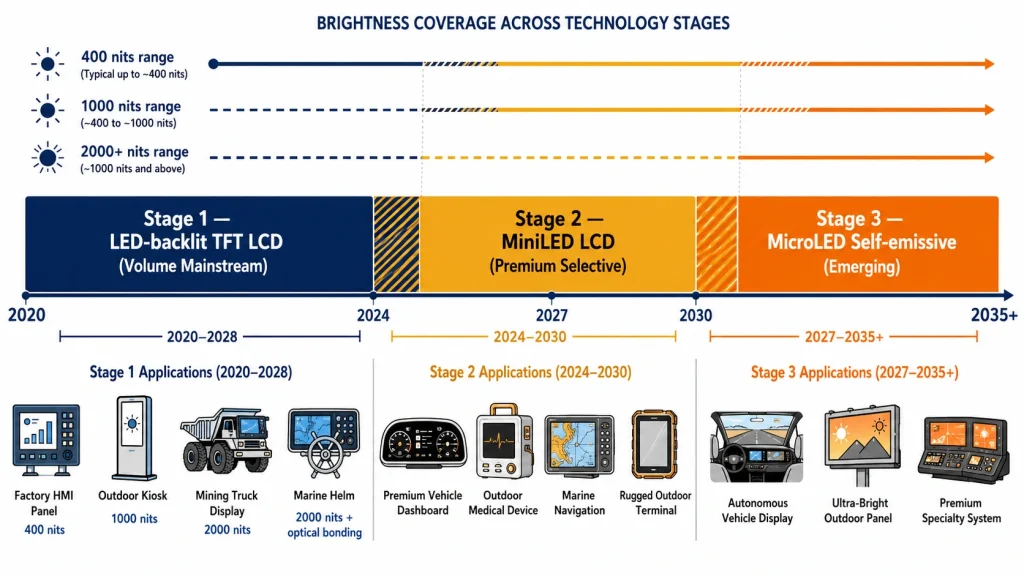
Design Recommendations for Engineers in 2025–2026
Engineers selecting a display in 2025 or 2026 should avoid two opposite mistakes. The first is assuming that the newest display technology is automatically the best choice for the project. The second is assuming that conventional LCD has stopped evolving. In most industrial projects, the correct decision still starts with measured ambient lux, target viewing distance, cover glass reflection, enclosure temperature, service-life target, interface requirements, and volume cost — not with which technology trend article appeared most recently.
- Choose 400 nits when the display is indoors, the operator works in controlled lighting, and comfort during long shifts matters. Standard LED-backlit LCD at this tier remains the most cost-effective, thermally simple, and supply-stable choice through the foreseeable production horizon.
- Choose 1000 nits when the product sits in bright indoor environments, vehicle cabs, semi-outdoor enclosures, or shaded outdoor locations. Specify anti-glare coating as standard. Calculate ECR at the actual peak ambient lux of the installation location, not at a generic outdoor value.
- Choose 2000 nits when the equipment faces direct sun, water or snow reflection, desert conditions, open construction sites, outdoor SCADA terminals, or safety-critical readability requirements where no margin is acceptable. Specify optical bonding, AG/AR cover glass, adaptive dimming with ALS sensor, and thermal path engineering as a system, not a panel.
- Consider MiniLED when the project has a high-brightness requirement combined with dark-mode UI elements, video content, map overlays, premium contrast expectations, or a tight thermal budget where local dimming can meaningfully reduce average power dissipation.
- Monitor MicroLED closely for future product roadmaps — especially for premium outdoor HMI, rugged vehicle displays, and high-value systems where brightness, contrast, and lifetime justify the investment — but do not build a standard industrial product roadmap around MicroLED availability until the supplier can demonstrate cost stability, qualification data, availability commitments, and field repair processes.
📐 The ECR Check Before Any Brightness Decision
Before specifying any brightness tier, calculate the Effective Contrast Ratio (ECR) for the actual installation: ECR = (Panel nits + L_reflect) / (Black level + L_reflect) where L_reflect = Ambient lux × Surface reflectance / π. Practical readability threshold: ECR ≥ 5:1. Industrial target: ≥ 10:1. Optical bonding + anti-glare coating reduces effective reflectance from ~4% (glossy) to ~1%, often allowing a step down in brightness tier while achieving better real-world readability.
Application Examples — Matching Brightness Technology to Factory Environment
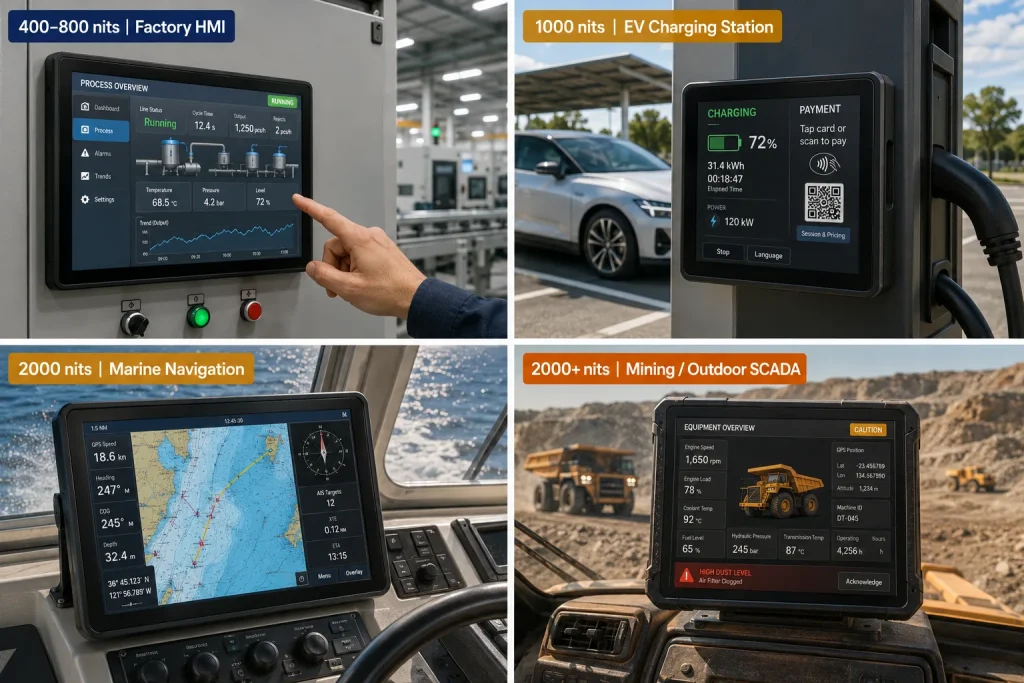
The practical breakdown of where each brightness tier applies across common industrial sectors:
Summary: The Next Generation Is Close — But Not Evenly Distributed
The evolution from 400 nits to 1000 nits to 2000 nits was first about stronger LED backlights. The next evolution is about smarter light: local dimming, better optical stacks, lower reflection coefficients, adaptive power control, improved thermal paths, and eventually self-emissive pixels. MiniLED is the practical bridge because it keeps the LCD ecosystem while improving brightness control and thermal distribution. MicroLED is the long-term destination because it changes the entire light engine.
For industrial display buyers, the answer to ‘how far away is the next generation?’ depends on the application. For premium, high-value, sunlight-readable systems, MiniLED is already close enough to evaluate as a near-term specification. For mainstream industrial HMIs, conventional high-brightness LCD remains the dependable choice for production programs through the second half of the 2020s. For MicroLED, the technology is no longer science fiction, but it is not yet the everyday answer for cost-sensitive industrial screens at standard volumes.
The practical engineering message: do not wait for MicroLED before building better outdoor products. Specify the right brightness tier based on measured ambient lux and ECR calculations, improve readability with optical bonding and AG/AR treatment, manage heat through enclosure design and adaptive dimming, and keep an eye on MiniLED and MicroLED as the high-brightness display roadmap continues to move forward.
For display modules, custom LCD assemblies, industrial touch solutions, and embedded display products across the 400 nits to 2000 nits range — including options with optical bonding, wide-temperature construction, and IPS panel technology — explore Kadi Display’s full industrial display product range and high-brightness LCD display modules for current production-ready configurations.
Product Reference & Engineering Support
For high-brightness TFT-LCD display modules, industrial touch solutions, and custom optical bonding assemblies across the 400 nits to 2000 nits range — with wide-temperature options and MIPI DSI / LVDS / eDP interface configurations — contact Kadi Display at Sales@sz-kadi.com. OEM and ODM services available. Browse industrial display products →
Disclaimer: Technical values, brightness specifications, and technology timeline estimates in this article are representative industry ranges for reference purposes. Actual performance depends on panel design, optical stack, enclosure environment, and application conditions. MiniLED and MicroLED commercialization timelines are based on public industry sources available at the time of writing and are subject to change. All third-party technology names and trademarks belong to their respective owners. This article does not contain verbatim reproduction of any third-party copyrighted text; all industry data has been independently synthesized and reworded.
PREVIOUS
LVDS vs MIPI for Industrial TFT LCD Displays: Which Interface Should You Choose?
NEXT
How to Choose an Industrial TFT LCD Display Module: Size, Brightness, Interface, Touch & Customization Guide
Leave A Comment

Latest Blog & News
- Electronic Component Obsolescence Management for Industrial Displays: An OEM Guide
- How to Develop a Production Ready Custom Display Assembly TFT Module Touch Cover Glass FPC Bonding and Mounting
- 15 Pin vs 22 Pin Raspberry Pi DSI Connectors Cable Pinout and Compatibility
- Native MIPI DSI vs LVDS or HDMI Bridge: An OEM Display Architecture Decision Guide
- MIPI DSI Display Driver Development for Embedded Linux What Hardware Buyers Need to Confirm