
Inicio
-
Blog & Noticias
-
Panel de visualización industrial: características, aplicaciones y soluciones HMI integradas.
Panel de visualización industrial: características, aplicaciones y soluciones HMI integradas.
2026-04-16
18:14
Los equipos de fábrica ahora dependen de enlaces visuales para el intercambio de información, guía y vigilancia. Desde configuraciones automáticas de plantas hasta herramientas agrícolas inteligentes y equipos de salud, panel de visualización industrial Desempeña un papel fundamental en el desarrollo de una buena comunicación entre humanos y máquinas.
Las plantas de producción requieren un funcionamiento más seguro, una mayor vida útil de los artículos y una gestión de puntos más rigurosa. En muchas configuraciones nuevas, el panel de visualización se conecta con una placa de proceso integrada. Esto conforma una solución completa de interfaz hombre-máquina (HMI).
¿Qué es un panel de visualización industrial?
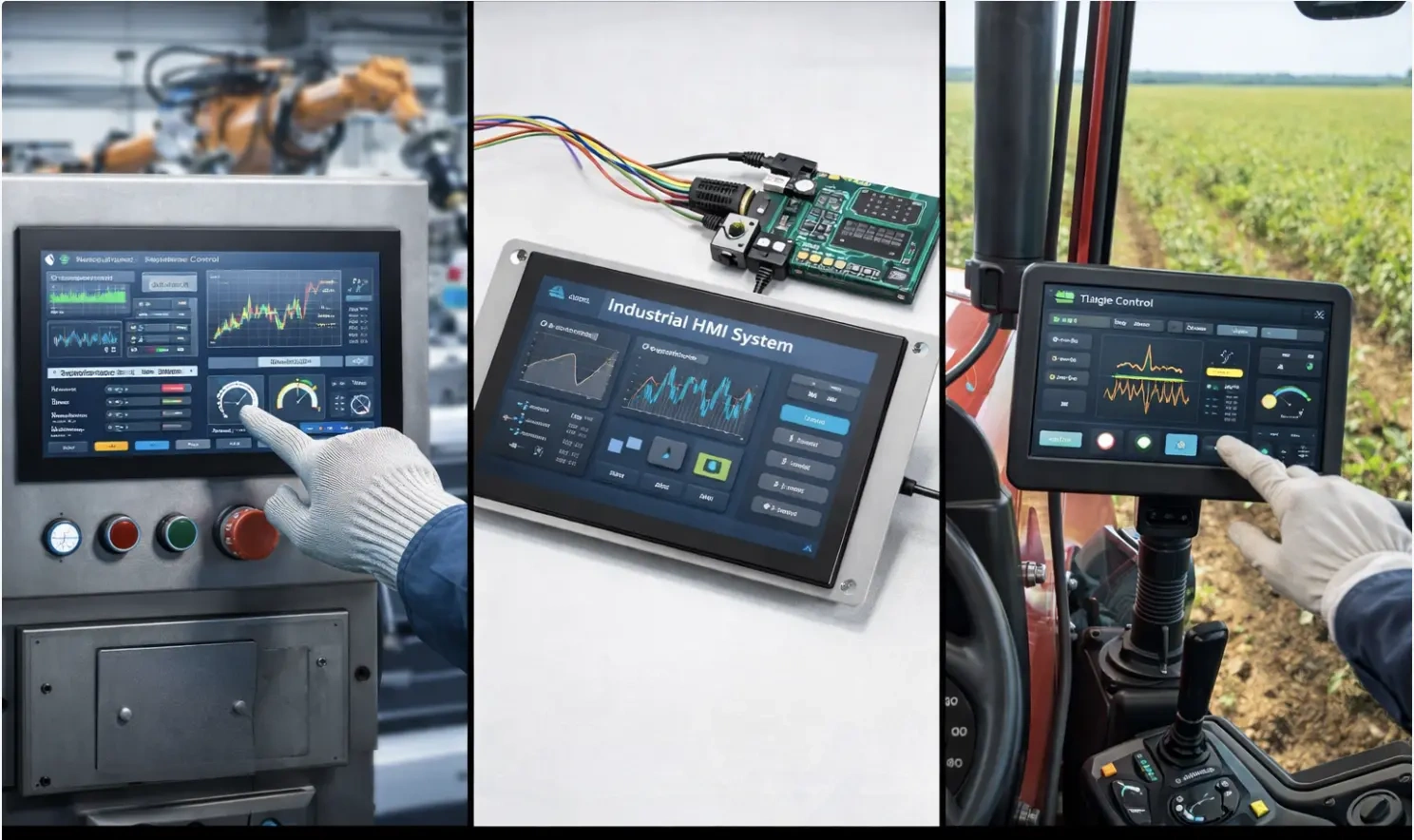
Un panel de visualización industrial Es una unidad de cribado especial diseñada para equipos de fábrica y herramientas profesionales. Funciona mejor que las cribas domésticas. Además, mantiene su estabilidad incluso en terrenos difíciles. También garantiza una larga vida útil del producto.
Una unidad de pantalla de fábrica típica cuenta con una pantalla LCD TFT. Se le añade una lámina táctil (capacitiva o resistiva). A continuación, se instala el cristal protector. Le sigue el sistema de retroiluminación. Finalmente, los componentes de conexión de la pantalla completan el conjunto.
En muchas tareas, el panel de visualización se integra con una placa base o una computadora de placa única. Esto crea una configuración completa de enlace de usuario. La combinación permite visualizar información, procesar datos y controlar las transacciones.
Los paneles de visualización industriales se utilizan ampliamente en equipos de fabricación de automóviles, herramientas de salud, sistemas de agricultura inteligente, hojas de control de producción, dispositivos IoT y herramientas inteligentes.
Características principales de los paneles de visualización industriales
Una pantalla TFT de fábrica fiable ofrece un rendimiento estable incluso en las condiciones más exigentes.
Alta fiabilidad
Las fábricas suelen funcionar sin interrupciones durante largos periodos de tiempo. Por ello, un panel de visualización LCD industrial aporta robustez y durabilidad a las piezas.
Los componentes principales de alta calidad incluyen brocas de grado industrial, sistemas de retroiluminación estables y herramientas de accionamiento robustas. Esto garantiza un funcionamiento estable incluso en entornos con vibraciones intensas o ruido eléctrico.
Ciclo de vida del producto prolongado
Las herramientas domésticas cambian rápidamente. Sin embargo, los equipos industriales pueden mantenerse en producción durante muchos años. Un proveedor habitual de paneles de visualización industriales garantiza una vida útil de sus productos de 5 a 10 años o más. Este flujo constante permite a los fabricantes de equipos mantener existencias durante toda la vida útil del producto.
Amplio rango de temperatura de funcionamiento
Los equipos de fábrica se instalan en entornos exigentes como plantas industriales, herramientas abiertas o sistemas de transporte. Una pantalla LCD industrial estándar ofrece un amplio rango de temperatura, que abarca desde -20 °C hasta +70 °C o desde -30 °C hasta +80 °C para aplicaciones extremas. Este amplio rango de temperatura garantiza su funcionamiento tanto en zonas frías como calientes.
Los modelos de los principales fabricantes suelen alcanzar rangos de temperatura de funcionamiento de -30 °C a +85 °C. En algunos modelos, la temperatura de almacenamiento llega hasta -40 °C a +90 °C. Estas especificaciones resultan fundamentales para tareas de clasificación en espacios abiertos y con sistemas automatizados.
Alto brillo y legibilidad a la luz del sol.
Muchas herramientas de fábrica funcionan en espacios abiertos o bien iluminados. En esos casos, una pantalla de visualización solar para fábricas resulta fundamental.
Las pantallas normales ofrecen entre 250 y 300 nits. Las pantallas de fábrica alcanzan los 800, 1000, 1100, 1500 nits o más. Las pantallas de alta luminosidad son ideales para herramientas agrícolas, soportes abiertos, equipos náuticos y atracciones.
Por ejemplo, algunos paneles de 10,1, 12,1 y 15 pulgadas proporcionan entre 1000 y 1100 nits de luz. Ofrecen amplios ángulos de visión, lo que los hace ideales para su uso con la luz solar directa.
Interfaz táctil industrial
Los equipos nuevos a menudo requieren una fácil utilización por parte del usuario. Una pantalla táctil industrial permite a los trabajadores guiar las herramientas mediante enlaces de imágenes.
Las tecnologías táctiles habituales incluyen láminas táctiles capacitivas (PCAP) para funciones multitáctiles y un funcionamiento fluido en las nuevas configuraciones HMI. Las láminas táctiles resistivas son adecuadas para trabajar con guantes o bolígrafo en entornos industriales exigentes. Actualmente, muchos planes impulsan el uso de tecnología capacitiva proyectada (PCAP) con unión óptica, lo que mejora la nitidez y la resistencia. Las soluciones antihuellas (AF) o antirreflejos (AG) ofrecen aún más ventajas.
Las mejoras adicionales, como la unión óptica, aumentan el contraste y reducen los reflejos. Los amplios ángulos de visión (a menudo 85/85/85/85 o visión libre en los paneles IPS) mantienen una buena calidad de imagen desde muchos ángulos.
Paneles de visualización industriales como parte de los sistemas HMI.
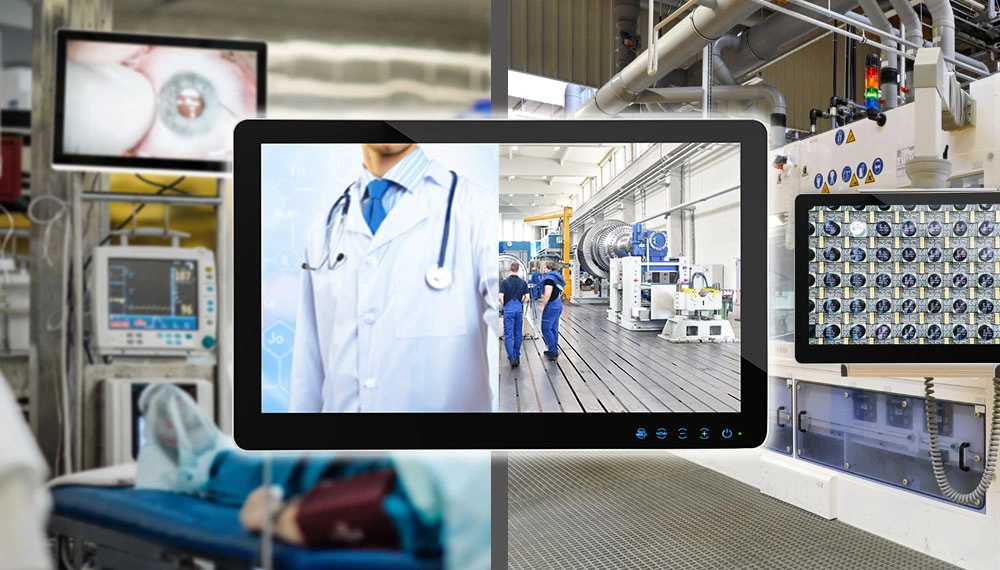
En el nuevo diseño de equipos, el panel de visualización constituye solo una parte de una configuración HMI completa.
Una configuración típica de HMI incluye el panel de visualización industrial, la interfaz táctil, la placa de proceso integrada, el sistema operativo (Android o Linux) y el software de tareas.
La unidad de visualización gestiona la información visual y las operaciones del usuario. El panel integrado procesa los datos, controla el sistema operativo y guía las charlas informativas sobre las herramientas.
Esta configuración integrada permite a los fabricantes crear conexiones de usuario robustas e inteligentes para herramientas de fábrica. Conexiones como LVDS, eDP, MIPI, RGB, HDMI y otras garantizan la compatibilidad con numerosas bases de montaje.
Placas integradas para sistemas de visualización industrial
Para construir una herramienta HMI completa, los fabricantes suelen combinar el panel de visualización industrial con un ordenador de placa única ya ensamblado.
Una placa base para configuraciones de pantalla generalmente cuenta con un procesador basado en ARM, memoria RAM y almacenamiento, múltiples enlaces de comunicación (USB, UART, Ethernet, RS485, bus CAN, SPI/GPIO) y un sistema de gestión de memoria.
Las placas integradas permiten que las herramientas de fábrica realicen tareas de procesamiento de datos, muestren enlaces de imágenes al usuario, se comuniquen con sensores y guíen las piezas, y se conecten a la nube con la integración de IoT.
Las arquitecturas basadas en procesadores ARM están ganando popularidad debido a su bajo consumo energético y buen rendimiento. Los sistemas operativos más utilizados en configuraciones HMI integradas incluyen Android y Linux. Estos admiten nuevos marcos de interfaz gráfica de usuario (GUI) y facilitan la creación de tareas.
Aplicaciones comunes de los paneles de visualización industriales
Los paneles de visualización industriales son útiles en muchos campos donde la correcta conexión con el usuario resulta fundamental.
Automatización industrial
Los sistemas de automatización industrial dependen en gran medida de las pantallas HMI industriales para la supervisión y el control. Las tareas habituales incluyen la gestión de PLC, hojas de control de máquinas y sistemas de automatización de planta. Estos sistemas requieren pantallas estables que funcionen sin interrupciones incluso en condiciones adversas.
Dispositivos médicos
Los dispositivos médicos suelen utilizar pantallas LCD industriales para monitorizar conexiones y configuraciones de reloj. Se emplean en dispositivos de monitorización de pacientes, equipos de laboratorio y equipos de imagen médica. La alta calidad y nitidez de la imagen son fundamentales. Normas como la ISO 13485 suelen respaldarlos.
Agricultura inteligente
Las herramientas agrícolas ahora dependen más de las guías digitales. Los estuches cubren sistemas de riego, exhibidores de herramientas agrícolas y equipos agrícolas especializados. En estos espacios, las vitrinas de fábrica con iluminación potente garantizan una visión clara. Su amplio rango de temperatura de funcionamiento permite su uso en condiciones climáticas cambiantes.
Control inteligente de hogares y edificios
Las pantallas de calidad industrial también se integran en configuraciones de automatización de la construcción y guías inteligentes. Las tareas abarcan hojas de control para hogares inteligentes, configuraciones de ejecución de la construcción y enlaces de monitoreo de energía. Estas configuraciones se benefician de las unidades de visualización táctiles de fábrica combinadas con bases de conteo integradas.
Otros campos abarcan el transporte, el equipamiento marítimo, la construcción de atracciones y la apertura de puestos. Allí, la fuerza, la iluminación intensa y la lucha puntual son fundamentales.
Cómo elegir el panel de visualización industrial adecuado
Para elegir el panel de visualización industrial adecuado, es necesario analizar detenidamente el funcionamiento de la pantalla y su configuración.
Tamaño y resolución de la pantalla
Los tamaños habituales de los expositores de fábrica incluyen 4,3 pulgadas, 5 pulgadas, 7 pulgadas, 10,1 pulgadas, 12,1 pulgadas, 15,6 pulgadas, y en algunas líneas se pueden encontrar modelos más grandes de hasta 18,5 a 27 pulgadas. El tamaño adecuado depende del diseño de la distribución y del espacio disponible.
La nitidez varía desde 800x480 hasta 1920x1080 (Full HD) o más. Los paneles IPS ofrecen mejores colores y ángulos de visión. Las pantallas alargadas o con formato de barra también son adecuadas para tareas especiales.
Compatibilidad de la interfaz de visualización
Las distintas pantallas admiten enlaces de señal como RGB, LVDS (de 20 y 40 pines), eDP, MIPI DSI y HDMI. Los fabricantes deben asegurarse de que sean compatibles con el proceso de fabricación elegido para evitar problemas de compatibilidad.
Requisitos táctiles
Según la tarea, las herramientas pueden requerir tecnología multitáctil capacitiva, funcionamiento con guantes o resistencia al agua. La unión óptica, las cubiertas antirreflejos y los circuitos integrados de control (como ILI o GT) facilitan el trabajo. Las fijaciones capacitivas con vidrio-vidrio o estructuras basadas en láminas proporcionan flexibilidad para una mayor resistencia en fábrica.
Consideraciones avanzadas para la selección de pantallas LCD TFT industriales
Más allá de los componentes básicos, los profesionales comprueban el tipo de panel (TN o IPS), la tasa de contraste, el tiempo de respuesta y la durabilidad ante golpes o vibraciones. Para trabajos de montaje, se comprueba la compatibilidad con herramientas de montaje, placas base y complementos, así como la velocidad de montaje.
El trabajo de fabricación crece en parte. Se seleccionan cubiertas para el diseño del vidrio protector, se ajusta la intensidad de la retroiluminación, se realizan correcciones suaves para la función táctil y se lleva a cabo la unión óptica completa. El trabajo OEM/ODM permite a los fabricantes combinar las pantallas a la perfección con sus diseños de equipos. Esto reduce el tiempo de comercialización y elimina el trabajo de configuración completa.
Los modelos de alta luminosidad (más de 1000 nits) y los de amplio rango de temperatura (de -30 °C a +85 °C) satisfacen las necesidades de iluminación más exigentes. Su combinación con unidades táctiles amplía las opciones para interfaces hombre-máquina (HMI).
Soluciones personalizadas de visualización industrial e interfaz hombre-máquina (HMI)
Muchos trabajos en fábricas necesitan que se realicen ajustes en las pantallas y la interfaz hombre-máquina (HMI) para configurar los planes de engranajes.
Se fabricaron selecciones, se fabricó un plan de vidrio de cubierta, mezcla de unión óptica, conjunto de retroiluminación de luz fuerte, fijación de calor amplia, se fabricó un tacto suave y se conectaron placas construidas.
Al combinar pantallas TFT industriales, interfaces táctiles y bases de datos integradas, los fabricantes crean soluciones HMI robustas y fiables para equipos nuevos. La fabricación conforme a los estándares de calidad internacionales respalda tanto las unidades estándar como los proyectos de fabricación a medida.
Preguntas frecuentes
¿Cuál es el rango típico de temperatura de funcionamiento para los paneles de visualización industriales? Los paneles de visualización industriales suelen soportar temperaturas de entre -20 °C y +70 °C, mientras que los modelos avanzados de amplio rango de temperatura se extienden desde -30 °C hasta +85 °C para entornos extremos.
¿Qué niveles de brillo son adecuados para pantallas industriales visibles en exteriores o a la luz del sol?
Las aplicaciones que requieren visibilidad a la luz del sol suelen necesitar entre 800 y 1500 nits o más. Muchos módulos LCD TFT industriales ofrecen opciones de 1000 a 1100 nits con tratamientos antirreflectantes.
¿Qué interfaces suelen admitir las pantallas LCD TFT industriales? Entre las interfaces más comunes se incluyen LVDS, eDP, MIPI DSI, RGB y HDMI, lo que garantiza una amplia compatibilidad con procesadores integrados y ordenadores de placa única.
Kadi Display, un fabricante profesional de pantallas TFT LCD industriales con sede en Shenzhen y con más de 20 años de experiencia, ofrece módulos TFT LCD de alta calidad, pantallas táctiles y soluciones personalizadas adaptadas al control industrial, sistemas embebidos, equipos médicos y aplicaciones para exteriores.
Kadi Display Ofrece soporte para proyectos OEM/ODM con servicios flexibles y soluciones integrales. Desde módulos estándar en tamaños de 7 a 15,6 pulgadas con resoluciones de hasta 1920x1080 y brillo de hasta 1100 nits, hasta integraciones HMI totalmente personalizadas, la empresa proporciona un suministro estable y soporte técnico para clientes B2B en todo el mundo.
Contacta con Kadi Display hoy mismo por correo electrónico a Sales@sz-kadi.com o llame al +86-13662585086 para hablar sobre las especificaciones del proyecto, solicitar muestras o explorar opciones de personalización.
PREVIOR
Pantalla IPS para uso industrial: 5 consideraciones clave
Siguiente
Explorando los módulos LCD TFT tipo barra: una guía completa
Deja un comentario

Últimos blogs y noticias
- Industrial LCD EOL: What Happens from Pre-Announcement to Replacement Mass Production?
- Electronic Component Obsolescence Management for Industrial Displays: An OEM Guide
- How to Develop a Production Ready Custom Display Assembly TFT Module Touch Cover Glass FPC Bonding and Mounting
- 15 Pin vs 22 Pin Raspberry Pi DSI Connectors Cable Pinout and Compatibility
- Native MIPI DSI vs LVDS or HDMI Bridge: An OEM Display Architecture Decision Guide