
Applications des écrans LCD industriels dans les dispositifs médicaux
2026-03-12
00:00
Affichages LCD industriels sont devenus une partie essentielle d'aujourd'hui’ S équipement médical. Ils combinent une grande fiabilité, une excellente qualité d'image, une longue durée de vie et une bonne adaptation aux règles d'hygiène et de sécurité rigoureuses. Cela en fait le meilleur choix pour les fabricants de dispositifs médicaux. Cet article examine de près pourquoi les écrans LCD de qualité industrielle sont largement utilisés dans les soins de santé. Il couvre leurs principaux domaines d'application, leurs points forts techniques de base, les points clés de conception et la conformité connexe ainsi que les détails de certification.
Pourquoi les écrans LCD industriels affichent Excel dans les paramètres de soins de santé
Les dispositifs médicaux fonctionnent dans des endroits où aucune panne ne peut se produire. Les écrans doivent donner des résultats stables pendant l'utilisation sans arrêt, le nettoyage régulier, le changement des niveaux de lumière et la contrainte physique occasionnelle.
Lorsqu'il est réglé contre des écrans de consommation réguliers, écrans LCD industriels apporter des avantages clairs :
- Conçu pour un fonctionnement continu 24 heures sur 24, 7 jours sur 7 — La plupart des versions ont une durée de vie de rétroéclairage de 50 000 à 70 000 heures. Cela réduit considérablement le risque d'échec soudain dans les utilisations vitales de soutien à la vie.
- Large plage de température de fonctionnement — Beaucoup de panneaux de qualité médicale supportent -20°C à 70°C (quelques-uns vont encore plus loin). Ils maintiennent un travail stable dans les ambulances, en dehors des installations d'urgence ou dans les zones d'équipement bouchonnées.
- Forte luminosité et lisibilité à la lumière du soleil — Les panneaux de 800 à 1500 nits apparaissent souvent. Ils permettent une vision nette sous des lampes chirurgicales intenses ou dans des espaces d'examen lumineux.
- Anti-éblouissement & Options de collage optique - Le collage optique élimine l'espace d'air entre le verre de couverture et l'écran LCD. Il réduit beaucoup les réflexions intérieures et augmente le contraste dans la lumière ambiante forte.
- Tough Touch Solutions — Le tactile capacitif projeté manipule les gestes multi-tactile. Il fonctionne avec des gants (y compris les gants chirurgicaux épais) et offre une très grande endurance au toucher (> 10 millions de touches).
- Matériaux de surface hygiéniques — De nombreux écrans disposent de verre ou de revêtements spéciaux. Ceux-ci résistent à l'utilisation répétée de désinfectants de qualité hospitalière (comme l'alcool, le blanchiment et les composés d'ammonium quaternaire) sans se décomposer.
Ces caractéristiques rendent les écrans LCD industriels beaucoup mieux adaptés aux tâches médicales que les moniteurs commerciaux ordinaires.
Applications clés dans les dispositifs médicaux
1. Systèmes de surveillance des patients
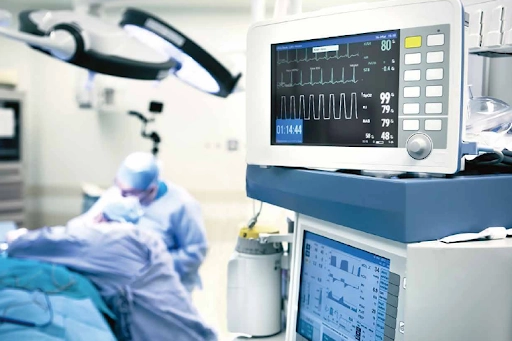
Les moniteurs multiparamètres de patients figurent parmi les utilisateurs les plus courants d'écrans LCD industriels. Ces écrans montrent les formes d'onde de l'ECG, la pression artérielle invasive et non invasive, la pléthysmographie SpO2, la fréquence respiratoire, la température et les valeurs ETCO2 tout le temps. Les principaux besoins d'affichage comprennent:
- Haut taux de rafraîchissement (≥60 Hz) et faible retard d'entrée. Ils aident à créer un affichage en forme d'onde lisse.
- Angle de vision large (panneaux IPS ≥178°/178°). Cela permet aux infirmières et aux médecins de lire facilement les données à côté du lit.
- Paramètres colorés et grandes polices numériques. Ils restent lisibles de 2 à 3 mètres.
- Configurations à écran divisé ou multi-fenêtre. Ils affichent les tendances, les alarmes et les valeurs calculées à la fois.
2. Équipement d'imagerie de diagnostic
Des échographies portables aux consoles fixes de tomographie tomographique / IRM, l'affichage correct de l'image est très important. Les affichages industriels dans ce domaine comprennent normalement:
- Haute résolution (Full HD, 2K, 4K)
- Suivi de l'échelle de gris conforme à la partie 14 DICOM (pour les stations de radiologie)
- Uniformité de gamma et de luminance calibrée en usine
- Rapport de contraste élevé et niveaux de noir profond. Ceux-ci s'avèrent particulièrement utiles pour l'échographie et l'endoscopie.
- Large gamme de couleurs lorsque le rendu Doppler ou 3D/4D devient nécessaire.
3. Affichages de chirurgie et de salle d'opération
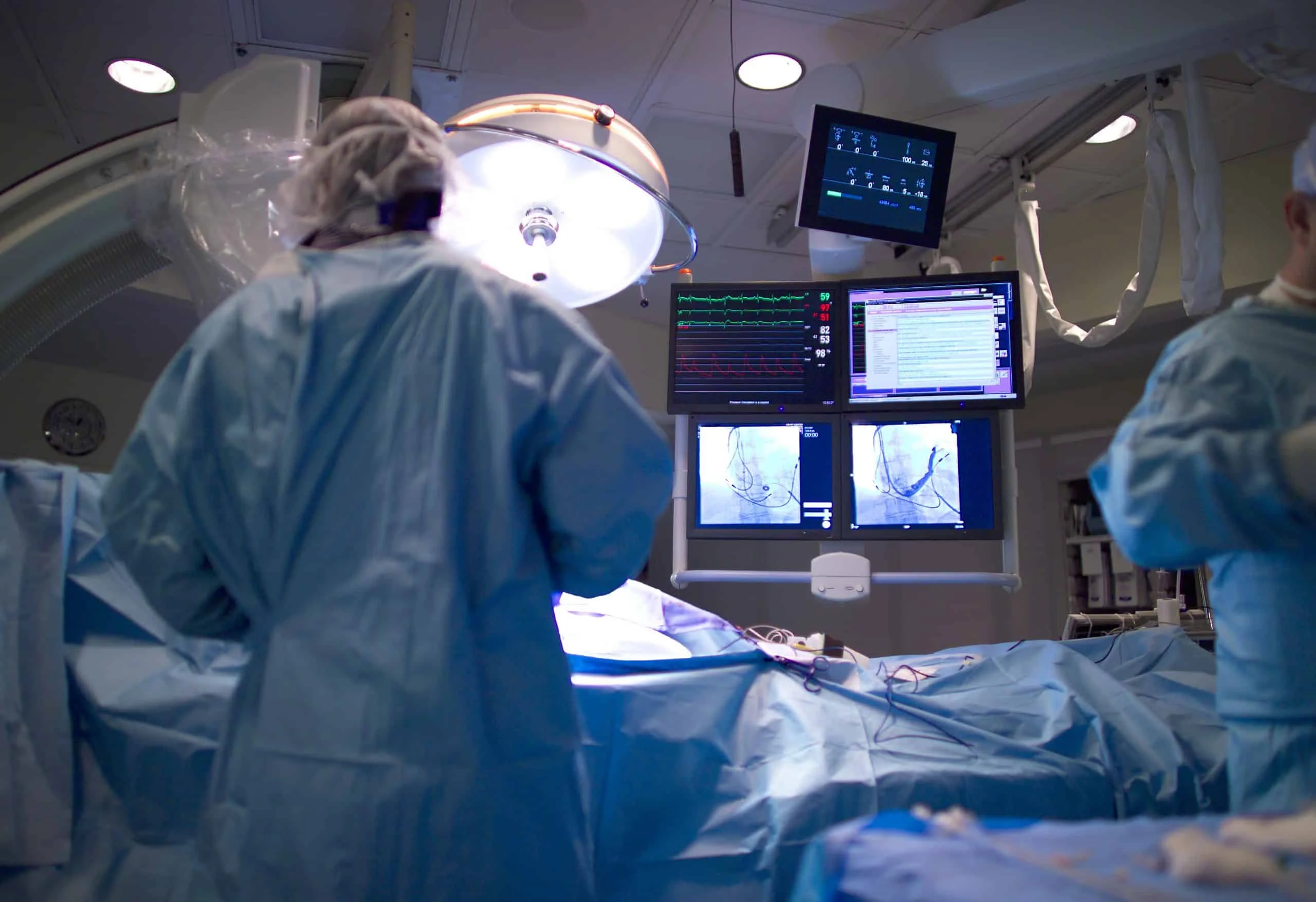
Les écrans chirurgicaux doivent fournir des vues en temps réel et sans retard des caméras endoscopiques, des microscopes chirurgicaux, des systèmes robotiques (par exemple, da Vinci) et de la fluoroscopie à bras C. Les besoins communs couvrent :
- Luminosité ultra-élevée (1000-2000 nits). Il aide à battre l'éblouissement des lumières de fonctionnement.
- Entrées de signal redondantes (HDMI, DP, 3G-SDI, DVI) avec failover automatique
- Faible latence d'entrée (<20 ms)
- Résolution 4K, de plus en plus courante pour le travail minimalement invasif
- Type tactile ou non tactile. Le choix dépend de savoir si l'écran contrôle les choses directement ou simplement affiche des images.
4. Instruments de laboratoire et d ' analyse
Les analyseurs d'hématologie automatisés, les analyseurs de chimie, les systèmes de coagulation, les plateformes d'immunoassay et les consoles de séquençage de nouvelle génération utilisent tous des interfaces LCD industrielles. Ces écrans fournissent:
- Interfaces graphiques faciles à utiliser pour choisir les paramètres de test
- Barres de progrès et signes d'état en temps réel
- Vues claires des résultats numériques, des histogrammes, des scattergrammes et des drapeaux d'alerte
- Lisibilité constante des polices et symboles minuscules même après des milliers d'heures
5. Pompes à perfusion et pompes à seringues
Les dispositifs de livraison de médicaments nécessitent des interfaces très fiables et faciles à lire. Les écrans LCD industriels dans les pompes à perfusion donnent généralement:
- Signaux d'état codés en couleur (vert = en cours, jaune = près de la fin, rouge = alarme)
- Grandes zones numériques à contraste élevé pour la vitesse, le volume et le temps restant
- Configurations d'affichage tactile ou boutonnaire pour la programmation
- Large angle de vision. Il permet aux infirmières de vérifier les paramètres de différents côtés sans déplacer la pompe.
6. Dispositifs de diagnostic portables et de point de soins
Les échographies portatives, les machines ECG portables, les analyseurs de gaz sanguins et les moniteurs mobiles de signes vitaux nécessitent de petits écrans à faible puissance et hautement visibles. Les principales caractéristiques couvrent:
- Panneaux à haute luminosité lisibles au soleil (700-1200 nits)
- Faible utilisation d'énergie pour prolonger la durée d'exécution de la batterie
- Construction robuste (résistance aux chocs, vibrations, chutes)
- Large plage de température pour le travail dans les ambulances, les hôpitaux de terrain et les soins à domicile
7. Systèmes d ' imagerie dentaire et de fauteuil
Les unités dentaires modernes apportent des écrans pour:
- Vue en direct de la caméra intraorale
- Radiographie numérique et imagerie panoramique
- Navigation en tranches CBCT 3D
- Éducation du patient (affichage des plans de traitement et des images avant/après)
Ces écrans mélangent généralement une haute résolution, une précision des couleurs solides et des surfaces anti-éblouissement. Ils s'adaptent bien dans le cadre dentaire lumineux.
Considérations de conception importantes pour les fabricants de dispositifs médicaux
Lors de la sélection ou de la personnalisation d'écrans LCD industriels pour des produits médicaux, plusieurs points d'ingénierie nécessitent une réflexion attentive:
Compatibilité de l'interface
Les interfaces courantes comprennent LVDS (6/8/10 bits), eDP, MIPI DSI, HDMI et DisplayPort. Les cartes mères médicales choisissent souvent LVDS ou eDP. Ils offrent un meilleur contrôle EMI et un soutien à long terme.
Stratégie de durée de vie et de remplacement de l'éclairage
La demi-vie de rétro-éclairage LED est généralement de 50 000 à 70 000 heures à 25 ° C. Certains fabricants fournissent des unités de rétro-éclairage remplaçables sur le terrain. Cela permet d'allonger la durée de vie de l'appareil au-delà de 10 ans.
Compatibilité électromagnétique (CEM)
Les dispositifs médicaux doivent satisfaire à la norme IEC 60601-1-2. Les écrans industriels devraient faire l'objet d'essais pour les émissions rayonnées et conduites ainsi que l'immunité. Cela est particulièrement vrai pour les processeurs rapides ou les pièces sans fil.
Stabilité de l'alimentation
De nombreux appareils médicaux comptent sur des sources d'alimentation isolées. Les écrans doivent gérer des oscillations de tension plus larges et afficher un courant d'entrée faible.
Disponibilité à long terme & Gestion EOL
Les cycles des produits médicaux durent souvent de 7 à 12 ans. Choisir des fournisseurs avec des promesses d'approvisionnement solides à long terme et des règles claires d'achat de dernière fois ou d'achat à vie est très important.
De nombreux fabricants d'écrans industriels de confiance fournissent des rapports d'essai utiles, des énoncés de matériaux et des règles d'avis de modification. Ils aident les fabricants de dispositifs à obtenir la certification de manière plus fluide.
Affichage Kadi est un fabricant, fournisseur et usine professionnel d'écran LCD TFT industriel dont le siège social est situé à Shenzhen, en Chine. La société est spécialisée dans les modules LCD à haute luminosité, à grande température, intégrés au tactile et personnalisés conçus pour des applications exigeantes, y compris les dispositifs médicaux. Kadi Display offre des services OEM/ODM flexibles avec des quantités de commande minimales faibles ou nulles pour de nombreux projets personnalisés et offre une stabilité d'approvisionnement à long terme. Les fabricants de dispositifs médicaux et les intégrateurs à la recherche de solutions d'affichage fiables sont les bienvenus à explorer la gamme complète de produits https://www.kadidisplay.com/ ou contacter l'équipe directement à sales@sz-kadi.com 86-13662585086 pour des consultations de projet, des échantillons ou des discussions de partenariat.
FAQ (questions fréquentes)
Quelle est la durée de vie typique des écrans LCD industriels utilisés dans les dispositifs médicaux?
La plupart sont évalués pour 50 000 à 70 000 heures à 25 °C, supportant 7 à 10 ans de fonctionnement continu dans de nombreuses applications.
Les écrans industriels peuvent-ils résister à la désinfection fréquente dans les hôpitaux?
- Oui, oui. De nombreux modèles utilisent des surfaces en verre ou des revêtements spéciaux testés avec des désinfectants courants tels que l'alcool isopropylique à 70%, le blanchiment et les composés d'ammonium quaternaire.
Les écrans de qualité médicale doivent-ils être conformes à DICOM ?
Seuls les écrans d'imagerie de diagnostic destinés au diagnostic primaire nécessitent généralement la conformité à l'échelle de gris DICOM partie 14. Les écrans de surveillance et de vue secondaire ne le font pas.
Précédent
RGB vs MIPI vs LVDS: Choisir la meilleure interface TFT LCD
Suivant
Fourniture d'écrans TFT rentables pour l'équipement médical
Laisser un commentaire

Derniers blogs et nouvelles
- Industrial LCD EOL: What Happens from Pre-Announcement to Replacement Mass Production?
- Electronic Component Obsolescence Management for Industrial Displays: An OEM Guide
- How to Develop a Production Ready Custom Display Assembly TFT Module Touch Cover Glass FPC Bonding and Mounting
- 15 Pin vs 22 Pin Raspberry Pi DSI Connectors Cable Pinout and Compatibility
- Native MIPI DSI vs LVDS or HDMI Bridge: An OEM Display Architecture Decision Guide