Accueil
-
Blog & Actualités
-
« Plus lumineux, c’est mieux » : le plus grand mythe en matière de choix d’écrans industriels
« Plus lumineux, c’est mieux » : le plus grand mythe en matière de choix d’écrans industriels
2026-05-05
12:30
« Plus lumineux, c’est mieux » : le plus grand mythe en matière de choix d’écrans industriels
La véritable logique derrière les valeurs de 400 nits, 1 000 nits et 2 000 nits — Un guide pratique d’ingénierie
Par l'équipe technique de Kadi Display | www.kadidisplay.com | Technologie d'affichage industriel
Le mythe qui gaspille le budget et tue les rétroéclairages
Un membre de l'équipe des achats saisit « 2 000 nits » dans la fiche technique et considère le travail terminé. Cela arrive plus souvent qu'on ne le pense. Le raisonnement est logique à première vue : l'écran doit être visible en extérieur, plus il est lumineux, mieux c'est ; il suffit donc de choisir la dalle la plus lumineuse disponible et de passer au poste suivant.
Les problèmes apparaissent plus tard. L'écran génère plus de chaleur que le boîtier ne peut en dissiper. Le rétroéclairage perd 50 % de sa luminosité en 18 mois au lieu des cinq ans prévus. L'opérateur de nuit doit plisser les yeux devant un écran affichant une luminosité maximale de 2 000 nits, car personne n'y a pensé. gradation adaptative. Et l'unité coûte 80 $ de plus par panneau qu'un module de 1 000 nits correctement spécifié qui aurait géré l'environnement de déploiement réel avec une marge confortable.
Il ne s'agit pas d'un mode de défaillance hypothétique. Il se produit lorsque la luminosité est considérée comme une marge de sécurité plutôt que comme un paramètre d'ingénierie. Ce guide détaille la logique de décision : les calculs de l'éclairement ambiant, les conséquences thermiques, les compromis liés à la durée de vie du rétroéclairage et les interactions du traitement de surface qui, ensemble, déterminent le niveau de luminosité approprié pour une application industrielle donnée.
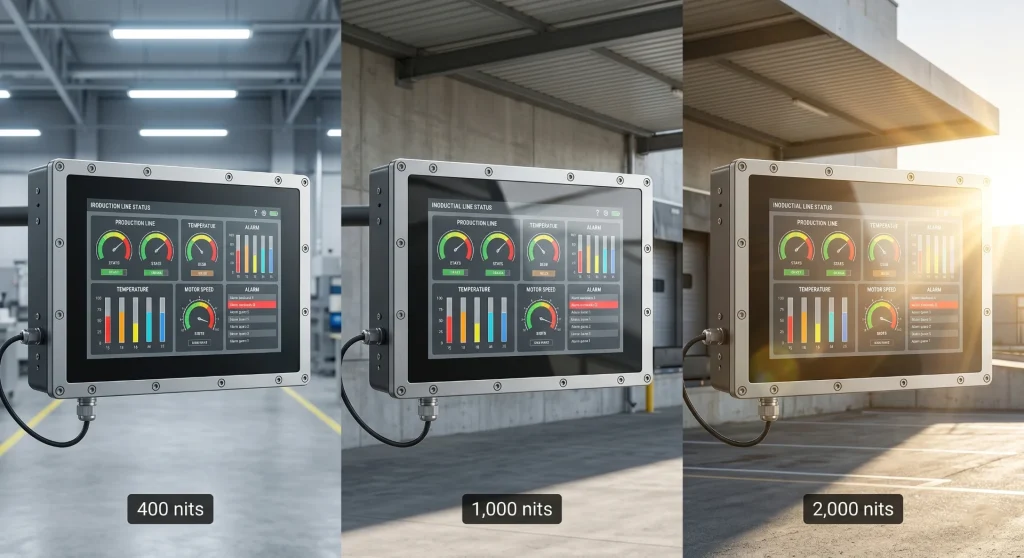
Principe fondamental : la haute luminosité a pour but de compenser la lumière ambiante, et non de rendre l’écran impressionnant. Les nits ne sont qu’un moyen d’y parvenir. La question pertinente n’est jamais « quelle luminosité maximale puis-je obtenir ? » mais plutôt « quelle quantité de lumière ambiante mon écran doit-il compenser ? »
Physique : Lux ambiant vs. Nits d'affichage
Comment fonctionne réellement la perception de la luminosité
La luminosité d'un écran est mesurée en candela par carré mètre (cd/m²), universellement appelé poux Dans le secteur, un panneau de 400 nits produit une luminance de 400 cd/m². L'éclairement ambiant de l'environnement dans lequel se trouve l'écran est mesuré en lux — mais le lux est une mesure d'éclairement (lumière tombant sur une surface), et non une mesure de luminance (lumière émise par une surface), on ne peut donc pas comparer directement les deux nombres.
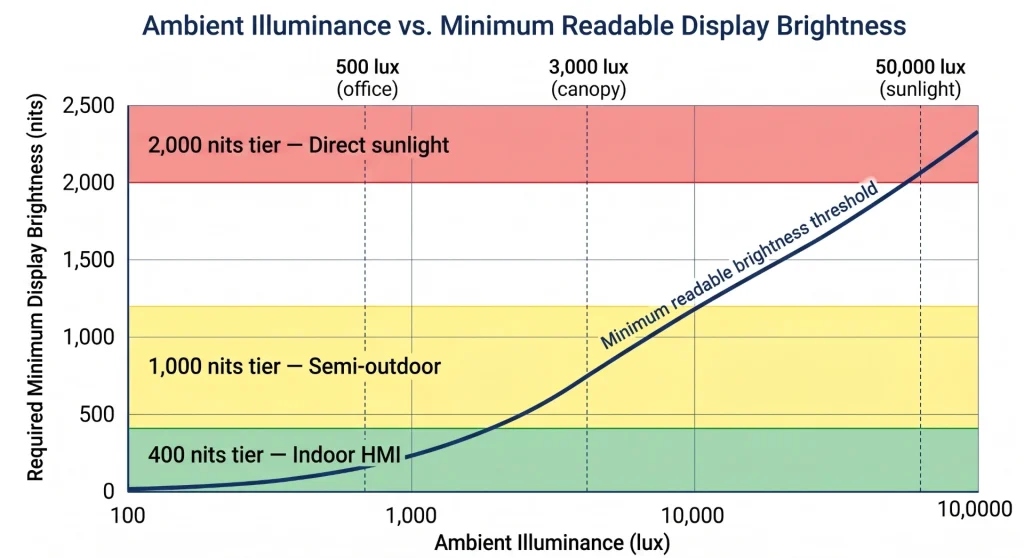
La comparaison utile est le rapport entre la luminance de l'écran et la luminance ambiante réfléchie à la surface d'affichage. Pour une dalle brillante avec un coefficient de réflexion d'environ 4 % (verre standard non traité), placée dans un environnement avec un éclairement ambiant de 10 000 lux, la luminance de la surface réfléchie est d'environ 10 000 × 0,04 / π ≈ 127 cd/m². Un écran de 400 nits présente un rapport luminance/éblouissement réfléchi d'environ 3:1 à ce niveau d'éclairement ambiant. La lecture est techniquement possible, mais inconfortable. Un écran de 1 000 nits, à la même luminosité ambiante, offre un rapport d'environ 8:1, nettement plus confortable. La plupart des ingénieurs en affichage utilisent… ratio minimum de 5:1 comme seuil de lisibilité.
Les niveaux de luxe que vous rencontrez réellement
Il s'agit de valeurs d'éclairement ambiant réelles mesurées au niveau de la surface d'affichage, et non à un mètre au milieu de la pièce :
- Bureau intérieur / salle de contrôle : 300 à 600 lux. Un écran de 400 nits est parfaitement suffisant.
- atelier industriel (éclairage fluorescent au plafond) : 400–1 000 lux. 400 nits fonctionnent ; 600 nits offrent une marge confortable.
- Aire extérieure couverte / quai de chargement / abri : De 2 000 à 10 000 lux selon l’orientation. C’est là qu’une intensité de 1 000 nits devient réellement nécessaire.
- En plein air, ciel couvert : 10 000 à 25 000 lux. 1 000 à 1 500 nits : plage utile.
- Lumière directe du soleil en été : 50 000 à 100 000 lux. 2 000 nits est la limite pratique pour les solutions de panneaux intégrés ; un refroidissement actif est généralement nécessaire.
Pourquoi le ratio est plus important que le nombre
Voici un point souvent omis dans les fiches techniques : la luminosité seule ne détermine pas la lisibilité, mais bien la combinaison de la luminosité et du traitement de surface. Un écran de 1 000 nits avec verre brillant standard, exposé en plein soleil à 80 000 lux, présente une luminance réfléchie d'environ 1 018 cd/m². La luminance de votre écran et les reflets sont quasiment identiques. L'écran devient alors pratiquement invisible.
Le même panneau de 1 000 nits avec liaison optique (en éliminant la réflexion de l'entrefer) et revêtement AG modéré (en réduisant la réflectance spéculaire d'environ 4 % à environ 1,5 %) dans les mêmes conditions, on obtient une luminance réfléchie en surface d'environ 382 cd/m². L'écran présente alors un rapport de luminance de 2,6:1 — toujours insuffisant, mais lisible en cas d'urgence. Rétroéclairage de 2 000 nits Le rapport devient alors de 5,2:1. C'est cette combinaison qui s'avère efficace pour les applications extérieures exigeantes. En effet, un écran de 2 000 nits sans traitement de surface offre souvent des performances inférieures à un écran de 1 000 nits avec un collage optique approprié.
Tableau de référence de l'éclairement ambiant — Correspondance entre l'environnement et le niveau de luminosité
Le tableau ci-dessous établit une correspondance entre les environnements de déploiement industriels courants, les plages d'éclairement ambiant mesurées et le niveau de luminosité minimal requis pour une lisibilité acceptable avec un traitement de surface standard. Ces valeurs sont basées sur un écran doté d'un revêtement AG et sans collage optique ; le collage optique peut réduire la luminosité requise de 20 à 40 % dans certains cas.
Éclairement ambiant par rapport au niveau de luminosité d'affichage recommandé
Important : poux Les valeurs du tableau ci-dessus supposent un rapport de contraste minimal de 5:1 entre la luminance de l'écran et l'éblouissement ambiant réfléchi. Certaines applications, comme les écrans critiques pour la sécurité, les panneaux d'alarme et les tableaux de bord de véhicules, nécessitent un rapport minimal plus élevé, de 7:1 ou 10:1. Augmentez la spécification de nits en conséquence. En pratique, demandez à votre fournisseur le rapport de contraste de l'écran sous éclairage ambiant, et non pas seulement la valeur du rapport de contraste en chambre noire indiquée dans la fiche technique.
Les coûts cachés d'une luminosité excessive
Conception de la charge thermique et de l'enveloppe
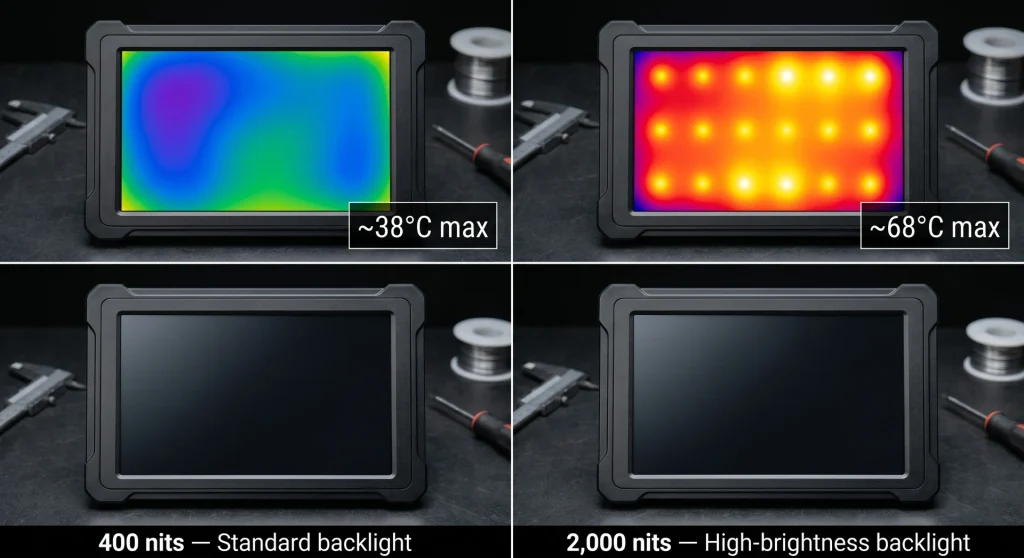
C’est celle-ci qui pose problème aux ingénieurs n’ayant jamais travaillé avec des panneaux à haute luminosité auparavant. Rétroéclairage LCD TFT de 2 000 nits Il ne s'agit pas simplement d'une version plus lumineuse d'un rétroéclairage de 400 nits ; la situation thermique est fondamentalement différente. À 2 000 nits, un panneau de rétroéclairage de 7 pouces peut dissiper entre 20 et 28 W de chaleur. La température de surface du panneau, à pleine luminosité et dans un environnement ambiant de 25 °C, atteint généralement 60 à 70 °C, voire plus.
Les écrans LCD possèdent une plage de températures de fonctionnement spécifiée pour une raison bien précise. À des températures supérieures à 70 °C de manière prolongée, l'alignement des cristaux liquides se dégrade, entraînant une perte de contraste, une dérive des couleurs (les verts ont tendance à jaunir) et, à terme, une rémanence d'image permanente. La température de fonctionnement indiquée dans la fiche technique de l'écran correspond à la température de la surface du verre, et non à la température ambiante. Les concepteurs qui voient une plage de températures de fonctionnement de « −20 °C à +70 °C » et en déduisent que le produit fonctionne dans des conditions ambiantes de 70 °C interprètent mal les spécifications.
La gestion thermique d'un panneau de 2 000 nits dans un boîtier étanche, sans refroidissement actif, est complexe pour les écrans de plus de 18 cm (7 pouces) à pleine luminosité. Au-delà de 25 cm (10 pouces), un refroidissement actif (caloducs, ventilateur ou refroidisseur thermoélectrique) est presque toujours indispensable pour maintenir le panneau dans sa plage de fonctionnement optimale. Ceci engendre des coûts supplémentaires, des pièces mobiles et des besoins de maintenance potentiels qui doivent être pris en compte lors de la conception du système.
Durée de vie du rétroéclairage — Le chiffre que tout le monde ignore
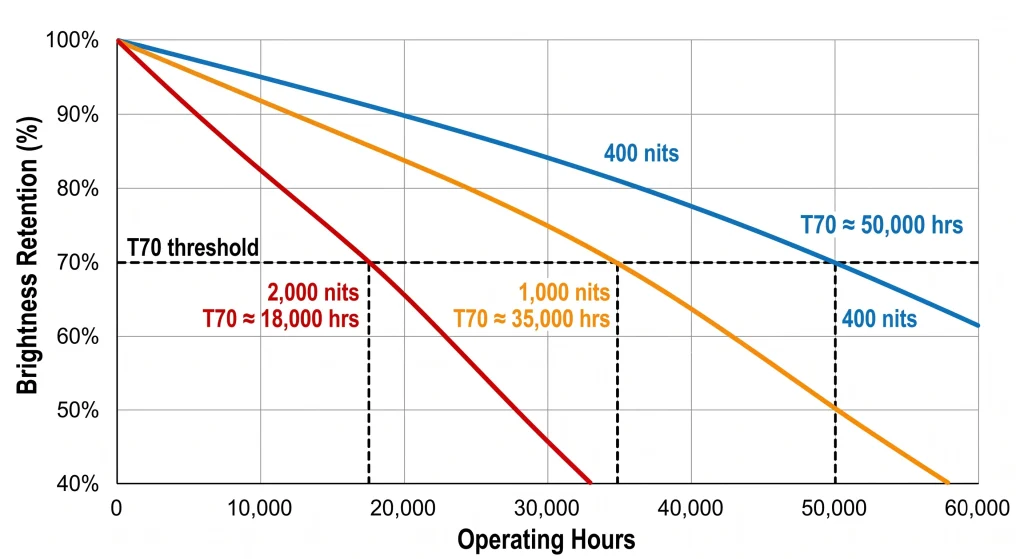
Le rétroéclairage des écrans LCD se dégrade avec le temps. La mesure standard du secteur est : T70 à vie — le nombre d'heures de fonctionnement avant que la luminosité du rétroéclairage ne chute à 70 % de sa valeur initiale. Pour une dalle de 400 nits avec une durée de vie T70 de 50 000 heures, fonctionnant 16 heures par jour, cela représente environ 8,5 ans avant son remplacement. Pour une dalle de 2 000 nits avec une durée de vie T70 de 20 000 heures et le même cycle d'utilisation, le remplacement s'effectue au bout de 3,4 ans environ.
Le principe physique est simple : un courant d’alimentation plus élevé pour les LED, nécessaire à une luminosité accrue, génère davantage de chaleur, ce qui accélère la dégradation de la jonction LED. Cette relation n’est pas linéaire : doubler le courant d’alimentation réduit considérablement la durée de vie des LED, voire la divise par deux, car la température de jonction augmente de façon non linéaire avec le courant. C’est pourquoi les panneaux haute luminosité conçus pour une durée de vie industrielle de 10 ans utilisent souvent une gradation adaptative intelligente : le rétroéclairage fonctionne à 2 000 nits uniquement lorsque la luminosité ambiante l’exige, et diminue à 400–600 nits en cas de faible luminosité ambiante, prolongeant ainsi considérablement la durée de vie réelle des LED.
Consommation d'énergie et coût énergétique
Ce facteur est rarement décisif dans les applications industrielles (les panneaux consomment beaucoup moins d'énergie que les moteurs, les compresseurs ou l'éclairage), mais il est essentiel à prendre en compte pour les déploiements hors réseau ou alimentés à l'énergie solaire et pour les équipements portables.
Un panneau de 7 pouces (18 cm) d'une luminosité de 400 nits consomme généralement entre 3 et 6 W au niveau du circuit de rétroéclairage. Un panneau de même taille, d'une luminosité de 2 000 nits, consomme entre 18 et 28 W. Sur une journée de fonctionnement de 16 heures, cela représente une différence de consommation d'énergie d'un facteur six, voire plus, entre 35 Wh/jour et 224 Wh/jour. Pour une borne interactive extérieure solaire ou une interface homme-machine (IHM) portable alimentée par batterie, cette différence constitue le seuil entre une conception viable et une conception nécessitant une batterie ou un système solaire nettement plus important que ce que le budget permet.
Analyse approfondie : Que signifient concrètement 400, 1 000 et 2 000 nits ?
nits — La norme intérieure qui fait ses preuves
Dans les catalogues d'écrans industriels, on décrit souvent une luminosité de 400 nits comme « luminosité standard », ce qui est légèrement réducteur. Dans les environnements intérieurs contrôlés (postes d'opérateurs en usine, postes de travail en salle de contrôle, instruments de laboratoire, panneaux de gestion de salles serveurs), 400 nits ne constituent pas un compromis. C'est la spécification adéquate. Écran LCD TFT IPS de 400 nits Dans un environnement industriel de 500 lux, il offre un rapport de luminance confortable de 5:1 par rapport à l'éblouissement réfléchi.
Qu'apporte concrètement une luminosité de 400 nits par rapport à des niveaux de luminosité supérieurs ? Une température de surface de la dalle plus basse (généralement de 35 à 40 °C à une température ambiante de 25 °C), une durée de vie du rétroéclairage plus longue (de 40 000 à 70 000 heures T70 pour les dalles de qualité), une consommation d'énergie réduite et un surcoût plus faible que les écrans grand public. Pour les opérateurs travaillant par roulement de 8 à 12 heures devant un écran IHM, la luminance plus douce d'un écran de 400 nits correctement configuré est en réalité meilleure pour l'ergonomie visuelle qu'une dalle de 2 000 nits suralimentée, même si sa luminosité est réduite à 20 % par logiciel.
Référence produit : Modules LCD TFT industriels — Kadi Display — Modules d'affichage LCD TFT standard et à large plage de températures de 4,3 à 10,1 pouces, avec options de luminosité de 400 à 600 nits et interfaces tactiles capacitives, MIPI DSI et RGB en option. Conviennent aux interfaces homme-machine (IHM) industrielles, aux panneaux de commande et aux terminaux embarqués.
1 000 nits — Le seuil pratique extérieur
Le seuil de 1 000 nits marque, à juste titre, la limite entre les produits destinés à une utilisation intérieure et extérieure sur le marché des écrans industriels. En termes de lux : à 10 000 lux (dans un espace extérieur couvert par une journée ensoleillée), un panneau de 1 000 nits avec un revêtement AG modéré (réflectance d’environ 1,5 %) produit un éblouissement réfléchi d’environ 48 cd/m². Le rapport de luminance est d'environ 20:1 — Excellente lisibilité. À 30 000 lux (conditions extérieures brumeuses), le rapport chute à environ 7:1, restant toutefois largement supérieur au seuil de lisibilité de 5:1.
La dissipation thermique à 1 000 nits reste gérable grâce à une conception thermique passive performante. Les températures de surface des panneaux, généralement comprises entre 45 et 55 °C dans un environnement à 25 °C, sont typiques. Un boîtier en aluminium extrudé bien conçu, assurant un contact thermique adéquat entre le module du panneau et la paroi du boîtier, peut supporter 1 000 nits sans ventilateur. La durée de vie du rétroéclairage à T70 se situe généralement entre 30 000 et 50 000 heures avec un tri optimal des LED et une gestion thermique efficace, ce qui correspond à 5 à 8 ans à raison de 16 heures par jour — une durée de vie raisonnable pour la plupart des produits industriels.
Référence produit : Moniteurs d'affichage industriels — Kadi Display — Moniteurs industriels haute luminosité adaptés à une utilisation en extérieur, de 8 à 21 pouces, y compris des modèles de 800 nits et 1 000 nits avec joint frontal IP65, large plage de températures de fonctionnement et collage optique en option.
2 000 nits — Une véritable performance solaire en extérieur, avec des conséquences
Deux mille nits représentent un véritable engagement technique, et non une simple spécification marketing. À 50 000 lux (soleil direct d'été), un panneau de 2 000 nits L'utilisation d'un collage optique et d'un revêtement AG permet d'atteindre un rapport de luminance d'environ 5 à 6:1, soit la limite d'une lisibilité confortable. Sans collage optique, le même panneau, dans les mêmes conditions d'éclairage ambiant, peut présenter un rapport de 2:1, ce qui reste techniquement visible mais entraîne une fatigue visuelle importante pour l'utilisateur.
Les conséquences thermiques et énergétiques sont bien réelles. On prévoit des températures de surface de 60 à 70 °C pour un panneau à pleine luminosité et une température ambiante de 25 °C. Au-delà de 32 °C (conditions estivales normales pour un terminal extérieur dans de nombreuses régions), un refroidissement actif devient nécessaire pour maintenir le panneau dans sa plage de fonctionnement optimale. La conception du boîtier pour un panneau de 2 000 nits requiert soit un dissipateur thermique en aluminium de grande taille, soit un refroidissement par air forcé, soit une combinaison des deux ; autant de solutions qui ont un coût et un encombrement non négligeables.
Le contrôle automatique de la luminosité est non optionnel à 2 000 nits Il s'agit d'un point essentiel pour la sécurité des opérateurs. Un écran fonctionnant à 2 000 nits dans un environnement sombre la nuit présente un danger pour les opérateurs et les conducteurs habitués à la vision nocturne. Tout écran extérieur conforme aux normes de luminosité devrait intégrer un capteur de luminosité ambiante et une fonction de gradation logicielle permettant de réduire la luminosité de l'écran entre 100 et 300 nits en cas de faible luminosité ambiante.
Tableau comparatif : Paramètres techniques 400 / 1 000 / 2 000 Nits
Le tableau ci-dessous récapitule les paramètres techniques pour les trois niveaux de luminosité. Utilisez-le comme référence pour justifier vos choix de spécifications de luminosité auprès des équipes d'approvisionnement ou de revue de projet.
Comparaison des paramètres d'ingénierie / 1 000 / 2 000 Nits
Le rôle de la gradation adaptative dans les conceptions à haute luminosité
Pourquoi une luminosité élevée fixe est presque toujours erronée
Un panneau de 2 000 nits fonctionnant à une luminosité fixe de 2 000 nits 24 heures sur 24 est presque certainement une conception erronée. gradation adaptative L’ajustement automatique de la luminosité du rétroéclairage en fonction de l’éclairement ambiant mesuré est la solution technique qui rend les écrans haute luminosité adaptés aux applications industrielles. La mise en œuvre est simple : un capteur de lumière ambiante (ALS), un circuit de commande de rétroéclairage par modulation de largeur d’impulsion (PWM) et une logique logicielle qui convertit les lux mesurés en un niveau de nits cible. De nombreux circuits intégrés de contrôle d’affichage intègrent nativement l’interface d’entrée ALS.
Les avantages sont cumulatifs. Un panneau de 2 000 nits fonctionnant 12 heures sur 16 à 600 nits (matin et soir en intérieur) et 4 heures à 1 800 nits (pic d'ensoleillement en extérieur l'après-midi) bénéficie d'une durée de vie du rétroéclairage nettement supérieure à celle d'un panneau fonctionnant en continu à pleine luminosité. La charge thermique est moindre pendant les périodes de faible luminosité, la température de jonction des LED se stabilise et la durée de vie T70 s'en trouve prolongée. Un système de gradation adaptative correctement implémenté sur un panneau de 2 000 nits peut offrir une durée de vie réelle comparable à celle d'un panneau fixe de 1 000 nits.
Résolution de gradation et scintillement
Un détail d'implémentation qu'il convient de préciser explicitement : Fréquence de gradation PWMLes LED de rétroéclairage sont généralement modulées par modulation de largeur d'impulsion (MLI) : la LED est allumée et éteinte rapidement, et la luminosité perçue est proportionnelle au rapport cyclique. À des fréquences MLI inférieures à environ 1 000 Hz, certains utilisateurs perçoivent un scintillement, notamment dans leur vision périphérique. À 200–400 Hz (fréquent dans les contrôleurs de rétroéclairage d'entrée de gamme), ce scintillement peut provoquer des maux de tête ou une gêne visuelle chez les personnes sensibles lors de longues heures de travail.
Pour les écrans industriels destinés à une utilisation intensive, spécifiez une fréquence de variation d'intensité PWM de 1 000 Hz ou plus, ou recherchez des panneaux offrant une variation d'intensité en courant continu (réduction de courant analogique plutôt qu'une commutation) pour la plage de faible luminosité. Il est conseillé de poser cette question directement à votre fournisseur d'écrans ; cette information n'est pas toujours mentionnée dans la fiche technique standard.
Liste de contrôle en sept questions avant de spécifier la luminosité
Les questions suivantes vous permettront de passer de « J’ai besoin d’un écran lumineux » à une spécification de luminosité précise et justifiable en moins de 20 minutes. Répondez-y dans l’ordre : les premières questions déterminent les suivantes.
Liste de vérification des spécifications de luminosité
Si, après avoir rempli cette liste de vérification, vos réponses convergent systématiquement vers 400 nits, résistez à la tentation de surestimer la valeur en spécifiant 1 000 nits. Le surcoût, la charge thermique et la durée de vie réduite sont des conséquences réelles. Fiez-vous aux données. À l’inverse, si le calcul de l’éclairement nécessite clairement 2 000 nits, n’essayez pas d’économiser en optant pour un panneau de 1 000 nits et en espérant que le revêtement AG compensera : ce ne sera pas suffisant et vous devrez remplacer les panneaux sur site d’ici deux ans.
Spécifications de luminosité personnalisées : Solutions d'affichage personnalisées — Kadi Display — Projets d'affichage personnalisés OEM et ODM, y compris des niveaux de luminosité non standard, l'intégration de collage optique, des spécifications personnalisées pour les pilotes de rétroéclairage et la qualification environnementale pour les applications industrielles extérieures exigeantes.
Scénarios d'application concrets
Interface homme-machine (IHM) pour ateliers de production : pourquoi 400 nits font généralement la différence
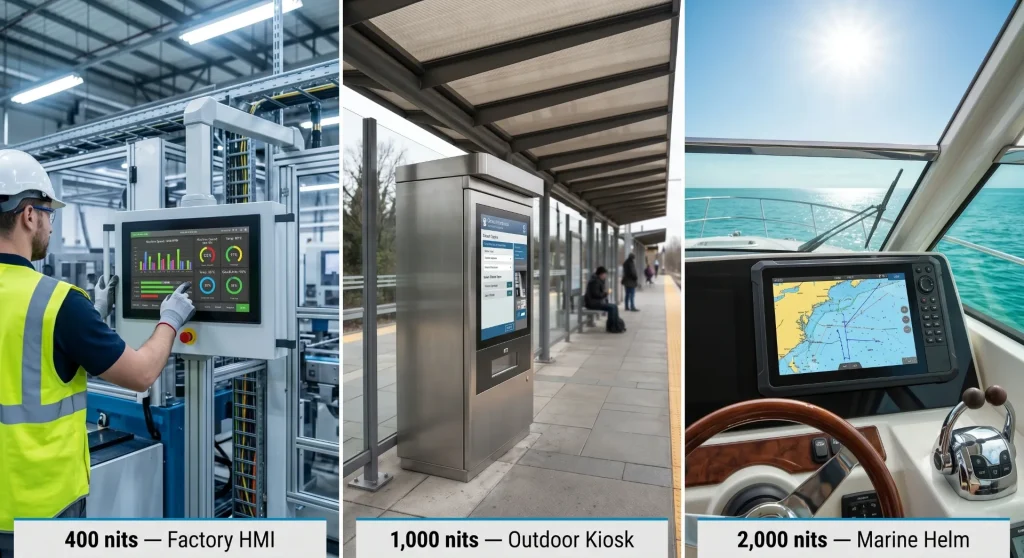
Un client avait initialement spécifié des panneaux de 1 000 nits pour un terminal opérateur en usine, car « l'usine peut être très lumineuse ». Or, une mesure d'éclairement sur site a révélé 450 lux à la surface du panneau, largement inférieur à la capacité de 400 nits. Le passage à un panneau de 400 nits a permis d'économiser 35 $ par unité sur une commande de 200 unités, de simplifier la conception thermique du boîtier et d'éliminer une alarme de surchauffe intermittente du circuit de rétroéclairage qui apparaissait sur le prototype de 1 000 nits. Le panneau de 400 nits n'était pas un compromis, mais un choix technique judicieux.
Terminal de billetterie extérieur — Quand 1 000 nits suffisent
Pour un terminal de billetterie installé sous un auvent (éclairement ambiant maximal mesuré en façade : 8 000 à 12 000 lux), un panneau de 1 000 nits avec revêtement AG modéré et collage optique a permis d’obtenir un rapport de luminance minimal de 6:1 dans les conditions de mesure les plus défavorables. Une option à 2 000 nits a été évaluée puis écartée après que la modélisation thermique a démontré que la conception du boîtier nécessiterait un refroidissement actif, engendrant un surcoût de 45 $ par unité. La solution à 1 000 nits s’est avérée efficace.
Présentoir de barre marine — L'argument en faveur de 2 000 Nits
Les écrans de navigation maritime constituent une application parfaitement légitime pour les panneaux de 2 000 nits. La combinaison de la navigation en pleine mer avec une forte réverbération du ciel, une exposition directe au soleil sous plusieurs angles et le caractère critique des informations de navigation justifient à la fois la haute luminosité et l'investissement associé dans la gestion thermique. Dans ce cas précis, le cahier des charges prévoyait une luminosité de 2 000 nits avec gradation adaptative (réduction progressive à 200 nits la nuit), un collage optique et un revêtement antireflet épais. Un boîtier en aluminium sur mesure, doté d'un dissipateur thermique à ailettes, a permis de gérer la charge thermique sans refroidissement actif. La durée de vie du rétroéclairage, dans les conditions réelles d'utilisation (équivalent à une luminosité moyenne de 800 nits), a été estimée entre 35 000 et 40 000 heures.
En résumé, choisissez le niveau d'éclairage adapté aux besoins de votre environnement, et non le plus élevé disponible.
La prochaine fois qu'un cahier des charges mentionne « 2 000 nits minimum » sans fournir de mesure en lux, insistez. Demandez les données d'éclairement ambiant. Renseignez-vous sur le traitement de surface. Demandez des informations sur la dissipation thermique. Demandez la durée de vie prévue du rétroéclairage. Dans la plupart des applications d'affichage industriel, la réponse sera de 400 nits, avec une option à 1 000 nits pour les applications exposées en extérieur ou semi-extérieur, et 2 000 nits réservés aux applications en plein soleil, pour lesquelles la dissipation thermique et la consommation énergétique du système ont été adaptées.
Le choix de la luminosité est une décision d'ingénierie, et non un choix marketing. L'écran qui impressionne le plus lors d'une démonstration en salle de conférence n'est pas forcément celui qui résistera cinq ans en usine ou à bord d'un navire sous les tropiques. Il faut mesurer l'environnement, calculer la luminosité en lux/nits, prendre en compte le traitement de surface, considérer la durée de vie du rétroéclairage et spécifier les paramètres en conséquence. C'est cette logique de sélection qui permet de produire des écrans performants. travail réel sur le terrain, pendant toute la durée de vie pour laquelle le produit a été conçu.
Pour obtenir de l'aide concernant les spécifications de luminosité et l'évaluation d'échantillons de panneaux à différents niveaux de luminosité (nits), veuillez contacter l'équipe d'ingénierie de Kadi Display à l'adresse suivante : Sales@sz-kadi.comDes échantillons de panneaux à 400, 1 000 et 2 000 nits sont disponibles pour les projets qualifiés, avec collage optique et surface AG en option pour des tests de comparaison directe dans votre environnement de déploiement.
Avertissement : La consommation d’énergie, la durée de vie (T70) et les données thermiques citées dans cet article sont des valeurs de référence du secteur. Documentation technique et fiches techniques des fabricants disponibles publiquement pour l'industrie de l'affichage. Les valeurs réelles varient selon le fabricant de la dalle, la catégorie de LED de rétroéclairage, le courant de commande, la température ambiante et la conception thermique du système. Tous les coûts indiqués ne sont que des estimations de marché indicatives. Veuillez vérifier toutes les spécifications auprès de votre fournisseur de dalles avant utilisation. finalisation Un design. Les marques déposées appartiennent à leurs propriétaires respectifs.
Précédent
Tendances des technologies d'affichage industriel 2025-2026
Suivant
Traitement anti-éblouissement et anti-reflets pour écrans industriels
Laisser un commentaire

Derniers blogs et nouvelles
- MIPI DSI Display Driver Development for Embedded Linux What Hardware Buyers Need to Confirm
- IP65 vs IP67 Industrial Displays: What the Rating Actually Covers
- How to Specify a Touchscreen for Food-Processing Equipment
- Thermal Management for High Brightness LCDs in Sealed Outdoor Enclosures
- 4 Wire vs 5 Wire Resistive Touchscreens for Industrial Equipment