
La haute luminosité n'est plus une option haut de gamme
2026-05-15
12:38
La haute luminosité n'est plus une option haut de gamme
Tendances des écrans industriels 2025-2026 : comment les luminosités de 400, 1 000 et 2 000 nits redéfinissent les normes
Par l'équipe technique de Kadi Display | www.kadidisplay.com Technologie d'affichage industriel
La spécification qui était auparavant découpée est désormais celle qui est vérifiée en premier.
Il existe un schéma d'approvisionnement que de nombreux ingénieurs en affichage reconnaîtront. Le projet débute par un cahier des charges précisant une luminosité de 1 000 nits, un collage optique et un revêtement antireflet. Vient ensuite l'analyse des coûts. La dalle de 1 000 nits coûte 30 % plus cher que l'alternative à 400 nits. Le collage optique ajoute 12 $ par unité. Le chef de projet se demande si ces deux éléments sont réellement nécessaires. La luminosité est réduite à 400 nits. Le collage optique est supprimé. Le produit est commercialisé. Dix-huit mois plus tard, l'équipe de maintenance reçoit des plaintes concernant l'installation dans le centre logistique, où le soleil de l'après-midi pénètre par les puits de lumière.
Ce schéma devient moins fréquent en 2025, non pas parce que les achats sont devenus plus éclairés, mais parce que L'écart de prix entre les panneaux industriels de 400 nits et de 1 000 nits s'est considérablement réduit. Au cours des trois dernières années, la décision qui nécessitait autrefois une justification et une validation des coûts par deux niveaux de direction est de plus en plus souvent prise dès la phase de spécification, sans escalade, car l'écart est passé d'un montant significatif pour le budget à un simple poste budgétaire.
Ce changement plus global est bien plus significatif qu'une simple variation de prix. Les environnements de déploiement des écrans industriels ont évolué. L'usine intelligente équipée de panneaux d'éclairage LED de 1 200 lux n'est plus celle de 2015 : elle est devenue la norme pour la construction de nouvelles installations dans les secteurs de l'automobile, des semi-conducteurs, de l'agroalimentaire et de la logistique. La borne de recharge extérieure pour véhicules électriques, qui doit rester lisible même en plein soleil, n'est plus une application de niche ; il s'agit d'une infrastructure déployée à grande échelle, avec des centaines de milliers d'unités supplémentaires chaque année dans le monde. L'idée selon laquelle 400 nits est la norme et une luminosité supérieure une option ne correspond plus à la réalité des lieux d'installation des écrans industriels.
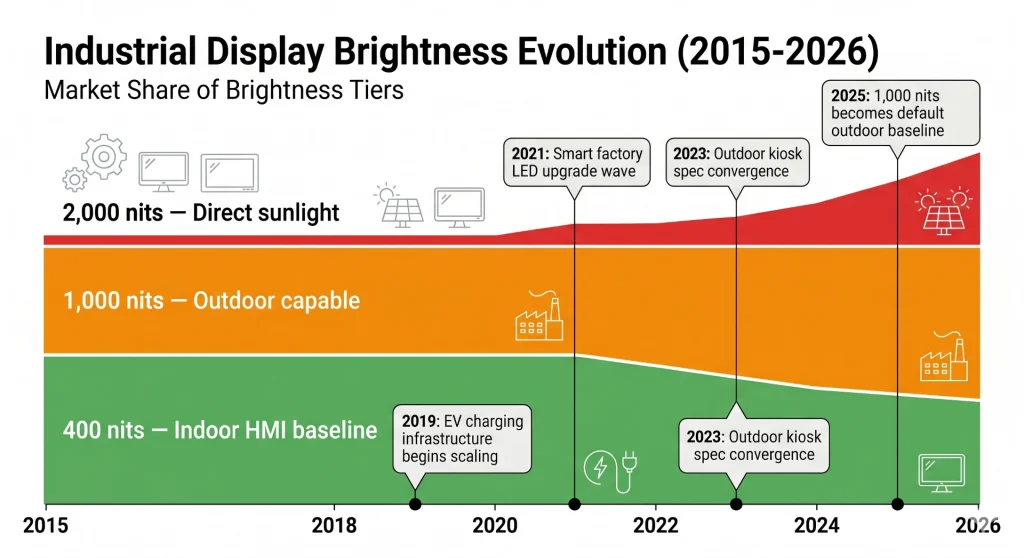
Contexte du marché : D’après les études générales sur le secteur de l’affichage et les données de la chaîne d’approvisionnement, la part des commandes de panneaux industriels spécifiant une luminosité de 800 nits ou plus est passée d’environ 18 % du marché en 2021 à environ 34 % début 2025. Le segment des écrans de 400 nits ou moins, bien que toujours le plus important en volume, a reculé d’environ 52 % à 38 % sur la même période. Il s’agit d’estimations indicatives ; les données réelles du marché varient selon les régions et les applications.
Ce qui a réellement changé : les quatre forces à l’origine du changement
L'éclairage des usines intelligentes est plus lumineux que celui des anciennes usines.
Le facteur le plus sous-estimé à l'origine des exigences croissantes en matière de luminosité des écrans industriels est le Mise à niveau de l'éclairage de l'usine intelligenteLes installations industrielles traditionnelles utilisaient un éclairage combinant lampes à vapeur de sodium, tubes fluorescents et lampes aux halogénures métalliques, produisant en moyenne 300 à 600 lux, avec des variations importantes d'un étage à l'autre. Les rénovations d'usines intelligentes modernes – et toutes les nouvelles constructions dans les secteurs de l'automobile, des semi-conducteurs et de la fabrication de précision – utilisent des systèmes LED haute efficacité conçus pour fournir un éclairage uniforme de 800 à 1 500 lux sur l'ensemble de l'étage, avec des zones d'éclairage dédiées aux tâches à plus de 2 000 lux.
L'écran IHM parfaitement lisible sous un éclairage fluorescent de 400 lux peut ne plus l'être sous un éclairage LED de 1 200 lux, non pas à cause d'une modification de l'écran lui-même, mais à cause d'un changement de l'environnement ambiant. Les ingénieurs qui ont spécifié les écrans IHM pour les ateliers de production il y a cinq ans et qui reçoivent aujourd'hui des plaintes concernant leur lisibilité de la part de nouvelles installations sont souvent confrontés à ce type d'inadéquation. Les spécifications de l'écran étaient adaptées à l'installation existante au moment de leur rédaction ; elles sont désormais inadaptées à l'installation actuelle.
Par définition, l'infrastructure de recharge pour véhicules électriques est une catégorie extérieure.
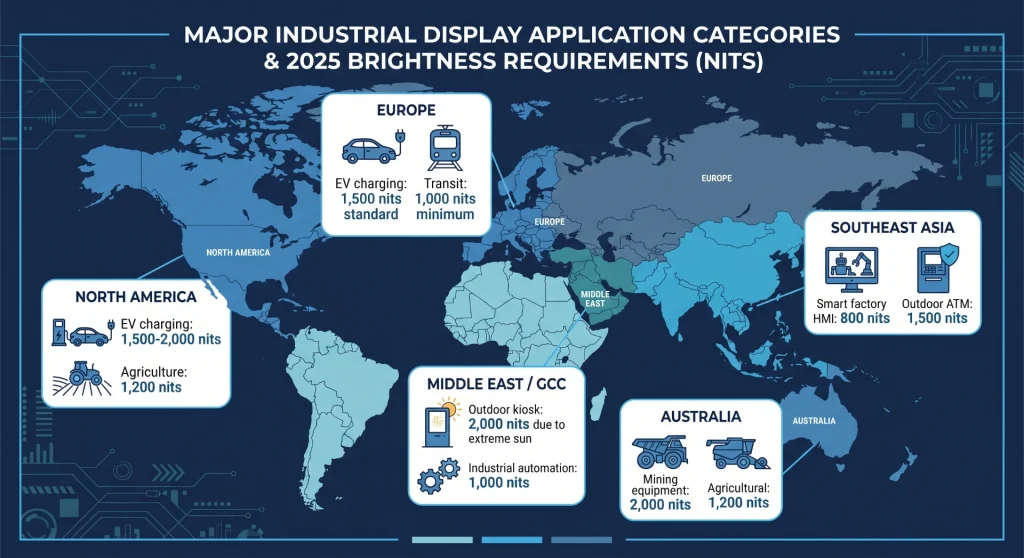
Le déploiement mondial des infrastructures de recharge pour véhicules électriques génère des centaines de milliers de nouvelles installations d'affichage extérieur chaque année. panneaux d'affichage des bornes de recharge pour véhicules électriques Ces bornes ne sont pas conçues pour une utilisation occasionnelle en extérieur ; elles sont installées en permanence à l’extérieur, quelles que soient les conditions météorologiques. Les bornes de recharge publiques en Amérique du Nord, en Europe et en Asie devraient fonctionner 24 h/24 et 365 j/an, avec une exposition directe au soleil pendant une grande partie des heures d’ensoleillement, selon leur orientation.
La luminosité minimale requise pour un écran de borne de recharge pour véhicule électrique, garantissant une lisibilité optimale en plein soleil (50 000 à 80 000 lux crête), avec collage optique et revêtement AG, est d'environ 1 500 nits. En dessous de ce seuil, le rapport de contraste effectif (rapport entre la luminance de l'écran et la lumière ambiante réfléchie) est inférieur à 5:1, seuil minimal généralement admis pour une lecture prolongée selon les normes d'ergonomie. La seule catégorie des bornes de recharge pour véhicules électriques ajoute environ plus de 200 000 unités d'affichage extérieures par an dans le monde. avec des spécifications de luminosité qui auraient été considérées comme celles d'un produit haut de gamme spécialisé en 2019.
Les environnements médicaux s'éclaircissent, au lieu de s'assombrir.
L'idée que les écrans médicaux fonctionnent dans des environnements faiblement éclairés et contrôlés est de plus en plus obsolète. Les blocs opératoires modernes utilisent des systèmes d'éclairage chirurgical LED multi-sources conçus pour fournir un flux lumineux de 40 000 à 160 000 lux au niveau du champ opératoire. Les écrans entourant l'intervention – moniteurs d'imagerie endoscopique, écrans de la machine d'anesthésie, panneaux de surveillance patient – doivent rester lisibles malgré la diffusion de la lumière par cet éclairage chirurgical. Les fabricants de dispositifs médicaux exigent désormais systématiquement une luminosité de 1 000 à 2 000 nits pour les écrans utilisés en bloc opératoire.
Les dispositifs de soins au point de service présentent un défi différent mais connexe. équipement de diagnostic portable Utilisés dans les services d'urgence, les ambulances, les postes de triage extérieurs et les centres de santé communautaires – des environnements sans aucun point commun avec une salle de lecture de radiologie faiblement éclairée –, les écrans de 400 nits, pourtant performants dans un contexte clinique idéal, deviennent illisibles lorsqu'un ambulancier les utilise dans un véhicule portes ouvertes, en plein soleil. Depuis 2022 environ, le marché des écrans médicaux tend vers une luminosité minimale de 800 à 1 200 nits pour les appareils portables.
Les coûts de fabrication des panneaux ont suivi la tendance des volumes.
Le facteur commercial qui rend toutes les solutions décrites ci-dessus déployables et non simplement souhaitables est le coût des dalles. Les dalles LCD IPS TFT haute luminosité (1 000 nits) sont fabriquées sur les mêmes lignes de production que les dalles à luminosité standard ; la différence réside principalement dans la densité du rétroéclairage LED, le courant de commande et la gestion thermique. Avec l’augmentation des volumes de commande de dalles 1 000 nits, la rentabilité de leur fabrication s’est considérablement améliorée.
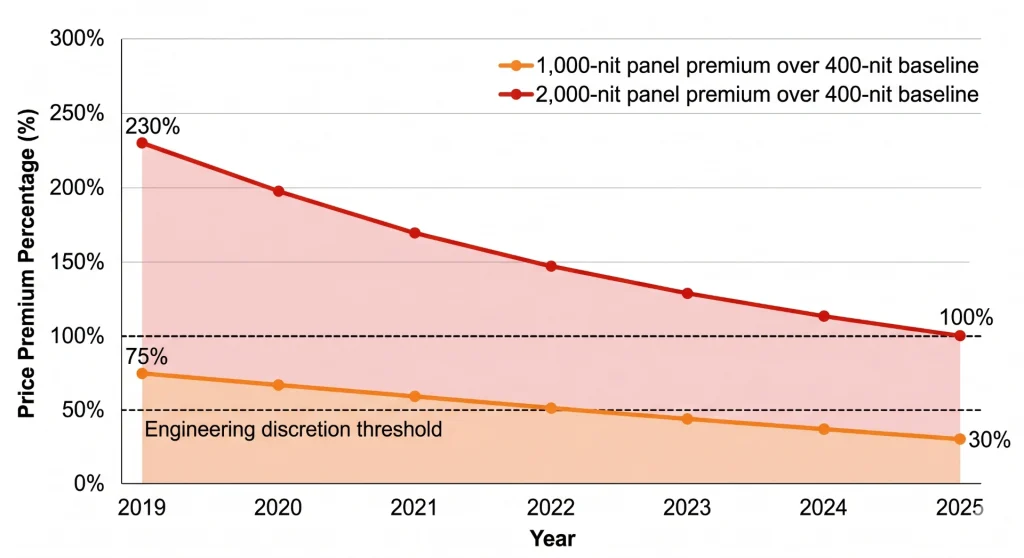
Entre 2020 et 2025, la prime de prix pour un écran IPS de 7 pouces et 1 000 nits par rapport à un écran comparable de 400 nits a diminué, passant d'environ 65 à 80 % à environ 25 à 35 %La prime pour le collage optique sur un panneau de même taille est passée d'environ 40-60 % à 15-25 %. Il ne s'agit pas de réductions négligeables — elles font passer la décision de « cela nécessite l'approbation de la haute direction » à « cela relève du pouvoir discrétionnaire normal de l'ingénierie de projet ».
Comment les niveaux de luminosité seront redéfinis en 2025
400 nits : toujours correct pour un nombre restreint d’environnements
L'éclairage de 400 nits n'est pas obsolète, mais son domaine d'application s'est restreint. Les environnements où 400 nits restent véritablement adéquats sont : les salles de contrôle dédiées avec un éclairage uniforme et contrôlé inférieur à 500 lux ; les écrans de gestion des serveurs et des centres de données fonctionnant dans des conditions de faible luminosité ambiante constante ; les équipements situés dans des espaces industriels clos où l'éclairage est artificiel en permanence et ne comprend pas d'éclairage de travail LED haute intensité.
Que représentent 400 nits ? n'est plus approprié pour: panneaux de commande d'atelier dans les nouvelles installations intelligentes avec éclairage LED de plus de 800 lux ; tout terminal ayant une vue directe sur une fenêtre ou un puits de lumière pendant plus de deux heures par jour ; écrans côté machine sur des équipements pouvant être déplacés entre les zones intérieures et extérieures ; et tout produit conçu pour être vendu sur un marché mondial où les clients finaux peuvent se trouver dans des régions où les conditions d'éclairage ambiant moyen sont plus élevées que sur le marché d'origine du concepteur.
Les opérateurs qui commettent cette erreur sont ceux qui effectuent leurs tests dans leur propre laboratoire – généralement un environnement de bureau européen ou nord-américain à 300–400 lux – et expédient leurs produits à des clients en Asie du Sud-Est, au Moyen-Orient ou en Afrique subsaharienne, où les conditions d'éclairage ambiant sont nettement plus intenses. Une spécification de 400 nits qui réussit les tests de lisibilité en laboratoire dans un environnement industriel tempéré peut échouer aux tests de lisibilité sur le terrain dans un environnement tropical équivalent.
1 000 nits : la nouvelle norme extérieure, et non un luxe
L'évolution la plus claire du marché des écrans industriels se dirige vers la normalisation de 1 000 nits comme seuil de référence pour une utilisation en extérieur Plutôt qu'une option haut de gamme. Il y a trois ans, spécifier une luminosité de 1 000 nits pour un écran de terminal extérieur nécessitait une justification explicite dans le cahier des charges. Aujourd'hui, pour tout écran destiné à un environnement extérieur exposé de manière significative, c'est la norme.
L'évolution de la chaîne d'approvisionnement est visible dans la manière dont les fabricants de panneaux et les fournisseurs de modules d'affichage cataloguent leurs produits. Alors que les catalogues de produits 2019-2021 présentaient les panneaux haute luminosité dans une gamme extérieure distincte, les catalogues 2024-2025 proposent de plus en plus de panneaux IPS de 1 000 nits en option standard, au même titre que les modèles à luminosité standard, avec les mêmes délais de livraison et sans tarification spécifique pour les projets spéciaux.
Produits de référence : Modules LCD industriels haute luminosité — Kadi Display — Guide de sélection d'écrans LCD haute luminosité de qualité industrielle couvrant les panneaux extérieurs de 1 000 à 2 500 nits, les options de collage optique, la gestion thermique et les spécifications d'interface pour les applications industrielles.
2 000 nits : Passer de l’extrême à la norme avancée
En 2020, les panneaux de 2 000 nits occupaient une place sur le marché comparable à celle qu'occupent aujourd'hui les panneaux de 1 000 nits : disponibles sur le marché, ils nécessitaient toutefois une ingénierie de projet dédiée et un prix élevé. Cette situation évolue. Entre 2020 et 2025, le surcoût d'un panneau de 2 000 nits par rapport à un modèle de base de 400 nits a diminué, passant de 200 à 250 % à environ 80 à 120 %. Ce surcoût reste important, mais il ne représente plus un ordre de grandeur justifiant une justification exceptionnelle pour chaque projet.
Les applications qui contribuent à l'adoption généralisée des panneaux de 2 000 nits sont principalement la recharge des véhicules électriques et les infrastructures de transport. Ces deux secteurs impliquent des déploiements extérieurs à grande échelle, avec des volumes d'achat suffisamment importants pour permettre aux fabricants de panneaux d'obtenir des prix compétitifs. Lorsque les opérateurs de réseaux de recharge pour véhicules électriques spécifient une intensité lumineuse de 1 500 à 2 000 nits dans leurs exigences d’affichage — ce que plusieurs grands opérateurs ont fait en Amérique du Nord et en Europe — la chaîne d'approvisionnement réagit en fabriquant en grande quantité selon ces spécifications, ce qui réduit le coût unitaire pour chaque acheteur de ce niveau de luminosité.
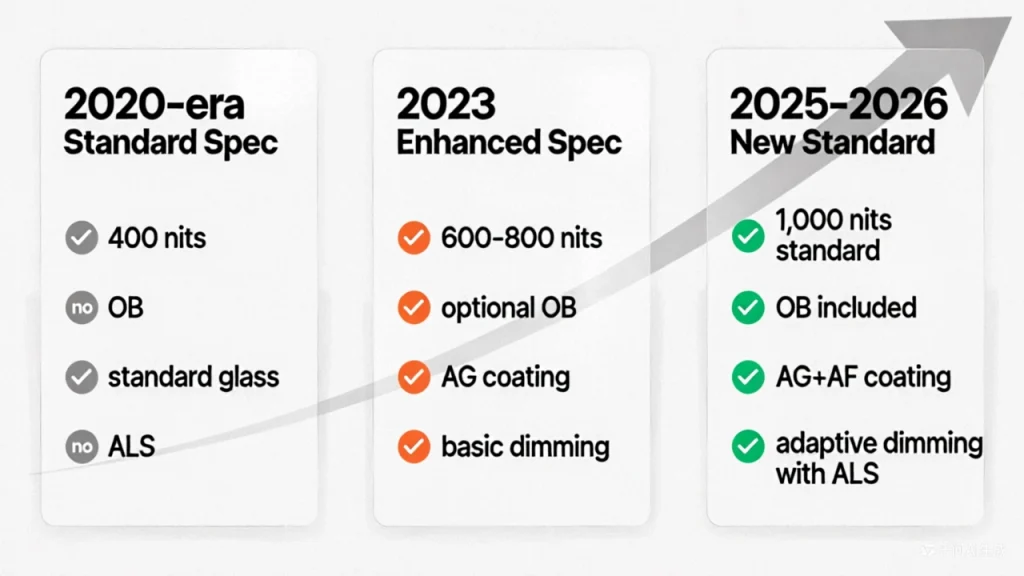
Redéfinition des niveaux de luminosité — 2018-2020 vs 2025-2026
Les données de marché représentent des estimations directionnelles basées sur l'observation du secteur et l'analyse de la chaîne d'approvisionnement. Les valeurs réelles varient selon la région, le segment d'application et le fabricant de panneaux.
Le changement de paradigme coût-performance : pourquoi une luminosité élevée n’est plus un compromis insurmontable
Ce que révèlent les chiffres
Le tableau suivant documente l'évolution approximative des primes de prix pour les principales spécifications liées à la luminosité entre 2020 et 2025. Il s'agit de fourchettes indicatives compilées à partir d'observations générales de la chaîne d'approvisionnement et d'études sectorielles, et non de données de marché certifiées, mais elles sont globalement cohérentes avec les informations communiquées par les équipes d'approvisionnement en écrans dans l'ensemble du secteur.
Surcoût lié aux spécifications de luminosité — Comparaison 2020 vs 2025
La ligne relative à la gradation adaptative dans ce tableau mérite d'être soulignée. Les circuits intégrés de commande de rétroéclairage intégrant une entrée ALS (capteur de lumière ambiante), plusieurs canaux de gradation PWM et des courbes de luminosité programmables, autrefois composants relativement spécialisés, sont désormais disponibles dans les catalogues des principaux distributeurs de semi-conducteurs. Le coût de nomenclature de l'ajout d'une fonction de gradation adaptative intelligente à un écran est désormais de 3 à 6 dollars par unité. À volume modéré, le coût est inférieur à celui d'une seule intervention sur site. Sachant que la gradation adaptative peut prolonger la durée de vie du rétroéclairage T70 de 20 000 heures à plus de 40 000 heures en conditions d'utilisation extérieure typiques, le retour sur investissement est évident.
L'équation du coût du système
Un élément souvent négligé dans les discussions sur les spécifications de luminosité est le coût total du système : il s’agit du coût global du choix de l’écran sur toute la durée de vie du produit, et non du seul coût de fabrication unitaire. La comparaison pertinente n’est pas celle du coût d’une dalle de 400 nits contre celui d’une dalle de 1 000 nits : elle prend en compte cette différence, à laquelle s’ajoutent les coûts de maintenance d’un écran non conforme aux exigences de lisibilité sur le terrain, le coût d’atteinte à la réputation d’un produit faisant l’objet de plaintes de la part des utilisateurs, et le coût d’un cycle de révision du produit si la spécification de luminosité s’avère erronée.
Les ingénieurs qui ont déjà dû procéder à une correction de la luminosité après le lancement d'un produit — en remplaçant des écrans installés sur le terrain car les spécifications d'origine étaient inadéquates — ont tendance à devenir de fervents défenseurs de spécifications de luminosité adéquates dans les projets ultérieurs. coût du remplacement d'un écran de terrain pour des raisons de lisibilité Le coût est généralement 15 à 30 fois supérieur à celui de la légère amélioration de la luminosité qui aurait permis d'éviter ce problème. Ce ratio rend, a posteriori, la justification d'une surprime de 25 à 35 % sur le prix des panneaux tout à fait logique.
Perspectives du marché — Préparation des segments pour 2025-2026
Toutes les applications d'affichage industriel n'en sont pas au même stade de cette transition. Le tableau ci-dessous compare les principaux segments aux normes minimales de luminosité actuelles et aux objectifs prévisionnels pour la conception des produits à l'horizon 2026.
Luminosité des écrans industriels — Matrice de préparation des segments 2025-2026
La catégorie « terminaux périphériques IoT industriels » illustre un segment d'application véritablement nouveau, qui n'existait pas à cette échelle il y a cinq ans. Les nœuds périphériques IoT — des terminaux de calcul qui agrègent les données des capteurs, effectuent des inférences locales et fournissent une interface utilisateur sur les sites de production et d'infrastructure — sont de plus en plus déployés dans des environnements semi-extérieurs ou soumis à une forte variabilité d'éclairage : sous-stations électriques, toits, sites agricoles isolés, plateformes offshore. Conçus pour les environnements extérieurs dès leur conception, ces appareils bénéficient d'une luminosité de 1 000 nits, qui devient la norme pour l'affichage dans ce type d'application.
En rapport: Écrans tactiles industriels — Kadi Display — Guide de sélection des moniteurs tactiles industriels 2025 couvrant les exigences de luminosité, la résistance environnementale, le collage optique et les spécifications d'interface pour les applications d'usine intelligente et d'extérieur.
Le facteur de rétroéclairage Mini-LED : pourquoi 2 000 nits deviennent plus pratiques
Ce que la mini-LED apporte aux panneaux industriels haute luminosité
L'une des technologies clés à l'origine de l'amélioration du rapport coût-performance des panneaux industriels haute luminosité est la maturation de Rétroéclairage Mini-LED Dans les applications industrielles, les panneaux LCD haute luminosité traditionnels de 1 000 à 2 000 nits utilisaient des matrices de LED à éclairage direct conventionnelles avec une densité de LED relativement faible ; l’obtention d’une luminosité élevée nécessitait un courant d’alimentation élevé par LED, ce qui accélérait le vieillissement et générait une chaleur concentrée au niveau de chaque LED.
Les rétroéclairages Mini-LED utilisent une densité de LED nettement supérieure (des centaines, voire des milliers de micro-LED par unité de surface, contre quelques dizaines pour les systèmes à éclairage direct classiques). Chaque LED fonctionne avec un courant d'alimentation plus faible pour obtenir le même flux lumineux total, ce qui réduit la température de jonction et prolonge considérablement sa durée de vie à luminosité égale. Un rétroéclairage Mini-LED atteignant 2 000 nits peut avoir une durée de vie T70 comparable à celle d’un rétroéclairage direct conventionnel de 1 000 nits. — résolvant l'une des objections techniques les plus importantes à la spécification de haute luminosité (durée de vie réduite du rétroéclairage).
Amélioration de la gestion thermique
La dissipation thermique répartie des Mini-LED simplifie également la gestion thermique du boîtier. Alors qu'une matrice LED haute luminosité classique tend à créer des points chauds localisés nécessitant un refroidissement ciblé, l'émission répartie des Mini-LED répartit la charge thermique de manière plus uniforme sur la surface du panneau. Ceci rend possible une gestion thermique passive à des niveaux de luminosité qui exigeaient auparavant un refroidissement actif, et réduit la température globale de la surface du boîtier, améliorant ainsi la sécurité des opérateurs pour les écrans situés à hauteur des yeux ou à proximité et réduisant les contraintes thermiques sur la couche de cristaux liquides du panneau.
Pour les concepteurs de produits industriels, cela signifie qu'un boîtier étanche IP65 contenant un panneau rétroéclairé Mini-LED de 1 500 nits peut atteindre des performances thermiques raisonnables sans ventilateur ni caloduc, alors que la même luminosité sur un rétroéclairage conventionnel aurait pu nécessiter un refroidissement actif. L'association de l'efficacité des Mini-LED et de la baisse des coûts des panneaux fait de 1 500 nits une spécification par défaut pratique en 2025-2026. pour des applications qui nécessitaient auparavant des panneaux conventionnels de 1 000 nits et un effort de conception thermique important.
Plage de températures étendue et haute luminosité : Écrans TFT à large plage de températures — Kadi Display — Guide technique pour la sélection d'écrans LCD TFT industriels à large plage de températures, incluant la conception du rétroéclairage LED haute luminosité (1 000 à 3 000 nits), les options Mini-LED, la gestion thermique et l'intégration dans un boîtier conforme à la norme IP.
Argumentaire en faveur de la spécification d'une luminosité élevée dès le premier jour
Longévité des plateformes et le piège des mises à niveau
Les écrans industriels ont une longue durée de vie. Un module d'affichage conçu aujourd'hui pour une interface homme-machine (IHM) en usine ou un terminal extérieur restera probablement en production pendant 7 à 12 ans. L'environnement ambiant d'une nouvelle usine intelligente construite autour de cette IHM évoluera au cours de cette décennie : les améliorations de l'éclairage, les modifications de l'agencement de la production et l'extension des heures d'ouverture peuvent toutes faire dépasser le niveau d'éclairement ambiant au niveau de l'écran les valeurs initialement prévues.
Un produit conçu avec une luminosité de 400 nits et sans possibilité de mise à niveau est un produit qui rencontrera des difficultés. Une plainte concernant la lisibilité a été formulée à un moment donné de sa durée de vie en production.Cela nécessiterait soit une refonte de la plateforme, soit la reconnaissance par le marché que l'écran ne répond plus aux exigences actuelles du secteur. Un produit conçu avec une luminosité de 1 000 nits et un système de gradation adaptative offre une marge de manœuvre importante : sa luminosité peut être réduite pour un confort optimal en intérieur et il peut fonctionner à un niveau plus proche de son maximum dans les environnements où la lumière ambiante augmente.
La direction réglementaire des voyages
Les cahiers des charges des grands opérateurs industriels, des autorités de transport et des agences d'infrastructures sont de plus en plus explicites quant aux exigences de luminosité. Plusieurs autorités de transport européennes ont désormais intégré la spécification de valeurs minimales de luminance dans leurs appels d'offres relatifs aux écrans. exigences de 1 000 à 1 500 nits Ces exigences figurent dans les spécifications des panneaux d'information voyageurs des principaux réseaux de transport métropolitains. La réglementation relative aux dispositifs médicaux dans l'UE (MDR 2017/745) et aux États-Unis (recommandations de la FDA sur la qualité des dispositifs d'affichage) favorise la convergence vers des spécifications de luminosité plus élevées pour les écrans destinés aux opérateurs en milieu clinique.
Les ingénieurs et les chefs de produit qui attendent l'apparition d'une exigence réglementaire avant d'augmenter la luminosité de leurs produits adoptent une approche réactive. Concevoir en fonction des exigences réglementaires actuelles, et non de celles en vigueur lors de la conception de la génération précédente, est ce qui garantit la compétitivité des produits tout au long de leur cycle de vie.
Conseils pratiques pour les équipes de conception de produits en 2025
Commencez par une mesure en lux, et non par une spécification historique.
L'action la plus utile qu'une équipe produit puisse entreprendre au début de la définition des spécifications d'affichage est de mesurer l'éclairement ambiant sur le lieu d'installation réel (ou représentatif). Pour les produits existants mis à jour, il est essentiel d'utiliser un luxmètre dans l'environnement d'installation cible pendant les heures de fonctionnement les plus lumineuses, et non lors d'une visite sur site à 9 h du matin en hiver. Pour les nouveaux produits destinés à un déploiement dans plusieurs régions, il convient d'utiliser des tables de référence d'éclairement documentées pour les zones géographiques et les périodes cibles, et de concevoir en fonction du 90e percentile, et non de la médiane.
Considérer le collage optique comme une solution par défaut
Compte tenu de la réduction des coûts du collage optique au cours des trois dernières années, la pratique technique par défaut devrait passer de « ajouter un collage optique si justifié » à ‘supprimer OB uniquement si cela est clairement inutile’Le collage optique améliore simultanément la lisibilité, la durabilité mécanique, l'étanchéité à l'humidité et la précision tactile. Le surcoût est désormais inférieur à 25 % pour la plupart des modules. Pour toute application en extérieur ou semi-extérieur, ce surcoût n'est plus significatif.
Spécifiez la gradation adaptative pour tout panneau supérieur à 800 nits.
Le contrôle adaptatif de la luminosité est le mécanisme qui permet aux écrans haute luminosité d'être utilisés dans des environnements mixtes et qui prolonge la durée de vie du rétroéclairage afin de répondre aux exigences de durée de vie des produits. Au niveau des composants, il nécessite un capteur ALS et un pilote de rétroéclairage compatible PWM. ajout total de la BOM d'environ 3 à 6 $ au volumeL'extension de la durée de vie du rétroéclairage qu'elle offre — doublant souvent les heures T70 effectives aux cycles de service typiques — en fait l'un des investissements les plus rentables disponibles dans la conception des systèmes d'affichage.
Pour toute question relative aux spécifications de luminosité, pour obtenir des échantillons de produits à 400, 1 000 et 2 000 nits, ainsi que pour vous approvisionner en modules LCD TFT haute luminosité avec collage optique et options de large plage de températures, veuillez contacter Kadi Display à l’adresse Sales@sz-kadi.com. La gamme d’écrans industriels de Kadi Display couvre une plage de luminosité de 800 à 2 500 nits avec les interfaces MIPI DSI, LVDS et… eDP interfaces, large plage de températures de fonctionnement de −30°C à +85°C et qualité de production ISO9001/ISO13485/IATF16949.
Résumé — Les chiffres qui signalent une transition du marché
Le passage d'une norme de 400 nits pour l'affichage industriel à une norme de 1 000 nits pour l'affichage extérieur ne prédit pas l'évolution du marché, mais décrit sa situation actuelle. Le secteur de la recharge des véhicules électriques, à lui seul, a validé l'utilisation de 1 000 à 2 000 nits pour une application à grande échelle. La modernisation de l'éclairage des usines intelligentes repousse les limites de la lisibilité des interfaces homme-machine (IHM) intérieures, qui dépassent les capacités des panneaux de 400 nits. Les équipements médicaux et agricoles adoptent désormais des spécifications qui relevaient du segment haut de gamme il y a trois ans.
Pour les équipes produit qui conçoivent des présentoirs industriels en 2025 et 2026, la conséquence pratique est simple. Considérez la valeur de 400 nits comme la spécification désormais réservée à un usage intérieur.Au lieu de constituer la norme universelle qu'elle était auparavant, considérez 1 000 nits comme le point de départ pour toute application extérieure. Quant à 2 000 nits, il ne s'agit plus d'une exception haut de gamme, mais d'une spécification commercialement accessible et techniquement réalisable avec les options de fabrication actuelles. L'écart de prix qui rendait la haute luminosité difficile à évaluer s'est réduit. Les environnements d'utilisation qui la rendent nécessaire se sont multipliés. C'est la combinaison de ces deux facteurs qui transforme un « plus » en standard.
Les ingénieurs qui intègrent ce principe dès la conception de leur prochaine plateforme produit livreront des produits compétitifs tout au long de leur cycle de vie. Ceux qui attendent une réclamation sur le terrain pour justifier leur choix en interne auront une discussion bien plus difficile avec leurs responsables produit dans dix-huit mois.
Parcourez le catalogue complet d'écrans industriels de Kadi Display, y compris les modules LCD TFT IPS de 400 nits, 1 000 nits et 2 000 nits avec LVDS, MIPI DSI et eDP Interfaces, collage optique, revêtement AG, fonctionnement à large plage de températures et technologie tactile PCAP : rendez-vous sur kadidisplay.com. Conseils en ingénierie et assistance aux projets OEM/ODM : Sales@sz-kadi.com.
Avertissement : Les estimations de parts de marché, les primes de prix et les données sur les tendances d’adoption mentionnées dans cet article sont des estimations directionnelles basées sur des observations générales du secteur et des études de la chaîne d’approvisionnement publiées jusqu’au début de 2025. Elles ne constituent pas une étude de marché certifiée et ne doivent pas servir de base à des décisions d’investissement sans vérification indépendante. Les spécifications techniques et la disponibilité des produits sont susceptibles d’évoluer. Toutes les marques et tous les noms de produits appartiennent à leurs propriétaires respectifs. Les durées de vie indiquées pour le rétroéclairage LED sont des fourchettes sectorielles indicatives ; les valeurs T70 réelles dépendent du courant d’alimentation, de la température de jonction et des spécifications de chaque LED.
Précédent
Écrans TN, IPS et VA : guide comparatif pour les applications industrielles et automobiles
Suivant
Des environnements intérieurs aux environnements extrêmes : un cadre de décision basé sur le spectre pour la luminosité des écrans industriels
Laisser un commentaire

Derniers blogs et nouvelles
- Industrial LCD EOL: What Happens from Pre-Announcement to Replacement Mass Production?
- Electronic Component Obsolescence Management for Industrial Displays: An OEM Guide
- How to Develop a Production Ready Custom Display Assembly TFT Module Touch Cover Glass FPC Bonding and Mounting
- 15 Pin vs 22 Pin Raspberry Pi DSI Connectors Cable Pinout and Compatibility
- Native MIPI DSI vs LVDS or HDMI Bridge: An OEM Display Architecture Decision Guide