
Huis
-
Blog & Nieuws
-
Last-Time Buy or LCD Replacement? A Decision Framework for Long-Lifecycle Display Projects
Last-Time Buy or LCD Replacement? A Decision Framework for Long-Lifecycle Display Projects
2026-10-30
12:00
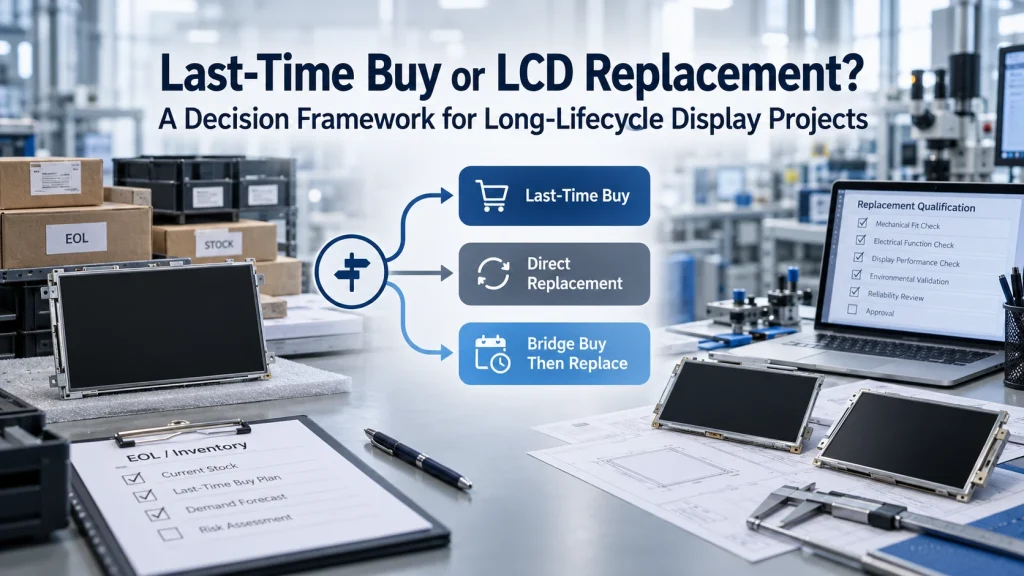
A last-time buy is usually the better choice when remaining demand is bounded, the current design is frozen, and the inventory can be stored and consumed with acceptable risk. An LCD replacement is usually stronger when the program still has years to run, demand is uncertain, or the old module creates recurring supply exposure. Many OEMs need a third option: buy enough of the outgoing display to protect near-term production while qualifying a successor.
The decision should not rest on unit price alone. It affects working capital, engineering capacity, field service, regulatory evidence, production change control, and the risk of another shortage. A structured comparison helps purchasing and engineering choose one plan instead of reacting separately to the same EOL notice.
First separate the three practical paths
Path A: Last-time buy
A last-time buy reserves a final quantity of the outgoing LCD before the last order date. It preserves the released product configuration and can avoid immediate redesign work. The tradeoff is that the OEM accepts forecast, cash, storage, aging, and shortage risk for the remaining life of the program.
Path B: Qualify an LCD replacement
The OEM changes to another display module and releases the new configuration after verification. This reduces dependence on obsolete stock but introduces engineering work. The replacement may require changes to the enclosure, FPC or cable, power sequencing, display timing, backlight control, touch system, firmware, or controller board. The industrial LCD drop-in replacement checklist helps teams identify these hard stops before treating a candidate as compatible.
Path C: Use a bridge buy while qualifying the replacement
This hybrid plan uses a limited last-time buy to cover production and service demand during qualification. It often fits long-lifecycle equipment because it prevents a rushed release without committing the entire remaining forecast to old inventory. The bridge quantity should match a dated qualification and production-change plan, not an open-ended estimate.
Define the demand that the decision must protect
Start with remaining exposure rather than the supplier’s minimum order quantity. Separate normal production, committed customer orders, warranty or service demand, destructive-test samples, expected yield loss, and safety stock. Then define the period each demand source must cover.
Forecast uncertainty matters as much as the forecast itself. A mature product with stable orders and a scheduled retirement date may support a defensible last-time buy. A program with volatile demand, possible extensions, or a long service tail can turn the same purchase into either a shortage or years of excess stock.
Record the assumptions behind the quantity. Include expected annual usage, retirement date, service policy, scrap allowance, storage life, cancellation terms, and whether mixed use of old and new displays is permitted. A single total without those assumptions cannot support a review later.
Compare total exposure, not just purchase price
The last-time-buy cost includes more than the invoice. Add financing or working-capital cost, storage, inspection, handling, insurance, traceability, possible aging loss, and the financial effect of unused stock. Also test the shortage case: if demand exceeds the final quantity, the OEM may still face an emergency redesign under worse schedule pressure.
The replacement path has a different cost structure. It may include samples, drawings, engineering time, fixtures, firmware work, environmental or optical testing, pilot builds, documentation updates, and controlled production release. Some projects may also need customer notification or renewed application-specific evidence.
Compare both paths over the remaining program and service period. The lower unit price can produce the higher lifecycle cost. The useful question is which plan produces an acceptable supply outcome under realistic high, base, and low demand cases.
Use six decision gates
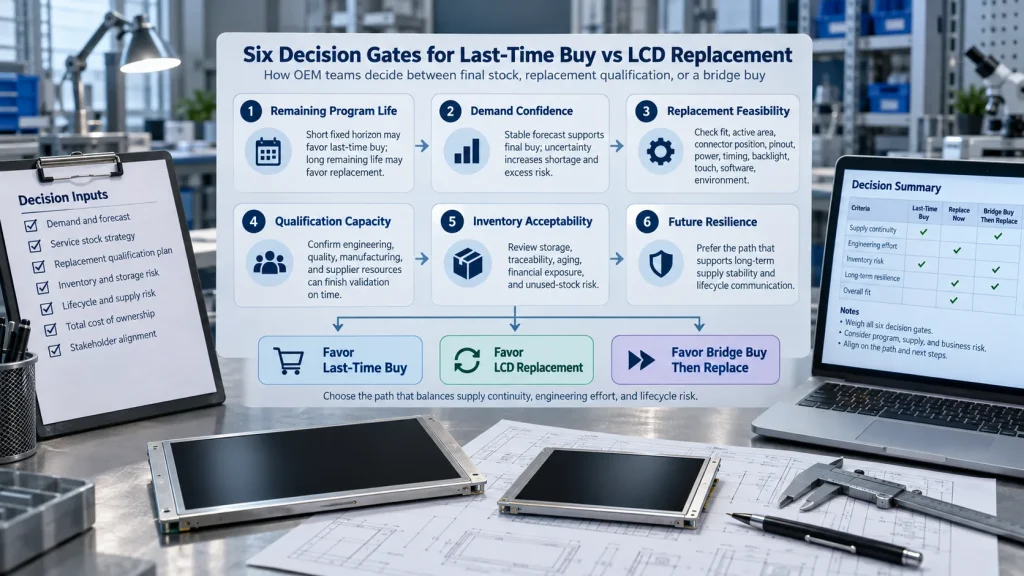
The following gates turn the discussion into a repeatable decision:
- Remaining program life:Favor replacement when the product and service obligation extend well beyond the final stock horizon. A short, fixed retirement period may favor a last-time buy.
- Demand confidence:Favor a last-time buy when demand is bounded and supported by firm orders or a stable history. High uncertainty increases both shortage and excess risk.
- Replacement feasibility:Check mechanical fit, active area, connector location, pinout, voltages, timing, backlight, touch behavior, software, and environmental limits. A matching diagonal size or interface name does not prove compatibility. The guide to display interface conversion limits explains why an adapter cannot correct every mismatch.
- Qualification capacity:Confirm that engineering, quality, manufacturing, and suppliers can complete samples, tests, approval, and release before old supply ends.
- Inventory acceptability:Verify storage conditions, packaging, inspection intervals, lot traceability, and the financial disposition of unused stock.
- Future resilience:Prefer a replacement architecture when the successor can support the expected product horizon and when the supplier can communicate lifecycle changes early.
How to qualify the replacement path
Create an old-to-new comparison matrix from released evidence. Include the exact model and revision, outline drawing, mounting points, active area, connector and pinout, voltage rails, power sequence, interface timing, initialization, backlight circuit, luminance and optical limits, touch stack, cable or FPC, controller settings, operating environment, and applicable inspection criteria.
Classify every difference as a hard stop, a change that needs verification, or an acceptable documented variation. Then build samples in the actual host system. A bench image alone does not verify boot behavior, timing margin, touch performance, optical acceptance, enclosure fit, temperature behavior, or end-of-line detection.
The release package should identify the approved display revision and every supporting item that changed. Define the effective date or lot, orderable identity, incoming inspection, work instructions, firmware selection, service identification, and evidence needed for production approval. Use an industrial display RFQ checklist to request lifecycle terms and supplier evidence before the project depends on the candidate.
Apply the EOL window to the project schedule
KADI Display generally uses an EOL pre-announcement about three months before the official notice for affected projects. The stated process then provides a last-buy window of about six months after the official notice. Final shipments may occur roughly three to five months after the last-buy deadline, followed by a running change and mass production of the approved replacement. Actual dates depend on the model, material position, written notice, and project confirmation.
Use those milestones as decision deadlines. The pre-announcement starts configuration mapping and candidate review. The official notice fixes the purchasing clock. The last-buy period should cover quantity approval and replacement qualification in parallel. Final shipment is the boundary for closing old orders, separating inventory, and releasing the new configuration.
KADI Display aims to support industrial display products for five to eight years, subject to the selected configuration, volume plan, and application. Its industrial display portfolio can be combined with project-specific support for touch and cover glass, optical bonding, FPC or cable customization, controller adaptation, mechanical coordination, and sample verification. The exact scope and lifecycle plan should be confirmed for each project.
Conclusie
A last-time buy protects a stable design but transfers forecast and inventory risk to the OEM. An LCD replacement reduces reliance on obsolete stock but requires time, evidence, and change control. Long-lifecycle projects often benefit from a limited bridge buy while the successor moves through qualification.
Choose through documented gates: remaining life, demand confidence, technical feasibility, qualification capacity, inventory exposure, and future supply resilience. Link the selected path to EOL dates, named owners, and a released production plan.
Veelgestelde vragen
What is a last-time buy for an LCD?
It is the final ordering opportunity before the supplier stops accepting orders for the outgoing display. The notice should identify the affected model, last order date, applicable conditions, and expected final shipment timing.
How should an OEM calculate the last-time-buy quantity?
Combine remaining production demand, service obligations, sample and yield allowances, and justified safety stock. Test the result against high, base, and low demand cases plus storage and unused-inventory risk.
Does the same LCD size make a replacement compatible?
No. Mechanical outline, active area, mounting, connector, pinout, power, timing, backlight, touch, software, and environmental limits may differ even when the diagonal size matches.
Can an OEM start replacement qualification before the formal EOL notice?
Yes. An early warning or pre-announcement gives the team more time to map the affected configuration, request samples, identify hard stops, and estimate the bridge quantity.
For a last-time-buy review or replacement fit check, request an EOL fit review from KADI’s technical team with the current model, drawings, annual usage, remaining program and service life, host interface, operating environment, and required approval date.
Voorgaande
Niet meer
Volgende
How to Control TFT LCD Revisions After Replacement Approval: Golden Samples, PCNs, Lot Traceability, and Incoming Inspection
Laat een reactie achter

Laatste Blog & Nieuws
- Last-Time Buy or LCD Replacement? A Decision Framework for Long-Lifecycle Display Projects
- How to Control TFT LCD Revisions After Replacement Approval: Golden Samples, PCNs, Lot Traceability, and Incoming Inspection
- Industrial LCD EOL: What Happens from Pre-Announcement to Replacement Mass Production?
- Electronic Component Obsolescence Management for Industrial Displays: An OEM Guide
- How to Develop a Production Ready Custom Display Assembly TFT Module Touch Cover Glass FPC Bonding and Mounting