
Accueil
-
Blog & Actualités
-
Test ultime en extérieur : comment les écrans industriels de 2 000 nits triomphent des environnements extrêmes
Test ultime en extérieur : comment les écrans industriels de 2 000 nits triomphent des environnements extrêmes
2026-05-25
09:01
Test ultime en extérieur : comment les écrans industriels de 2 000 nits triomphent des environnements extrêmes
Par l'équipe technique de Kadi Display | www.kadidisplay.com
Pourquoi la luminosité extérieure n'est pas qu'un simple chiffre
Un écran installé dans une salle de contrôle d'usine peut être exposé à seulement 500 à 1 000 lux de lumière ambiante. Une interface homme-machine (IHM) embarquée dans une cabine de véhicule peut percevoir les variations de la lumière du soleil à travers la vitre. Un écran de navigation maritime peut être exposé simultanément au soleil direct, aux reflets de l'eau, aux vibrations, aux embruns salés et à la chaleur d'un boîtier étanche. Un terminal pétrolier en zone désertique peut fonctionner sous des niveaux d'éclairage proches de la lumière directe du soleil, où l'éclairement peut atteindre plusieurs dizaines de milliers de lux et, dans certaines conditions, près de 100 000 lux.
C’est pourquoi un écran industriel de 2 000 nits n’est pas simplement une version plus lumineuse d’un écran LCD classique. Il s’agit d’un système complet de visibilité extérieure. Le rétroéclairage, la vitre de protection, le collage optique, le traitement antireflet, la structure thermique, la conception du boîtier, la dalle tactile et la logique de gradation sont autant d’éléments qui déterminent la lisibilité de l’écran après des mois, voire des années, d’utilisation sur le terrain.
Pour répondre aux besoins des acheteurs, ce sujet ne doit pas se limiter à une simple description des spécifications. Les ingénieurs, les équipes d'approvisionnement et les chefs de produit cherchent généralement à répondre à une question pratique : une luminosité de 2 000 nits est-elle nécessaire pour mon projet d'affichage industriel extérieur, ou puis-je me contenter de 1 000 nits avec un meilleur traitement optique ? La réponse dépend de l'environnement, de la réflexion, de la conception thermique, de la durée de vie et de la sécurité des utilisateurs.
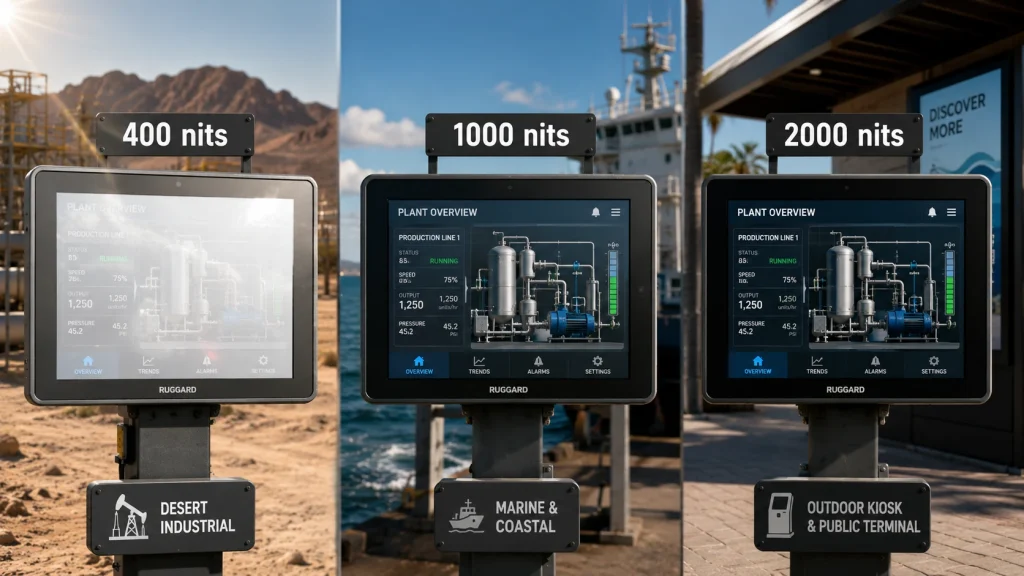
400 nits, 1000 nits, 2000 nits : que signifie réellement chaque niveau ?
Un écran industriel de 400 nits convient généralement aux environnements intérieurs contrôlés. Il est idéal pour les salles de contrôle, les équipements de test, les instruments médicaux, les panneaux d'automatisation industrielle, les terminaux d'entrepôt et les systèmes embarqués non exposés à la lumière directe du soleil. Dans ces cas d'utilisation, une luminosité de 400 nits est souvent suffisante sans provoquer de fatigue oculaire, de surchauffe excessive ni de consommation d'énergie excessive.
Un écran de 1 000 nits est généralement le point de départ pour les applications nécessitant une lisibilité en plein soleil. On le retrouve fréquemment dans les bornes de recharge pour véhicules électriques, les terminaux de paiement extérieurs, les tableaux de bord de véhicules, les dispositifs agricoles intelligents, les consoles de bateaux partiellement ombragées et les kiosques industriels. Dans de nombreuses applications semi-extérieures, un écran de 1 000 nits, associé à un collage optique et à un verre antireflet, offre une excellente lisibilité sur le terrain sans l'échauffement excessif d'un écran de 2 000 nits.
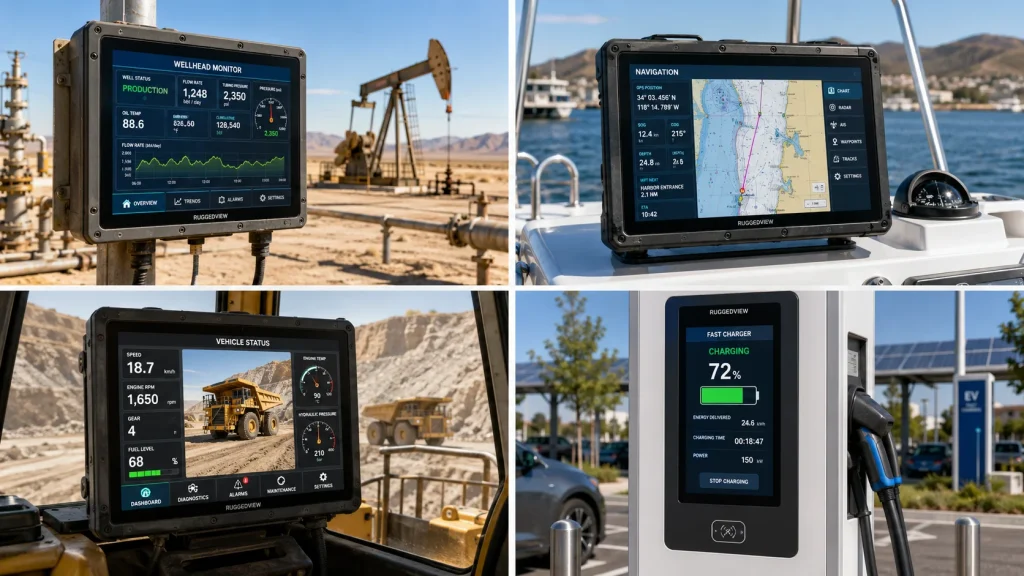
Un écran LCD de 2 000 nits appartient à une catégorie plus exigeante. Il est conçu pour une utilisation en extérieur, sous forte luminosité (soleil direct), dans des environnements à forte réflectivité, pour des installations à large plage de températures et pour des équipements critiques pour la sécurité. On le retrouve notamment dans les interfaces homme-machine (IHM) des véhicules miniers, les terminaux de transport public, les écrans d'équipements portuaires, les moniteurs de navigation maritime, les stations de surveillance désertiques, les panneaux SCADA extérieurs et les systèmes de contrôle industriels routiers.
Mais la luminosité seule ne garantit pas la lisibilité. Un écran brillant de 2 000 nits peut rester illisible en plein soleil si les reflets ne sont pas maîtrisés. Un écran de 1 000 nits correctement collé et doté d'un traitement antireflet peut, dans certaines conditions, être plus performant qu'un écran plus lumineux mais non traité. C'est pourquoi les ingénieurs en affichage évaluent la luminosité conjointement avec le collage optique, le revêtement antireflet/anti-reflet, l'angle de vision, le contraste et la conception du boîtier.
Le véritable ennemi : la lumière réfléchie
Lorsqu'un ingénieur demande : « 2 000 nits, est-ce suffisant pour une utilisation en extérieur ? », la question la plus pertinente est : « Quelle quantité de lumière réfléchie atteint l'écran ? » Un écran LCD émet de la lumière grâce à son rétroéclairage. La lumière du soleil extérieure frappe également la surface avant, la vitre de protection, la dalle tactile et les espaces d'air internes. Une partie de cette lumière est réfléchie vers l'utilisateur.
L'utilisateur ne voit pas seulement l'image affichée ; il perçoit également le ciel, le soleil, les véhicules environnants, l'eau, le sable ou la neige qui se reflètent sur l'écran. C'est pourquoi le rapport de contraste effectif est plus important que la seule luminosité maximale. Si la lumière réfléchie est trop élevée, les zones noires deviennent grises, le texte perd en netteté et les icônes d'avertissement deviennent difficiles à lire.
Par exemple, en extérieur par forte luminosité, un écran LCD de 400 nits peut être allumé et fonctionnel, mais l'utilisateur risque de ne pas pouvoir lire le contenu. Un écran LCD de 1 000 nits améliore la situation, mais si la surface en verre reflète trop la lumière du soleil, l'image peut rester terne. Un écran de 2 000 nits offre une bien meilleure luminosité, mais il nécessite un collage optique, un traitement antireflet ou une structure en verre de protection bien conçue pour exploiter pleinement son potentiel.
La logique d'ingénierie, en résumé, est simple : si la luminosité ambiante est faible, augmenter la luminosité peut résoudre le problème. Si elle est élevée, réduire la réflexion est souvent plus efficace qu'augmenter la puissance du rétroéclairage. En extérieur, dans des conditions difficiles, le meilleur écran n'est pas toujours celui qui affiche la luminosité la plus élevée (en nits), mais celui qui offre le meilleur équilibre entre lumière émise et réflexion maîtrisée.
Pourquoi une luminosité de 2000 nits est-elle nécessaire dans les environnements extrêmes ?
On choisit généralement un écran industriel de 2 000 nits lorsque l'écran est exposé à la lumière directe du soleil pendant de longues périodes, lorsque l'installation est soumise à de fortes réflexions dues à l'eau, la neige, le métal, le béton ou le sable, ou lorsque l'opérateur doit lire rapidement des informations critiques. Il ne s'agit pas de critères esthétiques. Dans les systèmes industriels et de transport, un délai de lecture peut poser un problème de sécurité.
Les applications marines et désertiques en sont deux bons exemples. En milieu marin, la lumière du soleil ne provient pas uniquement du dessus ; elle se reflète également sur la surface de l’eau. Un écran installé sur la passerelle ou le pont d’un navire peut être exposé à la fois au soleil direct et aux reflets. Dans les environnements désertiques, la lumière du soleil, la poussière, les températures ambiantes élevées et le manque d’ombre se conjuguent pour créer l’un des environnements les plus difficiles pour un rétroéclairage LCD.
Les bornes de recharge extérieures et les stations de recharge pour véhicules électriques présentent des caractéristiques variables. Toutes les bornes extérieures n'ont pas besoin de 2 000 nits. De nombreuses bornes partiellement ombragées fonctionnent correctement avec 1 000 ou 1 500 nits si l'écran est collé optiquement et protégé par un verre antireflet ou anti-reflets adapté. Cependant, les bornes exposées en bord de route, les bornes orientées au sud ou les bornes de recharge sur les parkings ouverts peuvent nécessiter une luminosité supérieure de 2 000 nits pour garantir la visibilité des instructions de paiement, des codes QR, des avertissements et des messages système.
La décision doit se fonder sur les conditions de visibilité les plus défavorables, et non sur une visibilité moyenne. Un écran fonctionnant correctement lors d'un test de réception en usine par temps nuageux peut tomber en panne à 14 h en juillet, une fois installé en plein soleil. Le choix d'un écran destiné à une utilisation extérieure extrême doit donc commencer par l'heure la plus critique de sa durée de vie.
Le coût caché d'une forte luminosité : la chaleur
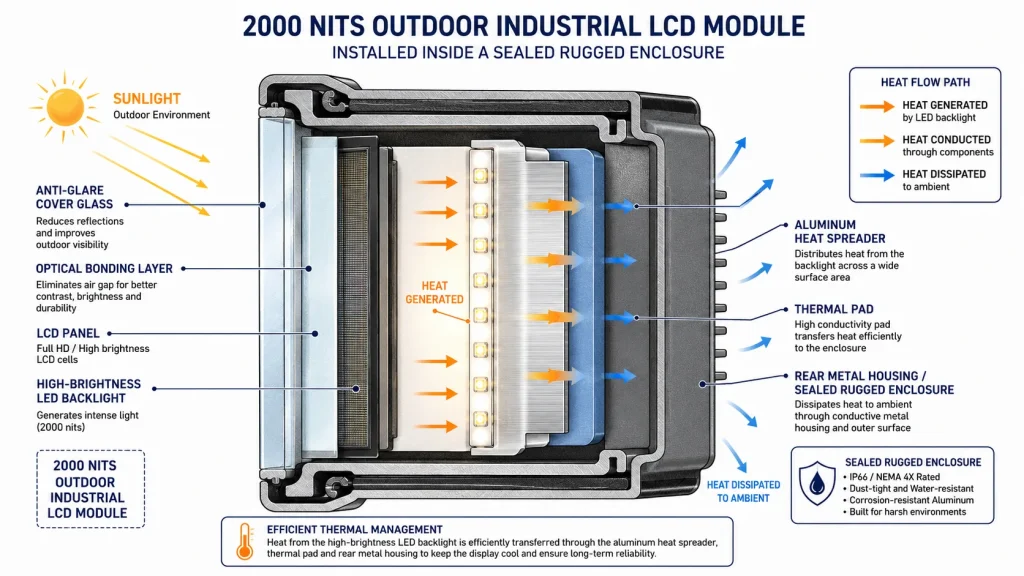
Chaque écran LCD haute luminosité Cela pose un problème thermique. Un rétroéclairage de 2 000 nits produit plus de chaleur qu'un rétroéclairage de 400 ou 1 000 nits. Dans un boîtier industriel étanche, cette chaleur ne peut s'évacuer que si la structure mécanique est conçue pour la transférer loin du module LCD.
Ceci est important car les performances des écrans LCD varient en fonction de la température. Une température interne élevée peut accélérer la dégradation du rétroéclairage LED, réduire la durée de vie du film optique, affecter la stabilité du polariseur, augmenter le risque de mura et raccourcir la durée de vie de l'écran. Pour les équipements extérieurs, le problème est plus grave car le boîtier peut déjà être chauffé par le soleil.
Un moniteur industriel extérieur de 2 000 nits doit donc être considéré comme un produit thermique, et non uniquement comme un produit optique. Les ingénieurs doivent prendre en compte la conception du châssis en aluminium, les dissipateurs thermiques, les pads thermiques, le matériau du capot arrière, la stratégie de ventilation, le refroidissement actif si nécessaire, ainsi que le rapport entre la luminosité maximale et le cycle d'utilisation quotidien.
C’est souvent là que les projets surdimensionnés deviennent onéreux. Un acheteur peut exiger 2 000 nits car le produit est destiné à une utilisation extérieure, mais le boîtier ne parvient pas à dissiper la chaleur. Le fournisseur ajoute alors des ventilateurs, des aérations ou des boîtiers plus volumineux, ce qui augmente les coûts et les risques liés à la maintenance. Dans certains cas, une solution à collage optique de 1 000 ou 1 500 nits offre de meilleures performances sur toute la durée de vie qu’une conception non dissipant la chaleur à 2 000 nits.
Collage optique : Le Partner 2000 Nits ne peut pas fonctionner sans
Pour les écrans d'extérieur soumis à des conditions extrêmes, le collage optique est souvent plus important que l'augmentation de la luminosité de 1 500 à 2 000 nits. La raison est simple : l'espace d'air entre les couches crée des réflexions internes. Lorsque la lumière du soleil pénètre dans l'écran, chaque interface entre l'air, le verre, le capteur tactile et la surface LCD peut réfléchir une partie de la lumière vers l'utilisateur.
Le collage optique remplit l'espace d'air avec un adhésif ou une résine transparente. Cela réduit la réflexion interne, améliore le contraste, augmente la résistance mécanique, contribue à prévenir la condensation et peut améliorer la sensibilité tactile. Dans le domaine de l'affichage extérieur, le collage n'est pas seulement une option visuelle haut de gamme ; c'est une méthode pratique pour préserver le contraste sous une forte luminosité ambiante.
Pour un écran industriel de 2 000 nits, le collage optique ne doit pas être considéré comme une option. Dans la plupart des applications les plus exigeantes, il fait partie des spécifications de base. Sans collage, une grande partie de la puissance de rétroéclairage supplémentaire est gaspillée à compenser des réflexions qui pourraient être réduites optiquement.
Cela est particulièrement vrai pour les panneaux IHM extérieurs, les écrans d'équipements miniers, les moniteurs de bord de navires, les écrans de véhicules agricoles et les écrans de recharge pour véhicules électriques, où l'utilisateur lit souvent l'affichage de biais plutôt que de face. Un panneau à haute luminosité avec une optique frontale de mauvaise qualité est une solution peu performante ; un écran correctement collé avec une réflexion maîtrisée est une solution adaptée à une utilisation sur le terrain.
Options de verre antireflet, anti-éblouissement et de protection
Un écran extérieur robuste nécessite généralement une vitre de protection. Cette vitre protège l'écran LCD des chocs, de la poussière, de l'eau, des produits de nettoyage, des traces de doigts et du vandalisme. Cependant, le verre est également source de reflets. C'est pourquoi son traitement de surface doit être adapté à l'environnement.
Verre antireflet Ce revêtement diffuse la lumière réfléchie, réduisant ainsi les reflets parasites. Il est particulièrement utile pour les écrans tactiles industriels extérieurs, les affichages de véhicules, les bornes interactives et les panneaux de commande où l'utilisateur peut être exposé à des variations d'éclairage. Le revêtement antireflet diminue la quantité de lumière réfléchie par la surface. Il est souvent privilégié lorsque la clarté, le contraste et la netteté de l'image priment sur le coût.
Le collage optique associé à un traitement AG ou AR donne les meilleurs résultats pour écrans lisibles en plein soleilLe collage réduit les réflexions internes, tandis que le traitement de surface limite les reflets sur la face avant. Pour les écrans extérieurs de 2 000 nits, cette combinaison est particulièrement importante car le panneau est généralement utilisé sous un éclairage non contrôlé.
Il n'existe pas de revêtement universel optimal. Un traitement antireflet intense peut améliorer la visibilité en plein soleil, mais risque de réduire la netteté perçue. Un traitement antireflet améliore la clarté, mais il est plus fragile et plus coûteux. Pour les projets industriels, la méthode la plus fiable consiste à tester des échantillons réels sous l'éclairage d'utilisation prévu avant de finaliser la configuration du vitrage.
Scénarios d'application : Quand 2000 nits l'emportent
Terminaux pétroliers et de fermes solaires du désert
En milieu désertique, les écrans sont exposés à un ensoleillement intense, à des températures ambiantes élevées, à la poussière et à d'importantes variations de température entre le jour et la nuit. Un écran de 400 nits n'est pas adapté. Un écran de 1 000 nits peut fonctionner uniquement à l'ombre. Un écran LCD de 2 000 nits, doté d'un collage optique, d'un verre antireflet/antigravité, de matériaux résistants aux UV et d'une conception adaptée à une large plage de températures, constitue généralement le choix le plus sûr.
L'écran doit afficher les valeurs de pression, les alarmes, l'état de la pompe, les données de l'onduleur solaire ou les informations SCADA sans que l'opérateur ait à le masquer manuellement. Dans ces installations, la lisibilité n'est pas un simple confort, mais une question de sécurité.
Équipements de navigation maritime et portuaires
Les écrans marins sont exposés au soleil, aux reflets de l'eau, aux embruns, aux vibrations et à l'humidité. Un écran robuste de 2 000 nits contribue à maintenir la visibilité des cartes, la netteté du flux vidéo et la lisibilité des alarmes. Toutefois, pour une utilisation nocturne, cette luminosité doit être associée à des panneaux avant étanches, une conception mécanique résistante à la corrosion, un collage optique et un contrôle précis de la gradation.
Véhicules miniers, de construction et agricoles
Les écrans industriels embarqués sont complexes à gérer en raison des variations constantes de luminosité. L'écran peut être à l'ombre le matin, exposé au soleil direct à midi et utilisé dans des conditions de faible luminosité la nuit. Un écran de 2 000 nits avec gradation adaptative permet de maintenir une lisibilité optimale en plein soleil sans éblouir l'opérateur la nuit.
Kiosques extérieurs et stations de recharge pour véhicules électriques
Tous les kiosques extérieurs n'ont pas besoin de 2 000 nits. De nombreuses bornes de recharge pour véhicules électriques et terminaux de paiement peuvent fonctionner avec 1 000 ou 1 500 nits s'ils sont partiellement ombragés et fixés par collage optique. En revanche, pour les bornes exposées en bord de route, les parkings ouverts ou les installations orientées au sud, 2 000 nits peuvent s'avérer nécessaires pour garantir la visibilité des instructions de paiement, des codes QR et des messages de sécurité.
Gradation adaptative : pourquoi une luminosité de 2 000 nits ne devrait pas toujours être maintenue à 2 000 nits
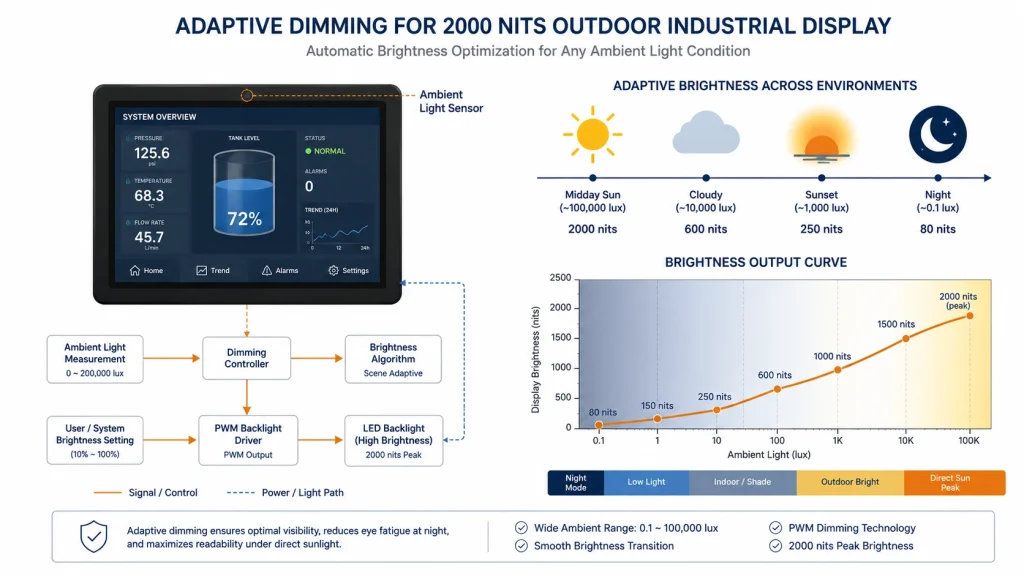
On confond souvent un écran de 2 000 nits avec un écran fonctionnant à pleine luminosité toute la journée. En réalité, un bon écran industriel d'extérieur doit utiliser la gradation adaptative.
Un capteur de luminosité ambiante mesure le niveau de lumière à proximité de l'écran. Le circuit de rétroéclairage ajuste ensuite la luminosité en fonction de l'environnement. En plein soleil, à midi, la luminosité de l'écran peut atteindre son maximum. Par temps nuageux, elle peut se situer entre 800 et 1 200 nits. La nuit, elle peut chuter entre 50 et 150 nits selon l'utilisation.
Cette stratégie améliore le confort d'utilisation, réduit la consommation d'énergie et la chaleur dégagée, et prolonge la durée de vie du rétroéclairage. Elle est particulièrement importante dans les véhicules, les systèmes marins, les bornes publiques et les équipements extérieurs alimentés par batterie. Un écran à pleine luminosité (2 000 nits) la nuit peut nuire à la vision nocturne et engendrer des problèmes de sécurité.
Pour les projets industriels de longue durée, il convient de spécifier la gradation adaptative ainsi qu'une luminosité de crête de 2 000 nits. La question n'est pas seulement « Quelle est la luminosité maximale de l'écran ? » mais aussi « Comment peut-il réduire intelligemment sa luminosité lorsque la pleine puissance n'est pas nécessaire ? »
Choisir entre 400 nits, 1000 nits et 2000 nits
Le meilleur choix de luminosité Cela dépend de l'environnement, et non d'un argument marketing. Utilisez une luminosité de 400 nits lorsque l'écran est installé en intérieur, que l'éclairage est contrôlé et que les opérateurs le consultent pendant de longues périodes. Cette luminosité convient aux interfaces homme-machine (IHM) industrielles, aux instruments de laboratoire, aux dispositifs médicaux, aux panneaux de commande montés en rack et aux terminaux d'automatisation intérieure.
Utilisez une luminosité de 1 000 nits lorsque l’écran est utilisé dans des environnements intérieurs lumineux, semi-extérieurs, dans un véhicule, à l’ombre en extérieur ou dans un kiosque. Ce réglage offre généralement le meilleur compromis entre lisibilité, consommation d’énergie, dissipation thermique et coût.
Utilisez une luminosité de 2 000 nits lorsque l’écran est exposé au soleil direct, à une forte réflexion, à des conditions d’exposition extérieure extrêmes, à des angles de vision larges ou à des opérations critiques pour la sécurité. Ce niveau convient aux environnements désertiques, maritimes, miniers, de construction, de transport et aux systèmes industriels extérieurs entièrement exposés.
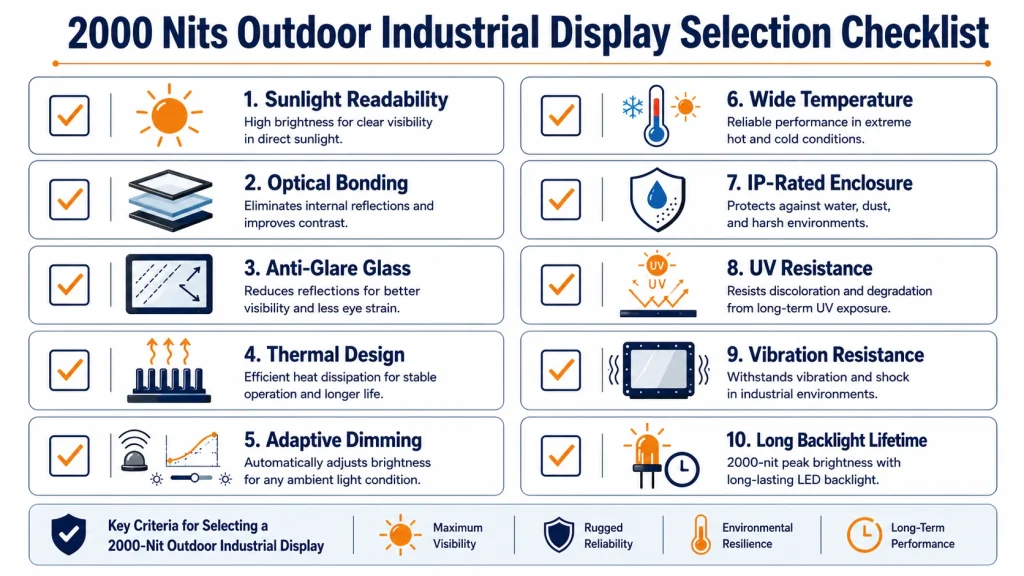
Toutefois, la décision finale ne doit pas se limiter à la luminosité. Les ingénieurs doivent vérifier l'éclairement ambiant, l'angle de vision, la réflectance du verre de protection, la liaison optique, le revêtement AG/AR, le chemin thermique, la température de fonctionnement, la durée de vie du rétroéclairage, la technologie tactile, l'indice de protection IP, l'exposition aux UV et la durée de vie.
Liste de contrôle technique pour les écrans extérieurs de 2000 nits
Note de publication : Remplacez cet espace réservé par une image générée ou originale avant publication.
Conclusion : 2000 nits est un système, et non une simple spécification.
Un écran industriel de 2 000 nits est conçu pour les conditions de visibilité les plus extrêmes en extérieur. Il permet aux opérateurs de lire les informations essentielles malgré la lumière du soleil, les reflets, la chaleur, la poussière, les vibrations et les intempéries. Mais 2 000 nits ne suffisent pas.
L'écran doit maîtriser les reflets grâce à un collage optique et un verre de protection AG/AR. Sa conception mécanique doit assurer une gestion thermique optimale. La gradation adaptative doit garantir sa durée de vie. Enfin, sa résistance aux intempéries doit être assurée par des composants à large plage de températures, une structure robuste, des matériaux résistants aux UV et une intégration tactile fiable.
La règle pratique est simple : 400 nits pour une utilisation intérieure contrôlée, 1 000 nits pour les environnements lumineux et semi-extérieurs, et 2 000 nits pour la lumière directe du soleil et les applications extérieures extrêmes. Mais le meilleur choix n’est pas l’écran le plus lumineux sur le papier, mais celui qui reste lisible, stable et fiable après des années d’utilisation réelle.
Pour les ingénieurs qui choisissent un écran LCD lisible en plein soleil, un moniteur industriel d'extérieur, un écran tactile robuste ou un module LCD TFT haute luminosité, la question pertinente n'est pas « Combien de nits puis-je acheter ? » mais plutôt : « Quelle combinaison de luminosité, de contraste, de collage, de traitement de surface, de conception thermique et de gradation permettra à cet écran de rester lisible même dans les conditions les plus difficiles ? »
Pour les projets compacts d'interface homme-machine (IHM) extérieure, de bornes de recharge pour véhicules électriques et de kiosques, un Écran IPS de 10,1 pouces lisible en plein soleil peut constituer un point de départ pratique pour l'évaluation d'échantillons. Solutions d'affichage industriel personnalisées Kadi Display sont également disponibles lorsque les exigences en matière de luminosité, de verre de protection, de collage, d'interface tactile et de boîtier doivent être adaptées à un environnement de terrain spécifique.
Précédent
Résolution, résilience et intégration : un cadre en forme de triangle d’or pour choisir entre les écrans industriels 1280×720, 1280×800 et 1920×1080
Suivant
Le meilleur rapport qualité-prix ? Pourquoi le format 1280×720 (720p) reste-t-il la pierre angulaire du marché des écrans industriels en 2025 ?
Laisser un commentaire

Derniers blogs et nouvelles
- Industrial LCD EOL: What Happens from Pre-Announcement to Replacement Mass Production?
- Electronic Component Obsolescence Management for Industrial Displays: An OEM Guide
- How to Develop a Production Ready Custom Display Assembly TFT Module Touch Cover Glass FPC Bonding and Mounting
- 15 Pin vs 22 Pin Raspberry Pi DSI Connectors Cable Pinout and Compatibility
- Native MIPI DSI vs LVDS or HDMI Bridge: An OEM Display Architecture Decision Guide