Hoe kies je een duurzaam afdekglas voor industriële buitendisplays?
2026-05-09
11:02
Hoe kies je een duurzaam afdekglas voor industriële buitendisplays?
5 belangrijke criteria die elke engineer moet evalueren voordat hij een schermafdekglas specificeert.
Door het technische team van Kadi Display | www.kadidisplay.com | Industriële displaytechnologie
Het onderdeel van het scherm waar niemand het over heeft totdat het kapot gaat.
Vraag een engineer naar de specificaties van hun HMI-display voor buiten en ze zullen je alles vertellen over helderheid, resolutie, touchtechnologie, bedrijfstemperatuur en waarschijnlijk ook de beschermingsklasse van de behuizing. Het afdekglas? Daarover wordt meestal maar één zin uitgesproken. "Het is chemisch gehard." Soms gewoon "standaard afdekglas." Achttien maanden na de ingebruikname vervangt het onderhoudsteam dan gebarsten panelen op een kiosk die een winkelwagentje met een snelheid van 0,3 m/s heeft geraakt, of is het glas van een fabrieksterminal troebel geworden omdat iemand er een jaar lang elke dag met een droge doek stof vanaf heeft geveegd.
Het afdekglas van het scherm vormt de interface tussen de ruwe fysieke omgeving en de gevoelige elektronica erachter. In een industriële buitenomgeving wordt het blootgesteld aan UV-straling, temperatuurschommelingen, fysieke impact, chemische invloeden, schurende vervuiling en – als het scherm een touchscreen heeft – duizenden dagelijkse contactmomenten met handschoenen, gereedschap en vingers. Elk van deze stressfactoren heeft een meetbare parameter. Het is niet ingewikkeld om deze parameters correct in te stellen, maar het vereist wel een goed gesprek met uw leverancier vóórdat er samples worden besteld, en niet pas nadat er in het veld defecten optreden.
Deze handleiding behandelt vijf belangrijke criteria voor de selectie van industrieel afdekglas voor buitentoepassingen. We bespreken de waarden die u daadwerkelijk zou moeten specificeren, de mogelijke oorzaken van fouten bij het kiezen van een verkeerd criterium en enkele valkuilen waar zelfs ervaren ingenieurs in terechtkomen.
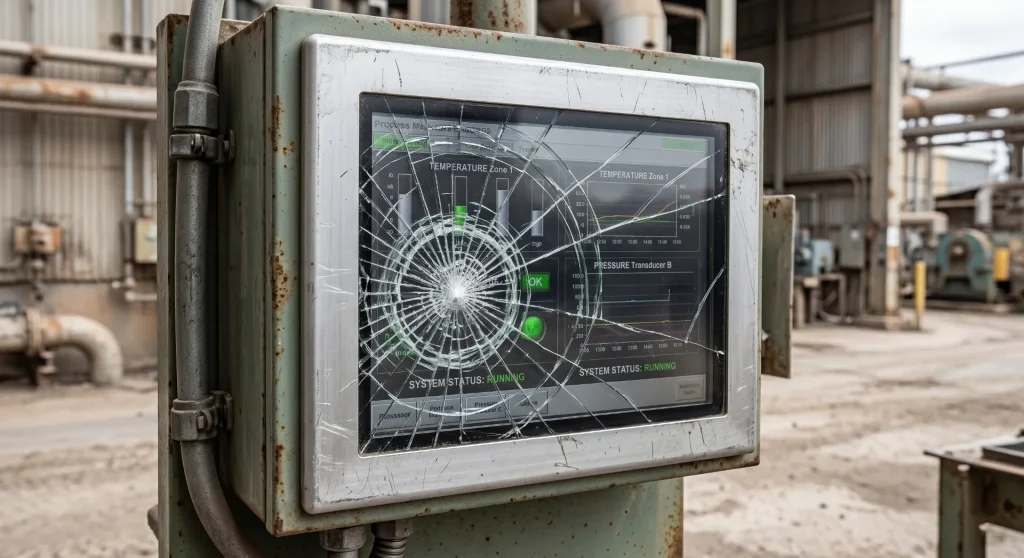
Waarom dit financieel belangrijk is: Een gebarsten buitenglasplaat is niet zomaar een onderhoudsklus, maar een potentieel probleem dat tot een kettingreactie kan leiden. Water dat door de barst binnendringt, kan in een vochtige omgeving binnen enkele dagen het LCD-scherm en de touchscreenlaag beschadigen. De vervangingskosten, inclusief de stilstandtijd, zijn doorgaans 8 tot 15 keer zo hoog als de kosten van het vanaf het begin kiezen voor de juiste glasplaat.
Wat is een schermafdekglas precies en wat is de functie ervan?
Functie en positie in de stapel
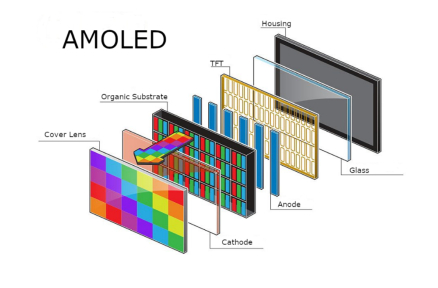
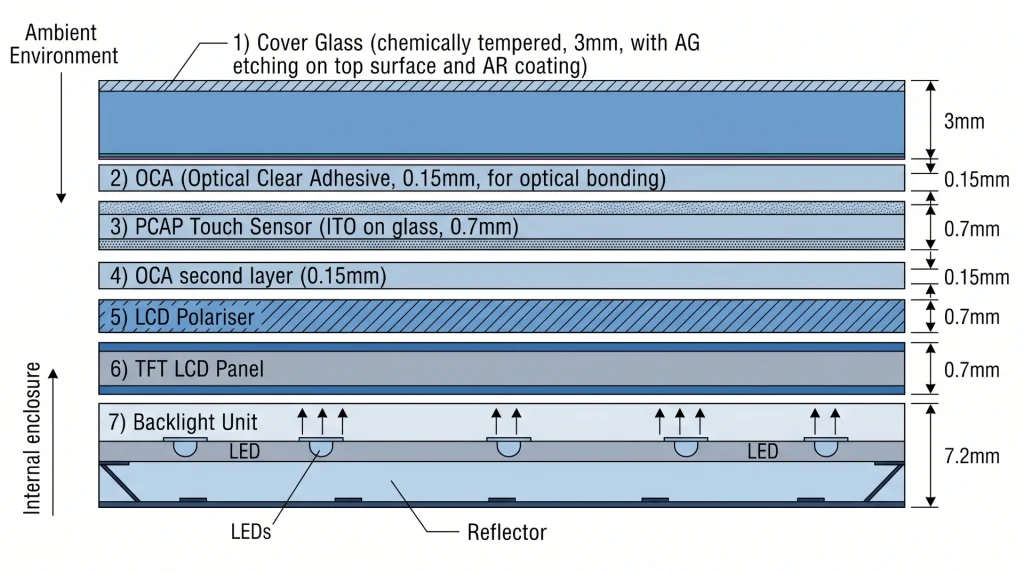
In een moderne industriële displayassemblage bevindt het afdekglas (ook wel beschermglas, frontglas of overlayglas genoemd) zich helemaal vooraan in de displaystapel, tussen de omgevingslucht en de aanraaksensor of het LCD-paneel eronder. Mechanisch gezien is het een vlakke plaat – doorgaans 2 tot 6 mm dik, afhankelijk van de toepassing – die krasbestendigheid, bescherming tegen stoten en een reinigbaar oppervlak biedt. Optisch gezien moet het zoveel mogelijk van de achtergrondverlichting doorlaten en tegelijkertijd reflecties minimaliseren. Thermisch gezien moet het bestand zijn tegen de extreme temperaturen in de gebruiksomgeving zonder los te laten van de lijmlagen waarmee het aan de rest van de displayassemblage is bevestigd.
Bij een display met optische bonding wordt het afdekglas direct op de aanraaksensor of LCD-polarisator gelamineerd met een optisch heldere lijm (OCA) of hars (OCR). Bij een air-gap-constructie bevindt het zich in een frame met een fysieke opening tussen het afdekglas en het onderliggende paneel. De optische bonding-methode elimineert interne reflecties en heeft de voorkeur voor buitentoepassingen. Het betekent ook dat het afdekglas en de rest van de constructie structureel met elkaar verbonden zijn, wat de mechanische analyse aanzienlijk verandert.
Wat 'buiten' betekent voor het afdekglas
'Industriële buitenomgeving' is geen uniforme omgeving, maar een spectrum dat alles omvat, van een overdekt tankstationterrein tot een open landbouwterminal en een poolbevoorradingsbasis. De technische factoren die binnen dat spectrum variëren, zijn: de piektemperatuur van de omgeving (-40 °C in arctische omstandigheden tot +65 °C oppervlaktetemperatuur in de directe zon van het Midden-Oosten), de UV-dosis (cumulatief over jaren), het type verontreiniging (zand, zoutnevel, chemische spatten, vet), het risico op impact (vandalisme, nabijheid van voertuigen, vallend gereedschap) en het reinigingsregime (industriële chemicaliën onder hoge druk in de voedselverwerking; voorzichtig afvegen in transportomgevingen).
De specificatie voor het afdekglas moet aan al deze aspecten tegelijkertijd voldoen. De vijf meetwaarden in deze richtlijn corresponderen direct met deze stressfactoren.
De 5 belangrijkste meetwaarden — Snel naslagwerk
Voordat we een gedetailleerde analyse uitvoeren, volgt hier een beknopt overzicht van de vijf meetwaarden, de normen die eraan ten grondslag liggen, de minimumwaarden die zinvol zijn voor industriële toepassingen in de buitenlucht, en de mogelijke oorzaken van storingen bij onderspecificatie van elk van deze meetwaarden.
Selectie van afdekglazen — Snel naslagwerk met 5 belangrijke criteria
Elk van deze vijf parameters beïnvloedt de andere op manieren die niet altijd even duidelijk zijn. Dikker glas verbetert de slagvastheid, maar vermindert de lichtdoorlatendheid enigszins en verandert de thermische massa van de constructie. Een hardere oppervlaktebehandeling kan de taaiheid iets verminderen. Chemisch harden verbetert de sterkte, maar verlaagt de maximale bedrijfstemperatuur in vergelijking met het onbewerkte glas. Deze interacties verklaren waarom de keuze van afdekglas het beste als een systeembeslissing kan worden beschouwd in plaats van als een afzonderlijke kostenpost.
Metriek 1: Hardheid en krasbestendigheid
Waarom krasbestendigheid belangrijker is dan het lijkt.
Krasbestendigheid wordt vaak onderschat, omdat een bekrast afdekglas eruitziet als een cosmetisch probleem. In industriële toepassingen buitenshuis is dat echter niet het geval. Een glazen oppervlak met opeenhoping van microkrasjes verstrooit licht – hetzelfde optische effect als matglas – waardoor het contrast afneemt en een scherm met een helderheid van 1000 nits aanzienlijk minder helder kan lijken dan de specificaties aangeven. In een medische of inspectietoepassing, waar het scherm fijne details moet weergeven, kan een bekrast afdekglas de diagnostische mogelijkheden ernstig belemmeren.
De hardheid van glas wordt in deze context op twee schalen gemeten. De Mohs-schaal beoordeelt de krasbestendigheid van het basismateriaal: standaard soda-calciumglas heeft een hardheid van 5-6, aluminiumsilicaatglas (chemisch gehard) bereikt een hardheid van 7-8 en saffierglas een hardheid van 9. De potloodhardheidsschaal (ASTM D3363) meet de hardheid van oppervlaktecoatings: een potloodhardheid van 7H of 8H is de gebruikelijke streefwaarde voor een harde coatinglaag op industrieel buitenglas. Deze twee schalen meten verschillende eigenschappen, en het is noodzakelijk om beide te specificeren voor een volledig beeld.
De vraag over de harde jas
Chemisch harden versterkt glas mechanisch, maar maakt het oppervlak niet automatisch harder tegen fijne slijtage. Zanddeeltjes, die veel voorkomen in buitenomgevingen, bestaan voornamelijk uit siliciumdioxide (kwarts) – hardheid 7 op de schaal van Mohs. Een kaal oppervlak van aluminosilicaatglas met een hardheid van 7-8 op de schaal van Mohs is enigszins bestand tegen krassen van kwarts; standaard soda-kalkglas met een hardheid van 5-6 op de schaal van Mohs is dat niet. In beide gevallen verhoogt het aanbrengen van een harde laag siliciumdioxide (op basis van SiO₂, doorgaans 2-7 μm dik, aangebracht via een sol-gel- of CVD-proces) de effectieve oppervlaktehardheid tot 8-9H potloodhardheid en biedt het een aanzienlijke bescherming tegen kwarts en andere schurende deeltjes uit de omgeving.
De hardcoating dient ook als basislaag voor latere oppervlaktebehandelingen. AG-etsen vindt plaats op het glazen substraat vóór de hardcoating (of gebruikt de hardcoating als medium), en AR- en AF-coatings worden daar bovenop aangebracht. De volgorde is van belang voor zowel de optische prestaties als de duurzaamheid, en het is raadzaam om uw leverancier van afdekglas hierover te raadplegen en dit expliciet te laten vastleggen.
Veldobservatie: Buitendisplays in kiosken die zich in de buurt van zandstranden, bouwplaatsen of landbouwvelden bevinden, moeten minimaal een hardcoating met een potloodhardheid van 7H hebben. Hetzelfde glas dat drie jaar meegaat in een overdekt winkelcentrum, kan binnen zes maanden zichtbare waas vertonen in een installatie vlakbij het strand, zelfs bij zorgvuldige reiniging.
Metriek 2: Slagvastheid en IK-classificatie
Het IK-beoordelingssysteem begrijpen
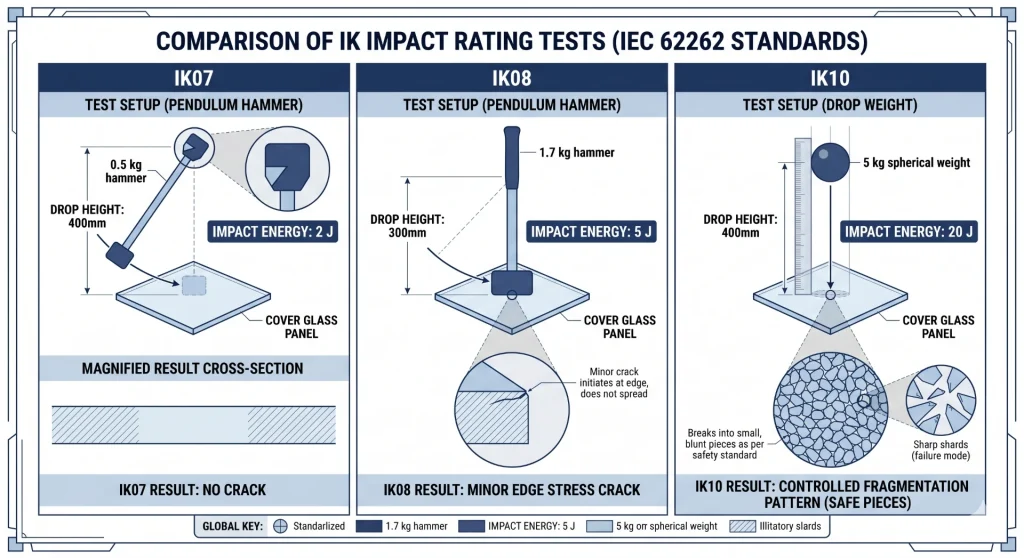
De IK-waarde (gedefinieerd in EN 62262 / IEC 62262) is de gestandaardiseerde maatstaf voor de mechanische schokbestendigheid van behuizingen voor elektrische apparatuur en afdekkingen voor beeldschermen. De schaal loopt van IK00 (geen bescherming) tot IK10 (bescherming tegen 20 joule), waarbij elke stap een ruwe verdubbeling van de schokenergie vertegenwoordigt. Ter referentie: IK07 komt overeen met een schok van 2 joule (gelijk aan een object van 0,5 kg dat van 400 mm valt); IK08 komt overeen met 5 joule (een gewicht van 1,7 kg dat van 300 mm valt); IK10 komt overeen met 20 joule (een gewicht van 5 kg dat van 400 mm valt).
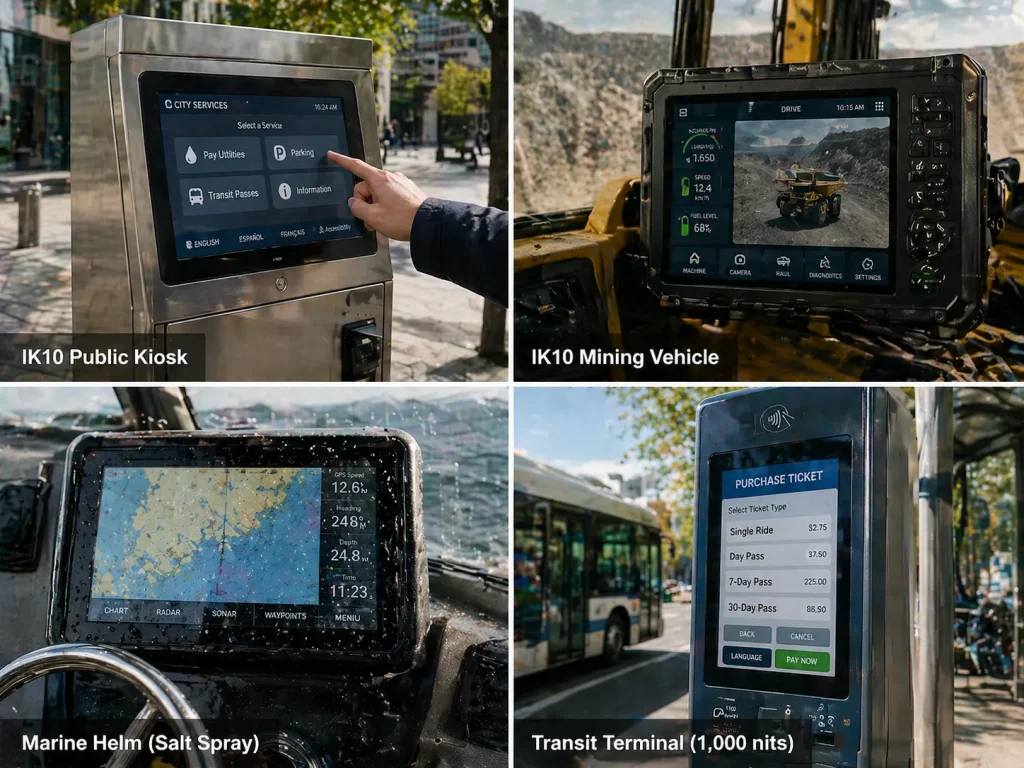
Voor industriële displays in de buitenlucht is IK08 in de meeste gevallen het praktische minimum. Voor kiosken in drukbezochte gebieden, displays in het openbaar vervoer die gemakkelijk bereikbaar zijn voor passagiers, en displays in een omgeving met voertuigen in de buurt, is IK10 vereist. Het verschil in kosten voor het afdekglas tussen IK08 en IK10 wordt doorgaans bereikt door een grotere glasdikte (van 2 mm naar 3-4 mm) en/of een diepere chemische harding. De extra kosten zijn gering in vergelijking met de kosten voor vervanging en uitval van een IK08-glas in een IK10-omgeving.
Chemisch temperen versus thermisch temperen: dit is geen onbelangrijk detail.
Het type harding is net zo belangrijk als de IK-waarde voor veiligheidstoepassingen. Thermische harding (warmtebehandeld gehard glas) biedt een hoge slagvastheid, maar bij breuk spat het in honderden kleine fragmenten uiteen – hetzelfde patroon als een zijruit van een auto. Chemische harding (ionenuitwisselingsversterking) biedt een vergelijkbare of hogere sterkte met een andere breukwijze: chemisch gehard glas breekt in minder, maar grotere stukken in plaats van in kleine fragmenten, waardoor het risico op letsel door glasscherven in omgevingen waar gebruikers direct contact hebben met de glasplaat, wordt verminderd.
Het profiel van de drukspanning is ook anders. Thermisch harden creëert een ruwweg parabolisch spanningsprofiel door de glasdikte, met maximale drukspanning aan de oppervlakken. Chemisch harden creëert een ondiepe maar zeer hoge drukspanningslaag – typisch 40–80 μm diep (de zogenaamde laagdikte) – met drukspanningen van 650–900 MPa, aanzienlijk hoger dan de typische oppervlaktespanning van 70–150 MPa bij thermisch harden. Deze hoge drukspanning aan het oppervlak maakt chemisch gehard glas zo bestand tegen scheurvorming aan het oppervlak.
Afweging tussen dikte en hardheid
Bij de specificaties voor afdekglas bestaat de neiging om simpelweg de dikte te vergroten wanneer slagvastheid vereist is. Dikker glas is moeilijker te breken, maar dikte alleen is geen vervanging voor de kwaliteit van de harding. Een 4 mm dik soda-kalkglas dat niet goed gehard is, kan bij een lagere impactenergie bezwijken dan een correct chemisch gehard 2 mm dik aluminiumsilicaatglas, omdat de breuk begint bij oppervlaktedefecten en de oppervlaktedruk van de chemische harding deze defecten onderdrukt, ongeacht de dikte.
De praktische aanpak: specificeer chemische temperering met een minimale DOL van 40 μm en een minimale oppervlaktedrukspanning van 650 MPa, selecteer vervolgens de glasdikte op basis van de vereiste IK-waarde en de optische verlijmingsmethode. Optisch verlijmde constructies kunnen iets dunner glas verdragen omdat de lijmlaag structurele ondersteuning biedt, terwijl constructies met een luchtspleet volledig afhankelijk zijn van de inherente stijfheid van het glas.
Metriek 3: Optische transmissie en oppervlaktebehandeling
Elke procent telt als je tegen de zon vecht.
De optische transmissie — het percentage invallend licht dat door het afdekglas heen de kijker bereikt — is geen ondergeschikte parameter bij displays voor buitengebruik. Elk verlies van 1% transmissie staat gelijk aan een vermindering van de helderheid van het scherm met 1%. Voor een systeem dat op de grens van leesbaarheid werkt bij fel omgevingslicht, kan een verlies van 4-6% door een niet-geoptimaliseerde afdekglasconstructie het verschil betekenen tussen leesbaar en onleesbaar.
Onbehandeld vlak glas laat ongeveer 91-92% van het zichtbare licht door in één doorgang (de rest is Fresnel-reflectie aan de twee oppervlakken). Het toevoegen van een antireflectiecoating (AR-coating) verhoogt de lichtdoorlatendheid tot 97-99%, afhankelijk van de coatinglaag. Het toevoegen van een anti-verblindingscoating (AG-coating) vermindert de lichtdoorlatendheid enigszins – een sterke AG-coating met een waas van 25% vermindert de lichtdoorlatendheid doorgaans met 2-4% ten opzichte van ongecoat glas. Een anti-vingerafdruklaag (AF-fluorpolymeer) heeft een verwaarloosbaar optisch effect (minder dan 0,5% verandering in lichtdoorlatendheid), maar vermindert de reflectie van vetvlekken aanzienlijk, wat effectief kan zijn bij touchscreen-toepassingen met veel verkeer.
De optische bonding-multiplicator
De meest impactvolle verbetering van de optische prestaties van afdekglas voor buitengebruik is optische verlijming: het vullen van de luchtspleet tussen het afdekglas en de aanraaksensor of LCD-polarisator met OCA of OCR. Een luchtspleet heeft twee extra glas-luchtgrensvlakken, die elk ongeveer 4% van het licht reflecteren. Door deze spleet te vullen met een lijm met een overeenkomstige brekingsindex (n ≈ 1,47–1,52) worden deze grensvlakken geëlimineerd, waardoor 6–8% van de lichtdoorlatendheid wordt hersteld en het contrastverminderende effect van intern gereflecteerd omgevingslicht wordt geëlimineerd.
Bij een lichtsterkte van 50.000 lux in de buitenlucht heeft een display met luchtspleet en een achtergrondverlichting van 1.000 nit een luminantieverhouding (paneelhelderheid ten opzichte van gereflecteerd omgevingslicht) van ongeveer 2:1 – nauwelijks leesbaar. Dezelfde display met optische bonding en een gematigde antireflectiecoating bereikt een verhouding van 4-5:1 – comfortabel leesbaar. Dit is de reden waarom optische bonding de meest effectieve manier is om de leesbaarheid van displays voor buitengebruik te verbeteren, en vaak meer waarde biedt dan een helderheidsverhoging van 50%.
Ontdekken: Industriële TFT LCD-modules met hoge helderheid — Kadi Display — Zonlichtleesbare TFT LCD-modules met optionele optische bonding, AG-oppervlaktebehandeling en heldere achtergrondverlichting van 500 tot 1500 nit. Breed bedrijfstemperatuurbereik en PCAP-touchopties.
Metriek 4: Chemische en UV-bestendigheid
Het probleem met het schoonmaakmiddel
Dit is de parameter die de minste aandacht krijgt in beeldschermspecificaties en die de meeste storingen in industriële omgevingen veroorzaakt. In industriële toepassingen in de buitenlucht worden beeldschermen gereinigd – vaak op agressieve wijze, met wat er maar voorhanden is. Voedselverwerkingsbedrijven spuiten hun apparatuur af met alkalische reinigingsmiddelen. Mijnbouwapparatuur wordt onder hoge druk gereinigd met water vermengd met boorvloeistof. Offshoreplatforms reinigen beeldschermen met IPA-producten met concentraties die veel hoger liggen dan waartegen AR-coatings bestand zijn.
Het glazen substraat zelf – of het nu soda-calciumglas of aluminiumsilicaatglas is – is zeer bestand tegen de meeste industriële chemicaliën. De coatings zijn dat niet. Standaard antireflectiecoatings (AR-coatings) zijn doorgaans geschikt voor reiniging met IPA-oplossingen met een concentratie lager dan 50% en milde neutrale reinigingsmiddelen. Alles wat sterker is – geconcentreerde IPA, oplosmiddelen op basis van ketonen, sterke zuren of basen – kan de coating binnen enkele weken na herhaalde blootstelling aantasten. Anti-vingerafdruk (AF) fluorpolymeercoatings zijn chemisch resistenter, maar niet inert; sterke basen tasten de Si-O-bindingen aan die veel AF-coatings aan het glasoppervlak hechten.
UV-degradatie — Cumulatief en onzichtbaar
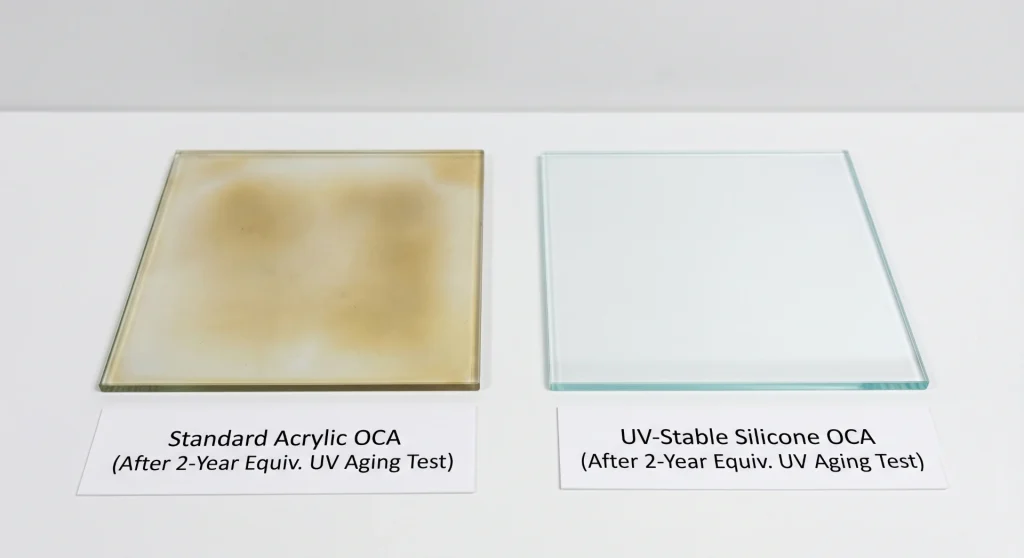
Ultravioletstraling is een langzaam voortschrijdend probleem voor glazen afdekplaten van buitendisplays. Het glas zelf wordt niet significant aangetast door UV-straling – met name borosilicaatglas is zeer UV-bestendig. De OCA-lijm die bij optische verlijming wordt gebruikt, is het kwetsbare onderdeel. Standaard acrylgebaseerde OCA, gebruikt in veel consumenten- en industriële displayassemblages, begint te vergelen en verliest hechting bij langdurige blootstelling aan UV-straling. Dit wordt doorgaans zichtbaar als verkleuring van de lijmlaag na 18 tot 36 maanden blootstelling aan de buitenlucht op lage breedtegraden.
De oplossing is eenvoudig, maar moet expliciet worden gespecificeerd: UV-bestendig OCA (meestal op siliconenbasis of met UV-absorberende stoffen geïmpregneerde acrylformuleringen) geschikt voor buitengebruik. De meerprijs ten opzichte van standaard OCA bedraagt doorgaans 20-40% per oppervlakte-eenheid – een kleine toevoeging aan de totale kosten van de displayassemblage, maar een aanzienlijke verbetering van de betrouwbaarheid. Vraag uw leverancier om het OCA-gegevensblad en controleer specifiek de UV-bestendigheid, niet alleen het temperatuurbereik.
Metriek 5: Bedrijfs- en opslagtemperatuurbereik
Thermische cycli — De sluipmoordenaar
Extreme temperaturen krijgen aandacht in specificaties voor industriële beeldschermen. Thermische cycli – de herhaalde overgang tussen extreme temperaturen – zijn de oorzaak van de schade aan beeldschermen in de praktijk. Bij een buiteninstallatie in een gematigd klimaat kan de temperatuur van het afdekglas binnen één dag oplopen van -10 °C 's nachts tot +50 °C (oppervlaktetemperatuur) in de directe middagzon. Gedurende een levensduur van 10 jaar komt dat neer op meer dan 3500 thermische cycli.
Het falingsmechanisme is differentiële thermische uitzetting. Het afdekglas, de OCA-lijm, de aanraaksensor en de LCD-polarisator hebben allemaal verschillende thermische uitzettingscoëfficiënten (CTE). In een goed ontworpen assemblage met compatibele materialen worden deze verschillen opgevangen door de visco-elastische eigenschappen van de OCA: deze rekt en krimpt bij temperatuurschommelingen en absorbeert zo de spanning die ontstaat door de temperatuurverschillen. In een slecht gespecificeerde assemblage – met name een assemblage waarbij de OCA te stijf is (hoge modulus) of waarbij de CTE van het glas niet overeenkomt met die van de aanraaksensor – veroorzaakt herhaaldelijk gebruik delaminatie aan de randen, beginnend bij de hoeken, waar de spanningsconcentraties het hoogst zijn.
Glassoort en thermische schok
Borosilicaatglas (thermische uitzettingscoëfficiënt circa 3,3 × 10⁻⁶/°C) is aanzienlijk beter bestand tegen thermische schokken dan soda-calciumglas (thermische uitzettingscoëfficiënt circa 9 × 10⁻⁶/°C), omdat de lagere uitzettingscoëfficiënt de spanningsverschillen vermindert die ontstaan door snelle temperatuurschommelingen. Voor toepassingen met snelle temperatuurwisselingen – een verwarmde buitenterminal in een koud klimaat waar warme gebruikers herhaaldelijk een koud scherm aanraken, of een display in de buurt van een warmtebron die aan en uit schakelt – is borosilicaatglas de meerprijs zeker waard.
Bij de keuze van OCA voor toepassingen met een breed temperatuurbereik moet specifiek rekening worden gehouden met de glasovergangstemperatuur (Tg) van de lijm. Beneden de Tg wordt acryl-OCA glasachtig en broos, waardoor het zijn vermogen verliest om thermische spanningen te absorberen. Voor toepassingen met bedrijfstemperaturen onder −20 °C dient siliconen-OCA (Tg doorgaans onder −60 °C) te worden gespecificeerd in plaats van standaard acryl-OCA (Tg doorgaans −20 °C tot −30 °C).
Ontdekken: Industriële beeldschermen — Kadi Display — Industriële monitoren met een breed temperatuurbereik van 8 tot 21 inch, geschikt voor gebruik bij temperaturen van -20 °C tot +70 °C en opslag bij -40 °C. Optionele optische verbinding en IP65-afdichting aan de voorzijde voor gebruik buitenshuis.
Materiaalkeuze voor het afdekglas: een vergelijking van de opties.
Met de vijf gedefinieerde criteria volgt hier een vergelijking van de glas- en beglazingsmaterialen die u zult tegenkomen in specificaties voor industriële displays, en waarvoor elk materiaal daadwerkelijk geschikt is.
Vergelijking van afdekglas en beglazingsmaterialen
Een paar opmerkingen over die tabel. De aantrekkingskracht van polycarbonaat (PC) vanwege de slagvastheid en het lichte gewicht is terecht — PC barst echt niet bij impacten die glas zouden verbrijzelen, en het wordt gebruikt in toepassingen die echt aan hoge impact worden blootgesteld, zoals oproerschilden. Het probleem is de krasbestendigheid: PC krast gemakkelijk (Mohs 3), en in elke omgeving met schurende vervuiling wordt het binnen enkele maanden zichtbaar dof. Polycarbonaat is geen vervanging voor gehard glas in industriële displays voor buiten, tenzij de toepassing zeer specifieke impacteisen stelt die zwaarder wegen dan alle andere overwegingen en het display zich in een schone omgeving bevindt.
Saffierglas — kristallijn aluminiumoxide, Mohs-hardheid 9 — is werkelijk krasbestendig voor elk schurend materiaal behalve diamant. Het wordt gebruikt in specialistische militaire, ruimtevaart- en luxehorlogetoepassingen. De kosten (15-25 keer zo hoog als die van standaardglas) maken het onpraktisch voor de meeste industriële toepassingen als afdekglas voor displays. Voor de zeldzame gevallen waarin het gerechtvaardigd is — een display op een precisie-instrument in een omgeving met hoge slijtage waar vervanging logistiek onmogelijk is — bestaat de technische oplossing, maar vereist maatwerk in de optiek omdat de brekingsindex van saffier verschilt van die van glas, wat van invloed is op het ontwerp van de antireflectiecoating.
Alles op een rijtje zetten — Scenario-gebaseerde selectiegids
De volgende tabel koppelt veelvoorkomende industriële buitendisplays aan aanbevolen afdekglasconfiguraties, gebaseerd op alle vijf de criteria.
Configuratie van het afdekglas per toepassingsscenario
Vragen die u aan uw leverancier van afdekglas kunt stellen
Wanneer u bij een leverancier specificaties of een monster van een afdekglas aanvraagt, kunt u aan de hand van de volgende vragen snel onderscheiden wie de industriële eisen begrijpt en wie alleen maar marketingpraatjes herhaalt.
Wat is de drukspanning en de laagdikte (DOL) van uw chemische temperering? Vraag naar de gemeten waarden, niet naar 'chemisch getemperde' waarden.
Welke IK-waarde heeft de complete constructie (glas + randbevestiging + verlijming) behaald tijdens de test? Een IK-test van alleen het glas is onvoldoende; de montage- en verlijmingsmethode beïnvloeden het resultaat.
Wat is de potloodhardheid van de hardcoating en volgens welke norm is deze getest (ASTM D3363)? Vraag om het officiële testrapport.
Welke OCA gebruikt u voor optische verlijming, en wat is de UV-bestendigheid en de Tg van die lijm? Vraag het gegevensblad van de lijm aan.
Welke reinigingsmiddelen zijn compatibel met het volledige oppervlaktebehandelingspakket? Vraag om een schriftelijk schoonmaakprotocol, niet om een mondelinge toezegging.
Welke thermische cycluskwalificatie heeft de gelijmde constructie doorstaan? Vraag naar het temperatuurbereik, het aantal cycli en de slaagcriteria.
Voldoet het glas aan de REACH- en RoHS-richtlijnen en zijn de coatings vrij van verboden stoffen? Vereist voor CE-markering in de meeste industriële toepassingen die in Europa worden verkocht.
Aanvragen voor op maat gemaakte afdekglazen: Displayoplossingen op maat — Kadi Display — OEM- en ODM-projecten op maat voor displays, inclusief specificatie van afdekglas, kwalificatie van chemische harding, integratie van optische verbindingen, AG/AR/AF-oppervlaktebehandeling en IK-waardebepaling voor industriële buitentoepassingen.
Samenvatting — Het gesprek over het afdekglas hoort aan het begin, niet aan het einde.
De vijf parameters in deze handleiding – hardheid en krasbestendigheid, slagvastheid en IK-waarde, diepte van de chemische harding, optische transmissie en bedrijfstemperatuurbereik – zijn geen onafhankelijke criteria. Ze beïnvloeden elkaar, beperken elkaar en een significante fout in een van deze parameters leidt in een industriële buitentoepassing doorgaans binnen 12 tot 24 maanden tot een defect. De keuze van het afdekglas is geen detail dat pas in een laat stadium wordt bepaald; het is een systeembeslissing die tegelijk met de beslissingen over de helderheid van het scherm, de interface en de behuizing moet worden genomen.
Het goede nieuws is dat voor de meeste industriële toepassingen buitenshuis de oplossingsmogelijkheden niet ingewikkeld zijn, zodra de vijf criteria voor de specifieke gebruiksomgeving zijn vastgesteld. Chemisch gehard aluminiumsilicaatglas van 3-4 mm met een IK08- of IK10-classificatie, een hardcoating van 7H of hoger, optische verlijming met UV-stabiel OCA en een oppervlaktebehandeling die is afgestemd op de omgevingslichtomstandigheden – dit dekt een zeer breed scala aan industriële buitentoepassingen effectief af, tegen kosten die slechts een fractie van de totale systeemkosten bedragen.
Voor ondersteuning bij specificaties voor afdekglas, aanvragen voor materiaalmonsters en kwalificatie van optische verbindingen voor specifieke industriële buitentoepassingen kunt u contact opnemen met Kadi Display. Sales@sz-kadi.comTechnische consultancy is beschikbaar voor OEM- en ODM-projecten die aangepaste glasafmetingen, niet-standaard hardingsspecificaties of de inkoop van gecombineerd afdekglas en displaymodules vereisen.
Disclaimer: De technische specificaties, testnormen en materiaaleigenschappen die in dit artikel worden genoemd, zijn afkomstig uit openbaar beschikbare industrienormen (EN 62262, ASTM D3363, IEC 60068, MIL-STD-810) en algemene materiaalkundige naslagwerken. Ze worden uitsluitend ter illustratie en voor educatieve doeleinden verstrekt. De daadwerkelijke productspecificaties variëren per fabrikant en dienen te worden geverifieerd door middel van onafhankelijke tests. Alle merknamen en standaardaanduidingen behoren toe aan hun respectievelijke eigenaren. Dit artikel vormt geen certificering of garantie voor enig product.
Voorgaande
Industriële touchscreens kunnen er ook geweldig uitzien.
Volgende
Trends in industriële displaytechnologie voor 2025-2026
Laat een reactie achter

Laatste Blog & Nieuws
- MIPI DSI Display Driver Development for Embedded Linux What Hardware Buyers Need to Confirm
- Why Outdoor LCDs Fog Inside: Condensation, Sealing, Vents, and Heaters
- IP65 vs IP67 Industrial Displays: What the Rating Actually Covers
- How to Specify a Touchscreen for Food-Processing Equipment
- Thermal Management for High Brightness LCDs in Sealed Outdoor Enclosures